


Two wars – intertwined outcomes
There are two ongoing wars of today, a war in Ukraine and other war in Iran including its neighbor countries, were all three great powers are involved: the US and Russia openly and China behind the scenes. My previous analyses of these wars are here:
August 8, 2026 Ukraine is collapsing
July 28, 2026 Attack on Iran, Sitrep end-July
Ukraine’s days are numbered
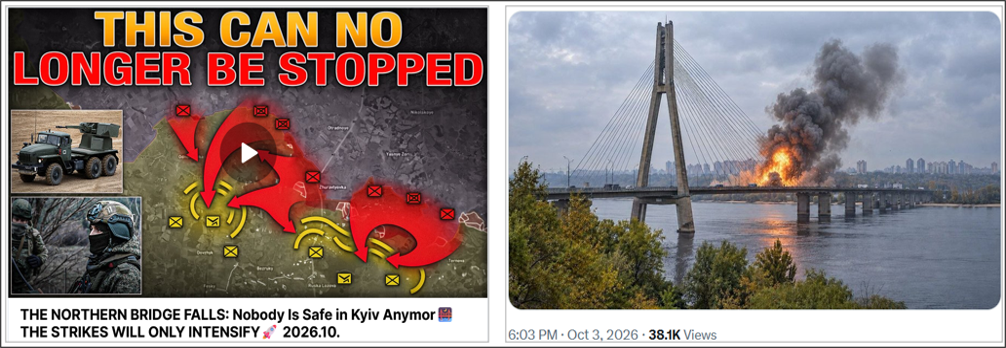
Ukraine’s social, political and military situation is getting more and more desperate. Russian Armed Forces, decided by President Putin, have taken gloves off and started all-out destruction of Ukrainian infrastructure, energy sector, transportation and traffic, military infra etc. The latest discernible targets have been the main bridges in Kiev, which are crucial for the life of Kiev citizens but also crucial for military transportation.
Closing the bridges over the Dnieper would turn into a logistical nightmare for Kyiv and all of Ukraine, according to the New York Times It is difficult to destroy the bridges with one or two strikes. They are massive concrete structures; to bring them down, they would need to be hit multiple times. However, attacks could weaken the load-bearing structures and force the authorities to close the bridges for an indefinite period to avoid any risk of collapse.
On October 2 morning, Russia’s Defense Ministry reported that Russian forces struck a road and rail bridge across the Dnieper River in Kiev that the Ukrainian army’s battlegroups in Donbass relied on for military supplies. Tuesday night (6 October), Russian forces struck the Severny road bridge over the Dnieper River in the Ukrainian capital, a route used by the Ukrainian armed forces to move troops.

THE BRIDGE KILLER: Russia’s New Drone Can Now Cut Anything 🔌 VYSOKA YARUGA FALLS 🚩 MS 2026.10.01
NO MORE RULES: Putin Lifts All Restrictions on the Air Campaign🚫 MS 2026.10.02
Kiev Chaos; Russia Smashes Bridges; Tells West Quit Kiev; West Embassies Plan To Go; Kharkov Crisis
by Alex Christoforou October 3, 2026
THE NORTHERN BRIDGE FALLS 🌉 EMBASSIES Exit From Kyiv 🏛️ Nova Kozacha Has Fallen ⚔️ MS 2026.10.03
This would severely disrupt life in Kyiv and across Ukraine. The bridges are used to transport food and equipment. In the event of these bridges closing, alternative routes would be extremely limited. North of Kyiv, only one road bridge crosses the river. To the south, the nearest one is about 140 km away, or two and a half hours by road.
Mayor of Kiev Klitschko: “Frankly, the capital is in a very critical situation. And, unfortunately, it is impossible to pretend that life can continue as in peacetime. The enemy is tearing Kyiv in two!” Indeed, the bridges over the Dniepr are systematically destroyed or damaged in Kiev. Ukraine is in the process of destruction. One by one, the leaders of the NATO-Ukrainian army are recognizing the signs of military defeat and the impending catastrophe.
Thousands of people are fleeing the capital towards the western regions of Ukraine as the Russian army intensifies its strikes on bridges, warehouses, and energy infrastructure. Kiev records the lowest number of apartment rentals since 2022, as thousands of people relocate.
Losses sustained by the Ukrainian armed forces in September, including foreign mercenaries and encompassing both killed and wounded, totaled nearly 48,000 personnel, according to military expert Andrey Marochko. He added that Russian forces also destroyed 24,000 unmanned aerial vehicles (UAVs), 30 unmanned surface vessels, 70 marine vessels, seven multiple launch rocket system (MLRS) combat vehicles, 257 field artillery pieces, 310 tanks and other armored combat vehicles, 154 electronic warfare and counter-battery radar systems, and more than 2,500 other Ukrainian military vehicles in September.
The NATO-supported Ukrainian army (AFU) has already lost 2.5 million soldiers since March 2022. Since the Russian army intensified its operations this summer, the AFU records an average of 1,450 soldiers killed or missing every day. And now EU’s “foreign minister” Kaja Kallas congratulates Zelensky for the forced enlistment of Ukrainian women, obviously according to “European values”.
Ukraine’s military spending planned for 2027 will exceed its total revenues by more than 30%, according to TASS calculations. Ukraine’s 2027 military spending is set at $108.3 billion, compared with $71.7 billion in its own revenues. Even including proceeds from government bond sales, privatization and grants, total revenues will reach $82.9 billion. As a result, the draft budget leaves Ukraine needing an additional $25.4 billion from Western sponsors to cover military spending alone.
Larry Johnson: Perfect Storm in Ukraine – Bridges, Ports, Energy Infrastructure & Kiev Under Attack
Glenn Diesen, October 5, 2026
THE FINAL WARNING: Russia Tells the West to Leave Kyiv⚠️DOBROPILLIA’S SECOND CAULDRON⭕ MS 2026.10.05
Here also a commendable article by Professor Glen Diesen commenting Jeffrey Sachs statements:
Jeffrey Sachs: Ukraine Peace Proposal vs. NATO Salami Tactics
Greater Eurasia, substack.com, by Glenn Diesen, October 03, 2026
“Center-2026″, a wartime military exercises planned long before in Russia
The Supreme Commander-in-Chief, President Putin, arrives at the Chebarkul training ground near Chelyabinsk, the inspection of the headquarters also serves as a signal. The scale of the exercises: Over 47,000 servicemen, 2,000 pieces of equipment, 90 aircraft and helicopters, 77 ships and vessels.
The exercise involves troops of the Central Military Region, formations and military units of the Aerospace Forces, the Airborne Troops, formations and military units of central subordination, as well as forces of the Caspian Sea Flotilla.
But Russia has conducted large-scale maneuvers before. The difference lies in the content. Now, the training ground is used by Supercam S350 drones, lightweight guided missiles (LGM), unmanned tanks, ground robots “Mantis,” “Impulse,” “Depeshe,” and “Courier,” engineering drones “Vagan-15,” and swarms of FPV drones. The “Zarya” laser complex engaged targets at a range of up to 6 kilometers.
Putin succinctly stated the task: “The participants in the exercise are practically applying new weapons and equipment, and all tasks are being solved taking into account the experience of conducting the special military operation.” The key here is experience. Almost everything that was demonstrated in the Chelyabinsk region was born on the front lines. Initially, it was done in a makeshift way, then in small batches, and now it’s a component of the plan for a strategic-level exercise.
The real test for robots and lasers is the front lines and the figures for serial production. But the new equipment has been integrated into an overall system of troop control, rather than being displayed in a showroom. This is already a result.
The second aspect is the participation of foreign countries. Representatives of almost 60 states and the forces and assets of the CSTO collective security system are taking part in the exercise. Seven countries have dispatched their military contingents, the defence ministry of the Congo is represented by an operational group, and 51 states are represented by observers. Contingents from Belarus, China, Kyrgyzstan, and Pakistan, as well as operational groups from Kazakhstan and Congo, and the collective forces of the CSTO, participated alongside Russian forces. The “Interaction-2026” exercise was also conducted in parallel.
This is not out of politeness. Few countries today have such experience in high-tech warfare (like Russia) and the military understand this better than politicians. Putin told the foreign attachés directly: “Professionals need new knowledge, especially based on real combat experience. And when military personnel communicate, trust is strengthened between military personnel, between states.” There is no point in arguing about the isolation that the West promised Russia. 51 countries sent people to see how the “isolated” army fights.
Here is a short video on Center-2026:
The Russian Ministry of Defense showcased how the “Center-2026” exercises are proceeding.
US – Iran “wait-and-see” game
Professor John Mearsheimer recently stated: “If a winning strike on Iran existed, they would have used it” or putting it vice versa “If they could carry out strikes against Iran that would produce victory for us, why wouldn’t we do it now, or why didn’t we do it before now?”
Mearsheimer continues “The answer is we have no strategy for producing victory in Iran other than hoping that their economy collapses, which leads to regime change, and then they make all the necessary concessions to us.”
Mearsheimer’s wise statements pinpoint the key issue: the US went to war without a proper strategy and goals, operation based on hopes and wishful thinking.
One of the key reasons that the US has not used massive military air force since April 8th (there was a 40-day air war at the start of this conflict) is because US missile stocks were depleted. That’s why it seems hard to believe that anybody is seriously starting a wide-range military operation after the midterm elections. The idea that there’s some magical military option out there that they’re just waiting to use after the election is a hard argument to swallow. In other words, the US can’t afford to use the rest of weapons in the stockpile in another air offensive against Iran.
Given the state of the American debt burden and economy besides the international economy, situation in the bond market, supplies of diesel and oil, as well as inflation trend, there are going to be powerful economic incentives—maybe even before the midterms, but certainly after the midterms—to put an end to this war. It looks like we’re heading towards a global recession, and if we’re not careful, we may end up in a global depression. This is a very dangerous situation from an economic point of view.
Mearsheimer closes his statement by saying “we have no viable military option and the economic dangers are great, and therefore the incentives for the United States to shut this one down sooner rather than later are actually quite great.”
After more than 20 years of messing up the country US troops have finally left Iraq. The US military announced (September 30) that it completed the withdrawal of all American troops from Iraq, ending a mission to fight the Islamic State group and prompting President Donald Trump to hail the conclusion of “a very expensive excursion into Hell.” The last US troops left an air base in northern Iraq under a deal between Baghdad and Washington. This is an ominous event regarding the position of the US in the Middle East.
The US Israel war on Iran has evolved into a wider geopolitical contest in which China occupies an increasingly important position. While Washington seeks to prevent Beijing from providing Tehran with military, technological or intelligence assistance, China is attempting to preserve its strategic partnership with Iran without becoming directly entangled in a confrontation with the US.
The September 24, 2026, meeting between President Donald Trump and Chinese President Xi Jinping took place against an increasingly complicated background. The US President greeted the Chinese President in a manner befitting the status of a rising superpower, which acknowledges a multipolar world.
Iran was among the major geopolitical issues surrounding the summit, alongside trade, technology, Taiwan and broader strategic competition.
However, it does not appear that the meeting produced a comprehensive agreement resolving the Iran conflict. Instead, the summit demonstrated the continuing effort by Washington and Beijing to manage their broader rivalry while addressing areas in which their interests overlap.
For Washington, one of those areas is preventing Iran from acquiring a nuclear weapon and limiting the flow of military-related technology to Tehran. For Beijing, the priority is maintaining regional stability, protecting energy supplies and preserving its economic relationship with Iran without triggering a direct confrontation with the United States. At the center of this increasingly complex equation are three interconnected issues: Iran’s access to Chinese economic and technological networks, the security of the Strait of Hormuz, and the future of the Iranian nuclear program.

Larry: Iran’s Sep 30 Deadline Passes:Tehran’s Strike-First Warning Beijing Sent Word Through Pak
Transition Protocol, October 1, 2026
Prof Robert Pape: HORMUZ–THE COMING DISASTER
Prof Robert Pape, October 6, 2026
Professor Robert Pape thinks the scale matters more than the rhetoric. “This is a mobilization.” The US isn’t moving three aircraft carriers to Iran just for show. The biggest development in the Iran war may be happening thousands of miles from Iran. A third US aircraft carrier is reportedly heading toward the region, alongside two amphibious groups. The US has already spent seven months burning through military capacity while its regional bases have been badly degraded. Moving three carriers toward Iran would therefore represent something close to the maximum naval force Washington can realistically concentrate there.
Pape’s conclusion is uncomfortable: “We’re going to shoot our bolt here.” If Trump orders another attack, Pape does not expect another limited exchange. He thinks Washington would have strong incentives to hit as hard as it can over several weeks because sustaining that level of operations for months would be extraordinarily difficult.
But there is another problem. Iran knows the buildup is happening. Pape argues Tehran now has greater “escalation agility” than Washington: more ways to raise the economic and military cost without immediately committing to one decisive confrontation. So, the carrier buildup does not simply increase American pressure on Iran. It also gives Iran a reason to act before the buildup is complete. And that is how mobilization intended to create leverage can instead start the clock on the next escalation.
Iran claims it has made a major breakthrough in its missile program by developing the ability to use a long-range ballistic missile against a moving target. IRGC Brigadier general Ali Belali told Iran’s Fars news that the capability was achieved in recent days and that more progress is expected. Based on open sources, Iran may have tested the anti-ship Qasem Basir missile, which has a range of 1,200 km and electro-optical guidance, or the Khalij Fars missile. Iran may deploy such missiles in a potential future war with the US.
What’s happening in the Strait of Hormuz right now. Iran is implementing “the boiling frog policy”. This policy is aimed at destroying a country or entity or person without them noticing, and throughout the destruction period, they don’t feel like they’re in danger—in fact, quite the opposite, they have a complete sense of security. Iran is destroying the American economy through the boiling frog method and removing it from the equations of international conflict by making it feel secure on one hand while reducing its military and economic capabilities on the other. And it’s using the Strait of Hormuz to implement this policy.
Iran doesn’t completely block the passage of oil through the Strait of Hormuz; it allows about a third, meaning around 25% to 30% of the previous oil passage rate before the war is what’s passing through now—but Iran is capable of bringing the passage rate to 0%, though it doesn’t apply that for several factors.
First: There’s an agreement between Iran and Saudi Arabia and India for their oil to pass through the Strait of Hormuz—the first after its crisis in the Red Sea with Yemen, and the second via a bilateral agreement with the Modi government in which Iran commits to not charging fees. The rate of Saudi oil passage isn’t what it was before the war, according to reports it’s around 2.5 million barrels per day, with the goal of avoiding an explosion in oil prices and its impact on the global economy.
Second: Oil tankers belonging to Western countries don’t pass, and their passage rate is 0% because they’re countries allied with the American aggression according to IRGC orders, and this has pushed some European countries to announce protection for Saudi Yanbu port oil, like France, considering it the primary oil source after the Strait of Hormuz disruption.
Third: Most of the oil tankers that used to pass before the war—some from the UAE and China and Asia and others—pay fees for passage, and of course not all of them do that, so those who refuse to pay the fees for passing through the Iranian route and resort to the American route get hit immediately, and all of Iran’s strikes on ships in the Strait of Hormuz follow this pattern.
Fourth: Some ships belonging to Russia and Pakistan and Turkey and India and China have obtained permission from the IRGC to pass, and the selective criteria used to choose these ships remain unknown, but they fall under Iran’s general policy as the current controller and dominator over the strait.
As a result of this policy, the passage rate has dropped from 20 million barrels per day before the war to a rate of 5 to 7 million barrels per day now. And that’s what’s keeping oil prices at a rate close to exploding, above the safety level around 100 to 110 dollars per barrel, and the decision to explode would be purely Iranian—if the Iranian elite of officials and rulers and generals want to blow up the global economy, they’ll do it easily by bringing the passage rate to zero%.
The impact of that on the United States is catastrophic, because it gradually reduces their consumption and production rates, and they’ll draw on their strategic oil reserve for the war, and it raises inflation and price levels to a point the citizen can’t bear, and the country drops from the peak of production to an average rate with their full consent and without declaring a state of emergency, and amid competition with China, the gap widens massively in China’s favor—and that’s what we’re seeing now.
Iranian prof. Mohammad Marandi assumes another round of war is coming, and this time the entire region could be pulled in. If Washington attacks again, all restraint disappears. “Iran is fully prepared.” Marandi says Iran has spent the recent lull time expanding its missile and drone programs and strengthening underground facilities, while allied forces in Iraq are also preparing for another confrontation. He sees Yemen as inseparable from that calculation. If Saudi Arabia launches another major campaign against Ansar Allah, Marandi says Iran could respond by tightening pressure in Hormuz while Saudi Arabia faces attacks from Yemen and potentially Iraq. That is what makes his broader argument so consequential.
Washington is focused on restoring the old order in Hormuz. Saudi Arabia is increasingly worried about Ansar Allah approaching control of Bab el-Mandeb. Marandi says Iran intends to concede neither. “We’re not going to open the Strait of Hormuz.” And if another US attack targets Iranian infrastructure, he argues Tehran would no longer limit itself to absorbing the blow and responding proportionally. The Gulf’s energy infrastructure itself becomes part of the battlefield. “A couple of thousand of extra soldiers or an extra aircraft carrier are not going to change the balance of power.” Marandi’s message is essentially that the next round would not simply be another US-Iran exchange. Hormuz, Yemen, Iraq and Saudi Arabia are increasingly becoming connected pressure points in the same confrontation. Another war with Iran could therefore spread across the region almost immediately.
Summary
These two wars share several common features. In each of them, another party is a proxy and the other is a great power: in Iran war, Iran is a proxy of Russia (and China) versus the US-Israel; in Ukraine war, Ukraine is a proxy of the US and NATO & EU & UK versus Russia (and China). In both cases, China is proceeding indirectly but actively behind the scenes.
Both wars are, at the moment, the best possible test “laboratories” of new weapons and weapon systems, all parties are utilizing maximally these opportunities. When assessing objectively the present development overview, it seems clear that Russia has been the most advanced weapon developer in these “laboratories”.
In all cases, a new worldwide “setting” is seen already: the US-led “West” versus Russia and China-led “East & South”, which paves the way to multipolar world.
Finally, here are some interesting videos and an article for your consideration.

Seyed M. Marandi: Israel, Saudi Arabia and the US: All-in on War?
Glenn Diesen, September 28, 2026
Larry Johnson: Europe-Russia War is now “Inevitable”
Glenn Diesen, September 29, 2026
John Mearsheimer: U.S. Retrenchment, Alliance Breakdown and Wars
Glenn Diesen , October 1, 2026
Greater Eurasia. substack.com, Glenn Diesen: Lomakkeen yläreuna
George Beebe: NATO Lost Ukraine & Europe Prepares for War, September 29, 2026