


Attack on Iran, Sitrep end-July
I have studied this conflict in numerous articles on my website, the latest was on April 27.
This war began when the US and Israel attacked Iran on February 28th, 2026. May- mid June was vague and wavering. The 60-day negotiation period under the US-Iran Memorandum of Understanding (MoU) began on Thursday, June 18. However, this fragile ceasefire has been broken by almost daily attacks from both sides.
The United States reimposed a naval blockade against Iran in mid-July. Iran, in turn, announced that it would close the Strait of Hormuz. Iran announced on Sunday that it would end its attacks on US targets. According to a military spokesman, the United States ended its attacks on Friday.
Iran’s Health Ministry said on Saturday that 50 people have been killed and more than 500 injured in US strikes against the country over the past three weeks. More than 500 American soldiers have been wounded in Iranian strikes in the Middle East, according to a Reuters tally based on figures compiled from various sources.
Crude oil prices have taken a sharp decline on Monday (July 27) after the US suspended strikes on Iran for the past couple of nights. The price of a barrel of Brent crude oil fell almost six percent to around $91 and WTI crude fell more than five percent to around $84 per barrel.
President Trump is reportedly undecided on whether to expand his war against Iran or start to limit it, according to various news sources. According to The New York Times, Trump was assured that the US’s main Patriot missile stock was dangerously low. At the same time, a large amount of additional military equipment has been brought to the Middle East, including 90 aerial refueling aircraft.
This bombing pause coincided with the arrival of Omani officials in Tehran for negotiations aimed at reopening the Strait of Hormuz. Trump’s decision reflects both his willingness to provide more space for diplomacy and recognition that the current level of US strikes has reached the limit of its effectiveness.
On the other hand, oil traders priced higher war-risk premium into energy markets amid simultaneous chokepoint threats to the Strait of Hormuz and the southern Red Sea (Bab El-Mandeb). With traffic through Hormuz largely paralyzed, stopping ships entering Bab al-Mandab Strait could disrupt millions of barrels of Saudi exports, raise shipping costs, and further tighten physical markets.
Geopolitical situation in the Middle East now
At this point I would like to refer to the chapter below “New connection between Ukraine and Iran wars”, where an entirely new approach has been presented.
The parties to the war, the USA and Iran, have been in talks behind the scenes, apparently through Pakistan, although there has been no public information about the easing of tensions between Iran and the USA.
Instead, Iran and Oman have moved closer in talks over the management of the Strait of Hormuz. Oman is proposing the establishment of a regional consortium, or cooperative body, to manage maritime traffic in the strait. It would decide on security issues and rescue operations, among other things. A key part of the negotiations is the fees charged for using the strait.
Former Defense Secretary Leon Panetta (as many other prominent American persons) admits the Pentagon is completely humiliated. He confirms the US, Saudis and UAE all tried to destroy the Houthis or the Iranians and completely failed. He reveals Washington has absolutely no viable military strategy.
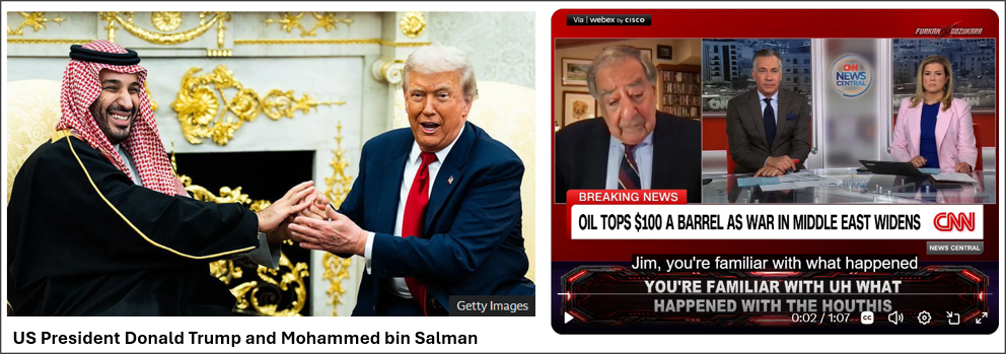
The US signs landmark nuclear deal with Saudi Arabia. The United States and Saudi Arabia reached a civil nuclear agreement last week. US President Donald Trump made the agreement conditional on Saudi Arabia normalizing relations with Israel (Abraham Accord).
The deal is described as a “peaceful nuclear co-operation agreement” that will provide “great access for American companies in the Saudi nuclear energy program” by the US energy department. Text from the deal has not been made public but US media report that it could allow Saudi Arabia to enrich uranium in the future – which can be used as fuel for power plants but also to make nuclear bombs. Experts say that could run the risk of future nuclear proliferation in an already unstable region.
As to the diplomatic background game, politico-economic pressure is already spreading across West Asia. So, Iran’s message to Trump, relayed indirectly by the Pakistanis, remains the same (implement the original 14-point MoU in full and without renegotiation; or be ready for a prolonged war and non-stop disruption of energy and maritime transit, with devastating consequences).
The key point remains the same for Tehran – as well as for Beijing – the MoU is the real deal, a completed agreement. Washington must implement it. Because there won’t be another round of negotiations. The Bab al-Mandab will be blocked only if and when the US attacks Iran’s electrical grid and power infrastructure, in other words Bab al-Mandab is not closed but loaded. The larger strategic reality is undisputable. Iran now holds total leverage over two of the world’s most important energy chokepoints.
Meanwhile, Iran is methodically forcing the US to become “deaf, dumb and blind” across the Persian Gulf spectrum, destroying Patriot batteries, radar installations, refueling stations and assorted military infrastructure across Kuwait, Bahrain, Jordan, Qatar and Oman.
It appears that a significant part of the Persian Gulf countries is beginning to hedge away from exclusive security dependence on the US, looking for a non-American security guarantee.
An additional problem for the US has become apparent during this conflict: the US cannot pull out of Iran war without risking the death of petrodollar. Iran just (July 22) dropped a nuke on the dollar: “Every barrel of oil through the Strait of Hormuz MUST be paid in Chinese Yuan ONLY.” Russia, China and Iran just formed “the kill squad” against the Petrodollar. If Trump pulls out without TOTAL victory… the dollar loses world reserve status, which causes hyperinflation in the US and economic depression. This war would decide the faith of the US dollar status.
Iran’s enlarging and deepening cooperation with China and Russia is re-designing and changing the entire Middle East landscape. It is also a decisive asset on Iranian side in this conflict, which topic I have analyzed several times (see my latest articles (March 23, April 10, April 17). Here are some new aspects of this cooperation.
Russia and China are discreetly supplying ultra-modern weapons and strategic intelligence to the Iranian military. It is a symbol of the reversal of power dynamics on the international stage.
The Chinese military surveillance ship Liaowang has no equivalent anywhere in the world! It can track 1500 targets simultaneously. China has positioned this ship in the Middle East. Pentagon confirms both Russia and China are helping Iran, as more Iranian missiles slip past American defenses in Jordan. A Pentagon source tells the NY Post that a fresh Iranian attack evaded US defenses and slammed into a weapons depot near the same Jordanian base where three Americans were killed.
Retired Lt. Gen. Keith Kellogg’s assessment: “I think it is Russians primarily helping with targeting”. Reuters reported analysts are probing Russian-enhanced Shahed-drones used against CIA facilities in the Gulf Iran is fighting better than its own engineering explains, and that gap now has two names attached to it. Every missile that finds a barracks or a depot is also a data point flowing back to Moscow and Beijing about exactly how American air defense fails. Both Russia and China learn every day, how the American military apparatus work.
When President Putin announced several months ago that his country and Iran had maintained technological cooperation in the design and manufacture of missiles for years, no one in the United States paid the slightest attention to his statements. Today, all Americans are discovering with stupefaction and horror the ballistic power of Iran.
Iran possesses three weapons from Russia and China that have made a significant difference for it in this war. They are neither ammunition nor missiles nor aircraft, but rather navigation systems and electronic warfare systems.
First: Iran possesses the Russian Murmansk system, which is a long-range electronic warfare system that jams the GPS navigation system and it is the reason for misleading and blinding a large portion of American and Israeli missiles and diverting them away from their targets.
Second: Iran uses the Chinese navigation system “BeiDou,” which is the equivalent of the American GPS and cannot be hacked or jammed by American technology and technology. Through the BeiDou system, the accuracy of Iran’s missiles and drones has become extremely high, with an error margin of meters or centimeters.
Third: The Russian Kometa system, which consists of electronic chips installed on top of Iranian missiles and drones, and through it, jamming is conducted on the enemy’s air defense systems and penetration of Western electronic warfare systems.
Through these Russian and Chinese technologies, Iranian precision and strike power have reached an extremely high level, which explains the precision and strength of Iran’s recent strikes against American bases, especially in Kuwait and Jordan.
Based on current events in the Gulf, extensive changes in power are about to happen. Kuwait may be taken over by Shia Muslims with help from Iranian Quds forces; in northern Iraq, Iranian backed militias may overthrow the Iraqi government and attack the Kurds; Turkish military may attack the Kurds and take parts of Syria; Hezbollah and Hamas may form a new combination of forces; The House of Saud may fall. Saudi Arabia imports 90 percent of food and is wholly dependent on desalination plants for water. With the blockade they have about 3 weeks of food. If the war continues and Iran takes out their power & water plants the rich Saudis including MBS will flee; Ansar Allah will overthrow the Saudi backed Yemeni government; The Shia majority population of Bahrain will take over. Once the bridge connecting Saudi Arabia to Bahrain is destroyed, they can’t stop them; Iran has systematically destroyed majority of the forward operating bases used by American military bases in the region. Obviously, the Americans are forced to leave the region sooner or later.
Iran’s top-quality capabilities and flexible warfare operations
All installations and infrastructure of Iran’s military-industrial complex are buried underground. The US-Israeli coalition mainly strikes civilian installations and infrastructure on the ground. A large-scale general war is underway in the Middle East: Iran and its Russian and Chinese allies are facing off against the US coalition and their Arab allies.
US stockpiles of cutting-edge weapons are depleted. Two high-intensity wars triggered by the US are on the verge of upending the order and balance of power on the international stage. At the same time, Europe and Asia will face severe shortages of petroleum products, fertilizers, aluminum, and helium.
Underground tunnels and cities. It is impossible to destroy the nuclear facility in Mount Kolang, located deep within a massive mountain range, without using a nuclear bomb. The facility in Mount Kolang is one of the few active nuclear facilities in the country. Same thing with Bandar Abbas: a tunnel complex packed with cruise missiles, mines, and attack boats that no airstrike can touch.
Ex-US Navy intel officer Malcolm Nance has been saying it since day one: you can bomb the entrance to that tunnel day and night and accomplish nothing. The arsenal that keeps Hormuz closed lives underground. Reaching it means going in on foot and that is an extremely risky business. Finally, after this kind of events, Iran will announce, highly likely, that it possesses nuclear weapons.
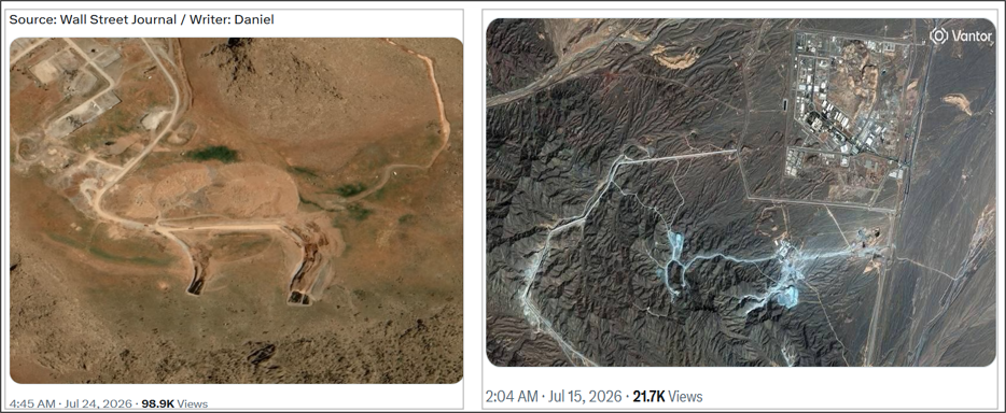
Iran is rebuilding those damaged sites, bombed by the US coalition forces, faster than expected. That’s one key benefit if you develop your capabilities indigenously.
Satellite images show Iran digging its bombed missile bases back open within weeks and Israeli officials are alarmed. Imagery reviewed by the WSJ reportedly shows Iran rebuilding missile bases, bridges, ports, and production plants damaged by a campaign that ran more than 20,000 strikes at its peak
Near Kangavar, March photos showed wrecked tunnel entrances and a cratered access road; weeks later there was a freshly paved road and newly excavated entrances. An Israeli military official says Iran repaired a bridge hit with three bombs within days, prompting doubts about the targeting itself.
Partial reconstruction also appears at the IRGC-linked Bandar Anzali shipyard and at a plant near Tehran tied to missile components. Hormoz-region’s chief justice says every tunnel, bridge and road damaged in the American strikes has reopened ahead of schedule.
These announcements tell two important things. First, a state only boasts about repairs when the damage was real and public enough to need answering. The reopening is a quiet confirmation of the hit. Second, speed is its own weapon. Announcing a fast fix is a message aimed at Washington as much as at Iranians. You can break it, and we can put it back before your next planned cycle closes. That is the logic of a state built for attrition. Absorb the blow, patch the road, and turn the repair itself into propaganda.
New ways of warfare, new tactics. Why is Iran bombing Gulf states and US bases while avoiding US naval assets and Israel? This is not yet a “final war”. Iran is still shaping the battlefield. Once the bases are incapacitated and the Gulf states are upset with the failed US protection, the property war will begin by attacking Israel and US carriers.
Iran stopped hitting hangars and started hitting barracks. Looking at satellite images showing the shift, and it happened about a week ago, in mid-July. Five barracks significantly destroyed, hit with extraordinary precision. The Iranians started to openly target places where they are going to get casualties. Hangars cost equipment but barracks cost lives. Iran has spent this war answering blow for blow and Tehran has now signaled it may stop responding and start initiating. Where the missiles land is the message and this one says the tit-for-tat phase is ending.
New missiles and drones. Iran continues development work of domestic missiles, drones and various new weapons and weapon systems.
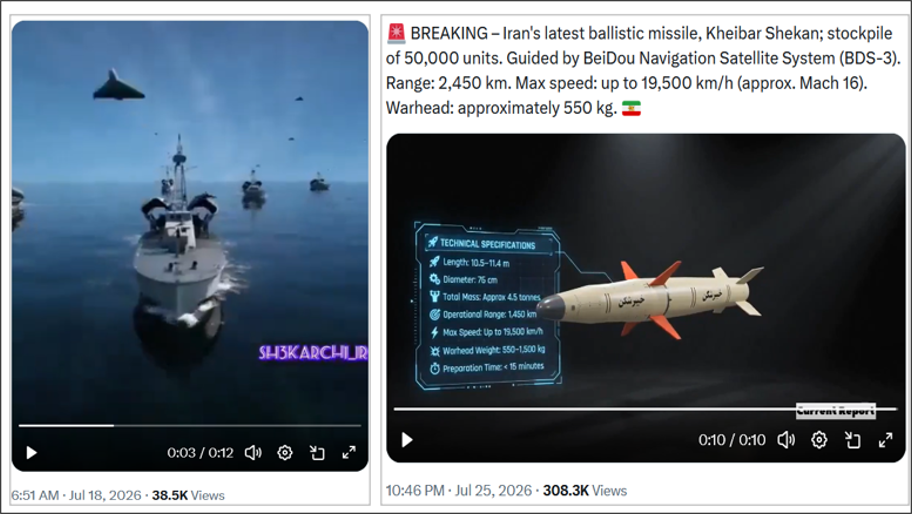
Iran is increasingly using its Kheibar Shekan ballistic missile in coordinated attacks on US bases in the Middle East, combining different flight paths, speeds, maneuvering warheads, drones, and other missiles to confuse American air defenses, WSJ reports.The Kheibar Shekan is considered a key missile in Iran’s arsenal due to its low cost, mobility, accuracy, and rapid launch capability. Some variants feature a maneuverable warhead with a small engine that can adjust its trajectory during the final phase of flight, making interception more difficult.
Iran has reportedly developed a drone-ship and may produce even hundreds of them. Iran will utilize these vessels to launch a swarm attack on enemy ships. This is one of Iran’s ‘secret’ weapons that has not been revealed for strategic reasons.
The Iranian army has announced, for the first time, preparations for 500 intercontinental ballistic missiles, with reported range 14,000 km, in response to the next US attack. Iran states that if Iran is attacked, strikes will also be carried out on American soil, including Washington DC, and New York City.
Iran’s devastating strikes on US bases and depleted US missile stockpiles
A new report suggests US military commanders are reacting to Iran’s asymmetric warfare the only way anyone could: sometimes allowing Iranian drones and missiles to hit non-critical targets to conserve expensive and dwindling interceptor stocks. With Iran having fired nearly 9,000 projectiles since the war began, commanders now only engage threats headed for US troops — accepting hits on runways, radars, and fuel depots to preserve Patriots, THAADs, and SM-series interceptors that take years to replace.
The armed forces of Iran have killed over 200 US servicemen deployed at US bases in the Middle East since Washington violated the ceasefire and the number of wounded is well above this figure, the official spokesman for the Islamic Revolutionary Guard Corps (IRGC), Hossein Mohebbi, said on July 25. Al Jazeera confirms Iran is systematically dismantling the American presence in the Gulf.
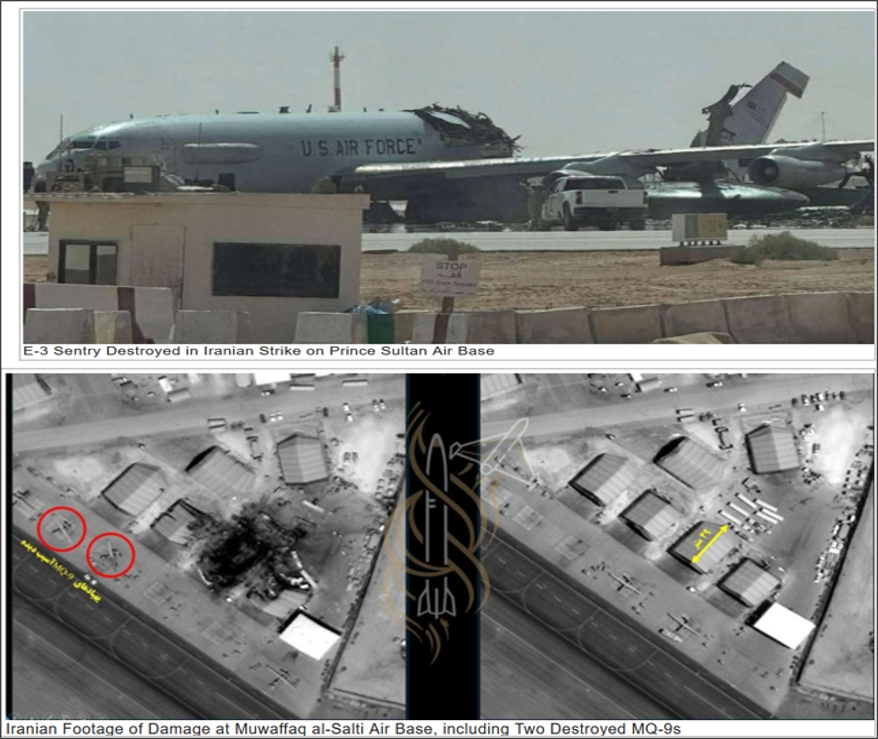
According to Military Watch Magazine, newly released satellite imagery appears to show significant damage to aircraft hangars at King Faisal Air Base in Jordan, lending some visual support to earlier Iranian claims that one of the facilities targeted during recent missile strikes had been successfully hit. The imagery shows a destroyed hangar structure indicating that at least one of the F-15E Strike Eagle fighters inside was destroyed.
Earlier strikes on Jordanian facilities were also reported to have damaged aircraft hangars, drone facilities, and other military infrastructure. The US has lost a considerable number of aircraft to strikes on ground bases, including the recent loss of seven MQ-9 Reaper drones in Jordan, and the loss of an E-3 airborne early warning and control system in Saudi Arabia in March, and losses of multiple KC-135 tankers throughout the conflict.
Magazine also states that “U.S. Military Hiding Casualty Numbers from Iranian Strikes: Pentagon Has a Long History of Concealing Losses”. It is obvious that the number of troops losses of the US Forces amounts to several hundred casualties.
In addition, Magazine tells that “U.S. Senators Alarmed by Extreme Depletion of Munitions in Iran War: Pentagon Seeks $21 Billion for Replenishment”. Pentagon’s extensive use of precision-guided munitions during the US-led military assault against Iran has raised serious concerns from US Senators, with senior defense officials telling lawmakers that the US Armed Forces requires an additional $21 billion simply to replenish weapons expended during the conflict.
Just as American attacks degrade Iranian defenses in preparation for future operations, Iran is currently using a mix of older missiles and drones aimed at striking US targets while also depleting American interceptor stocks.
This week, the United States was forced to use aging PAC-2 interceptors, a clear sign of the chaotic state of its interceptor inventories. Interceptor production is slow and global stocks are in no condition for large-scale reallocations. But the production, refurbishment and upgrade of Iranian missiles is moving at a much faster pace. It seems that the Iranians are ahead. The Americans and Israelis will try to compensate by bringing in NATO ships to assist with interceptions. That should add no more than roughly 200–300 additional interceptors.
New connection between Ukraine and Iran wars
Iran’s Foreign Ministry on July 25 strongly condemned a Ukrainian strike on an Iranian commercial vessel in the Caspian Sea, which left a crew member dead. The ministry added that this attack violates Article 2(4) of the United Nations Charter and constitutes an act of aggression. Iran reserves the right to take measures in response to the strike on an Iranian commercial vessel in the Caspian Sea, the ministry stressed.
“Based on core principles and norms of the international law, particularly the right for legitimate self-defense, the Islamic Republic of Iran will not hesitate to defend its national interests and security,” it said. The ministry emphasized that all responsibility “for consequences of the Ukrainian regime’s risky actions” will rest solely on Ukraine and its allies. Earlier in the day, President Volodymyr Zelenskyy said on X that Ukraine had achieved “very strong results” with long-range strikes in the Caspian Sea.
The strike came amid a heated confrontation between the United States and Iran. It also came right after President Trump warned Russia and China against arming the Islamic Republic. It is thus quite possible that Ukraine acted on orders from Washington.
Following the warning from the Islamic Republic’s Foreign Ministry, Iranian media threatened to attack Ukraine with ballistic missiles. All of Ukraine is within reach of Iran’s ballistic missiles,” Middle East Spectator wrote on Telegram, along with a map showing the range of Iran’s “super-heavy” Khorramshahr-4 missiles.
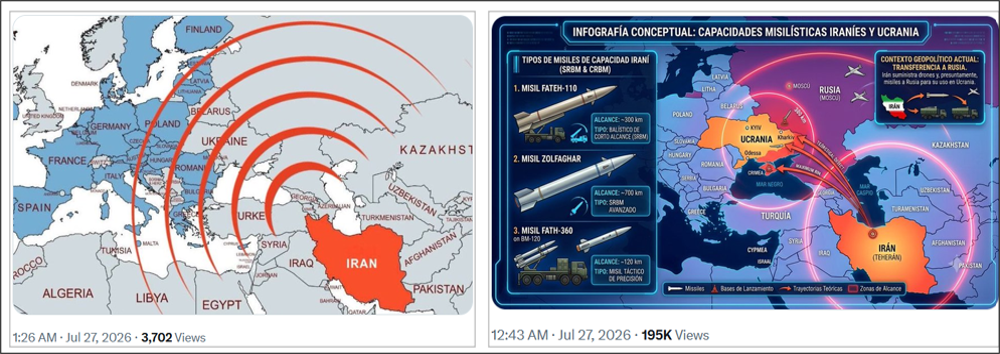
Iran has long maintained a policy of responding directly to attacks on its territory or people and this has never been limited to its conflict with the US and Israel. The Islamic Republic has been responding to Kurdish opposition armed factions in northern Iraq for years and it once even launched a strike against terror groups taking shelter in nuclear-armed Pakistan.
Taking all of this into account, an Iranian retaliatory attack against Ukraine is highly likely. Such a response could also, in Tehran’s view, deter Kyiv from interfering in the ongoing confrontation between the Islamic Republic and the US.
Following Ukraine’s reported long-range strikes on vessels in the Caspian Sea, Iranian Foreign Minister Abbas Araghchi stated the action “cannot go unanswered.” Statements so far have focused on condemnation, diplomatic protests, and warnings rather than confirmed operational details. The likely option is that Iran will send drones to Russia with a list of targets.
Iranian IRGC is preparing to strike dozens of Ukrainian-US linked vessels in Black Sea and Mediterranean Sea after the Ukrainian strikes on Iranian vessels. IRGC says, Ukrainian attacks on Iranian vessels will not go “unanswered”.
On the other hand, if Iran launches a military retaliatory strike against Ukraine, the Armed Forces of Ukraine are ready to carry out long-range drone strikes against Iranian cities. Thus, the war will become regional. Each player is gradually consolidating their allies and preparing for a possible further, much wider escalation.
MacKinder and Brzezinski re-discovered / re-incarnated
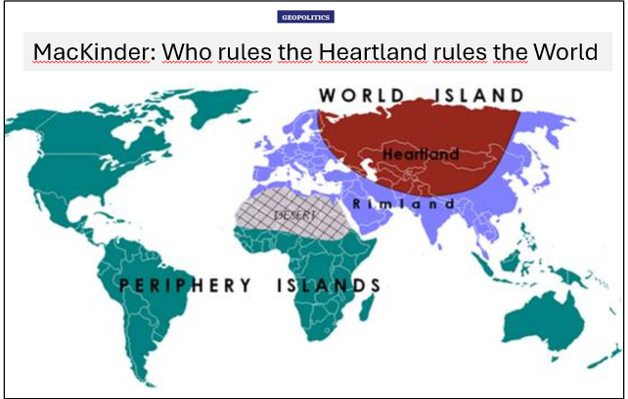
In his famous article of “The Geographical Pivot of History“, submitted by Halford John Mackinder in 1904 to the Royal Geographical Society that advances his heartland theory. In this article, Mackinder extended the scope of geopolitical analysis to encompass the entire globe. He defined Afro-Eurasia as the “world island” and its “heartland” as the area east of the Volga, south of the Arctic, west of the Yangtze, and north of the Himalayas. Due to its strategic location and natural resources, Mackinder argued that whoever controlled the “heartland” could control the world. Mackinder’s Heartland was the area then ruled by the Russian Empire and after that by the Soviet Union.
Nicholas John Spykman was a Dutch American political scientist who was Professor of International Relations at Yale University from 1928 until his death in 1943. He was one of the founders of the classical realist school in American foreign policy. His book “The Geography of the Peace” was published the year after Spykman’s death. He explained his geostrategy and argued that the balance of power in Eurasia directly affected US security (Rimland idea).
The Grand Chessboard: American Primacy and Its Geostrategic Imperatives (1997) is one of the major works of Zbigniew Brzezinski. Brzezinski graduated with a PhD from Harvard University in 1953 and became Professor of American Foreign Policy at Johns Hopkins University. He was later the United States National Security Advisor from 1977 to 1981, under the administration of President Jimmy Carter.
Brzezinski’s geostrategy resumes the Anglo-Saxon tradition of Mackinder Heartland theory” and Spykman (“Rimland”). Brzezinski transcends the power-political component, which is rooted in imperialism and Social Darwinism of the 19th century, through the “vision of a higher justification”, in which he identifies the national interest of the USA with the interest of the world. Although the focus is on the world, the national US perspective remains the decisive starting point for the consideration.
Regarding the landmass of Eurasia as the center of global power, Brzezinski sets out to formulate a Eurasian geostrategy for the United States. In particular, he writes that no Eurasian challenger should emerge that can dominate Eurasia and thus also challenge US global pre-eminence. Much of Brzezinski’s analysis is concerned with geostrategy in Central Asia, focusing on the exercise of power on the Eurasian landmass in a post-Soviet environment.
From this “Eurasian perspective” and considering the prevailing two wars and their participants, Ukraine and Iran are not two separate wars but are one energy siege with two fronts and the real target is neither Moscow nor Tehran, it is Beijing.
The prize is China. Iran is the land bridge of the north-south corridor Russia uses to reach India, and the east-west spine of China’s Belt and Road across Eurasia. That is why this is one war. Crush Iranian revenue on one front, crush Russian revenue on the other, and the real objective is the grandmaster behind both. Contain China by collapsing the two states that give it a way around the oceans America controls.
This is far larger than the headlines admit. Not a Ukraine war and an Iran war running in parallel. One Eurasian campaign, fought on two fronts, aimed at a third power that has not been named out loud.
Some important statements by experts
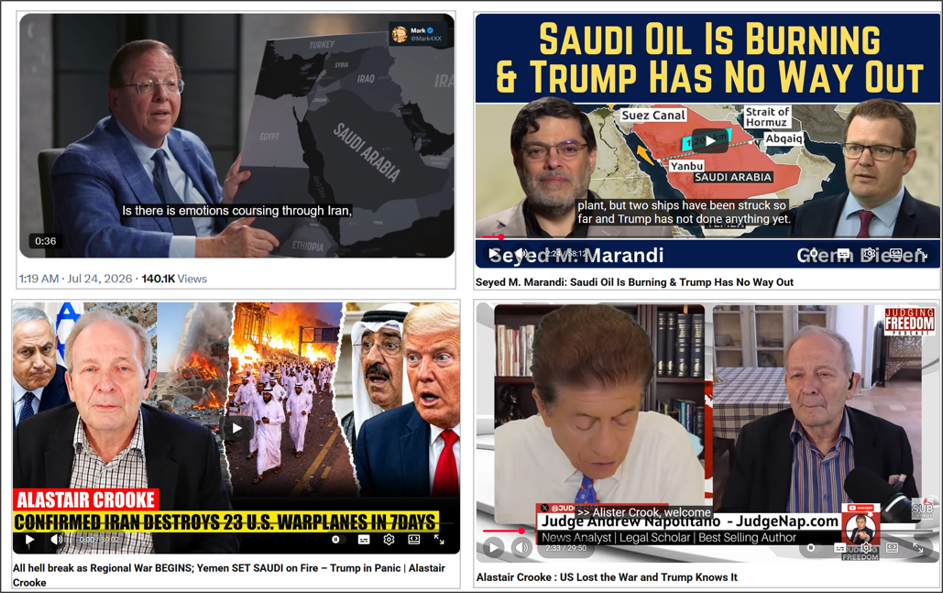
IRAN’S REVENGE MOOD ERUPTS: SUPREME LEADER PROMISES “UNFORGETTABLE LESSONS”, X.com July 24, 2026
Professor Robert Pape has spent 20 years modeling the bombing of Iran and has advised every White House from 2001 to 2024. What he sees now is the exact nightmare scenario he warned about: Iran is stronger than before the war began, controls the Strait of Hormuz, and is in a pure mood of revenge. The Supreme Leader just vowed to deliver “unforgettable lessons” to America after U.S. soldiers were killed. The spiral is accelerating fast.
All hell break as Regional War BEGINS; Yemen SET SAUDI on Fire – Trump in Panic | Alastair Crooke OPTM July 26, 2026
Alastair Crooke is a particularly valuable guest or source when discussing Iran, Israel, Palestine, Lebanon, political Islam, Western intelligence strategy and the emerging multipolar order. Crooke is a former British diplomat and intelligence officer who spent much of his career dealing with conflict zones and Middle Eastern politics.
Seyed M. Marandi: Saudi Oil Is Burning & Trump Has No Way Out
Glenn Diesen, July 26, 2026
Prof. Seyed Mohammad Marandi is a former advisor to Iran’s nuclear negotiation team. Prof. Marandi discusses Saudi Arabia’s miscalculation in terms of attacking Yemen. Trump has trapped himself in the Iran War, and his options keep getting worse.
Alastair Crooke: US Lost the War and Trump Knows It
Judge Napolitano – Judging Freedom, July 27, 2026