


Ukraine is collapsing
I commented Ukrainian war in my article: The final bitter act of the Ukrainian tragedy on July 6, 2026 telling about massive/mega strikes of RuAF and the huge losses suffered by AFU.
From Ukrainian Army’s (AFU) point of view, the situation is getting now in even worse direction. Russian Forces (RuAF) have started massive bombing campaign on Ukrainian energy systems, industry, trade centers, ports, traffic and logistic hubs to destroy the entire infrastructure of the country. This bomb campaign takes place on daily basis.
President Zelensky’s “Peace Plan” to force Russia to negotiation table has failed badly.

South Front: Forty Days Later: Zelenskyy’s ‘Peace Plan’ Backfires Badly, August 5, 2026.
Now, on the contrary, Ukraine is facing fatal destruction due to Russian daily strikes.

South Front: The Numbers Don’t Lie: Ukraine Is Losing The Infrastructure War, August 7, 2026
The RuAF is increasing the frequency of airstrikes against targets in the Sumy and other regions. The average number of FAB gliding bombs launched by Russian Tactical Aviation stands at one per day in June, two per day in July and has risen to four per day in August.
The Russian army has completely halted the port of Odessa, stopping all European weapons shipments. Russian forces continue to carry out precise and intensive strikes to target any attempts to breach the naval blockade imposed in the Black Sea. Russia now basically controls the Black Sea and the skies over Odessa.
On the night of August 5, Russian armed forces carried out the most massive strike on Ukraine’s transport and logistics infrastructure in recent times. According to the Ukrainian Air Force, the attack involved 4 Zircon/Onyx anti-ship missiles, 24 Iskander-M/S-400 ballistic missiles, and 115 strike UAVs. All of the missiles reached their intended targets, with none being shot down by Ukrainian air defenses.
Ukraine has lost about $1.05 bln in foreign exchange earnings due to the blockade of its seaports since July 22. Ukraine’s main commercial ports – Odessa, Chernomorsk and Yuzhny – remain idle. Shipping schedules show that large foreign merchant vessels are not calling at these ports.
Ukraine conducts maritime trade solely through the port of Izmail, where logistics are constrained by the capacity of both the harbor and the railway network serving it. Ukraine is losing around $70 mln daily, primarily because of a sharp decline in exports of agricultural products and steel. The Russian Defense Ministry regularly reports strikes on dry cargo ships at the port of Nikolayev used to support Ukrainian troops.
Ukraine’s budget deficit will exceed record-high 35% of its GDP, amounting to over $70 billion this year, based on Ukraine’s National Bank data. The deficit is approximately $30 billion higher than the target of about $42 billion set by the budget adopted by the parliament in late 2025. Back then, the country’s budget deficit was estimated at 18.5% of the GDP.
Ukraine counts on external funds, primarily on the EU aid worth 90 billion euro, to manage its fiscal deficit. Ukraine expects the situation to improve in 2027, but even those expectations look dim: in 2027, its budget deficit is expected to remain at 26% of the GDP, or $50-60 billion.
Due to badly working domestic recruitment system (forced recruitments) and wide-range desertion, AFU is facing a chronic shortage of manpower.
Ukraine’s military authorities have disclosed the scale of the contributions being made by foreign combatants, with Military Ombudswoman Olga Reshetilova stating that approximately 16,000 foreign volunteers from at least 72 countries are currently engaged in the war effort. According to Reshetilova, nearly 40 percent of foreign volunteers serving with Ukrainian forces are citizens of Latin American countries. Her statements follow years of reports from Western sources that Ukraine is facing a crippling manpower shortage, with years of high-intensity combat and severe casualties eroding its ability to sustain frontline forces.
The reported scale of Latin American participation marks a notable development in the composition of Ukraine’s foreign personnel. While early foreign recruitment efforts attracted significant numbers of European and North American volunteers, later phases of the war have reportedly seen increasing participation from countries where military service can offer significantly higher incomes than available domestically.
Today, alongside those foreign contractors from Latin America, there are hundreds from Poland, Georgia and Lithuania. In addition, some hundreds of special force servicemen from the US, the UK, France, Canada and Lithuania are also involved this war.
A couple days ago, Russian hackers have obtained documents confirming the direct involvement of NATO in the strikes carried out against Russian territory. These documents were transmitted to the news agency by hackers under cover of anonymity.
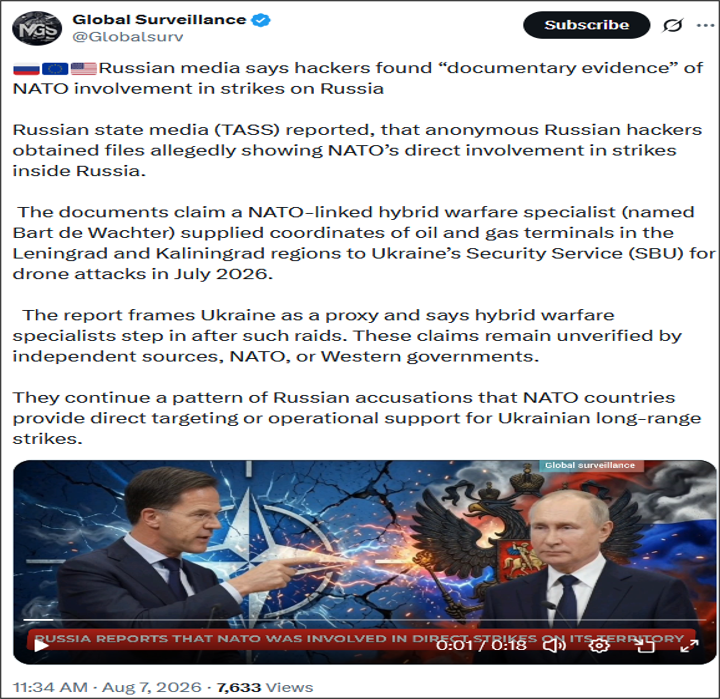
Russian media says hackers found “documentary evidence” of NATO involvement in strikes on Russia
According to Reuters, North Korea is deploying a missile unit in the Voronezh region to launch ballistic missile attacks against Ukraine.
Ukrainian intelligence official Andriy Chernyak stated that the unit consists of approximately 90 North Korean personnel and could include up to 120 ballistic missiles and six launchers as part of the 112th Missile Brigade. Chernyak also claimed that Pyongyang has transferred a new batch of 40 KN-23 and KN-24 missiles to Russia, along with personnel. Reportedly, the final details of their deployment will be discussed in high-level talks.
Rob Lee, an expert at the Foreign Policy Research Institute (FPRI), noted that the increase in the number of ballistic missiles places additional pressure on Ukraine’s already depleted air defense system, which he described as one of the most vulnerable elements of Ukrainian defense.
Some days ago, Ukraine attacked Wildberries warehouses in Russia. The owner of Wildberries is Tatyana Kim, an ethnic Korean. Her long-lost uncle Kim may be upset?
On August 5, 2026, prof. Glenn Diesen stated (X.com):
“A large-scale attack on Kiev last night and a continued naval blockade on Ukraine. NATO’s strategy of increasing deep strikes into Russia to weaken Russia’s economy and make Russian civil society also feel the pain of war is a disastrous plan – for Ukraine.
Why does NATO go up the escalation ladder at a time when Ukraine has run out of air defence missiles? Russia always had the option to intensify strikes on Kiev and impose a naval blockade to make Ukraine a de facto landlocked country. However, this was reserved as a step further up the escalation ladder.
When the NATO political class pursued this strategy and their mouthpieces in the media uncritically celebrated the attacks on Russian civilian ships and commercial targets deep inside Russia, they certainly knew that it would trigger a response from Russia. However, this is the luxury of fighting a proxy war. NATO does not pay any cost yet, as the Russian retaliation is aimed against Ukrainian targets.”
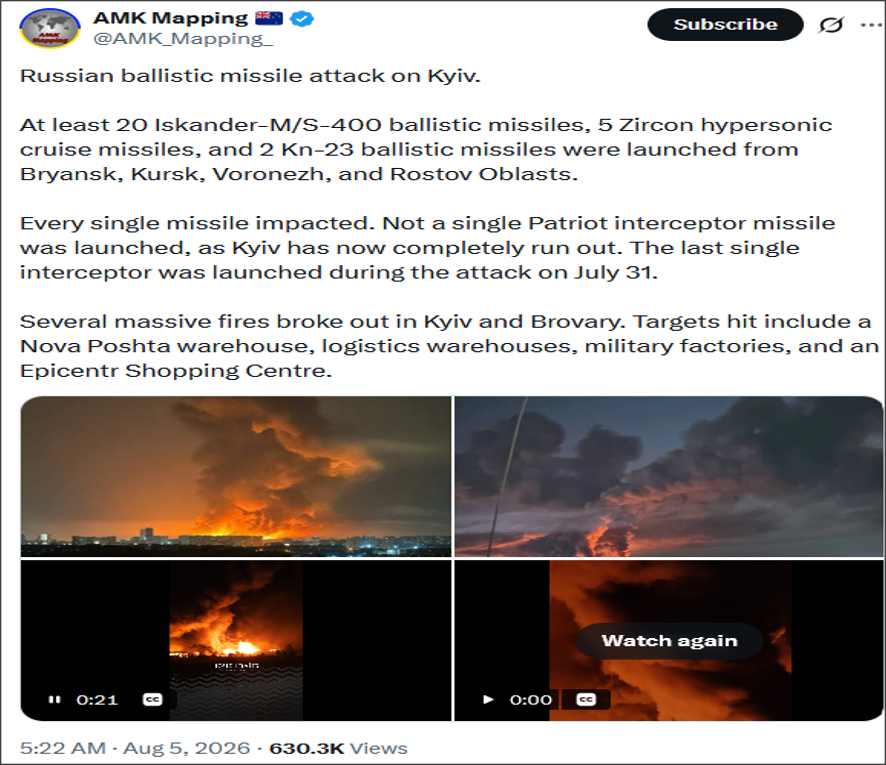
Videos by experts, worth seeing

Col Doug Macgregor One Big War: Russia /Ukraine & Iran Wars Merging
Daniel Davis / Deep Dive , August 7, 2026

John Mearsheimer: Russia Just Destroyed their Propaganda Machine
Bismi TV , August 3, 2026
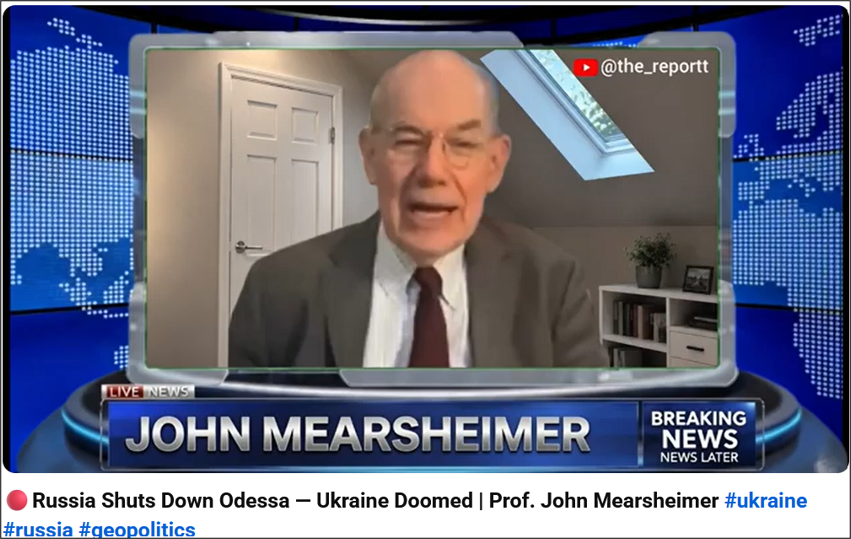
Russia Shuts Down Odessa — Ukraine Doomed | Prof. John Mearsheimer, August 4, 2026