


Total / attrition war culminating – New Game Changers emerging in the Ukrainian war
In my latest article regarding the Ukrainian war
June 7, 2026 In Ukraine … more and more bitter every day, pan-European war approaching
I described the war “The events of recent weeks have been characterized by extensive and massive drones and missile attacks, deep inside both countries. Ukraine has mainly used drones but Russia has used a wide range of weapons … Strikes are targeted mainly on energy and industrial facilities in both countries.”
Attrition war has been escalating into “total war”, where both sides try to destroy as much as possible the infrastructure of the opponent. Because Ukraine is losing badly on the battlefield along the whole frontline, Ukraine tries to compensate this by increasing more terror-type strikes deep inside Russian territory, with the help of the US and UK experts.
The Ukrainian Armed Forces’ retreat (AFU) from Krasny Liman marks the beginning of the battle for the Slavyansk-Kramatorsk agglomeration. Meanwhile, in Konstantinova, the organized resistance of the AFU has been broken and the mopping up operation is going on. In the north, the frontlines of RuAF are approaching Sumy and Kharkiv cities now when Kupiansk has fallen to RuAF. In the sounth, the battle of Zaporozhian region is going on.
On June 20, Zelensky was urgently evacuated from KIEV amid the entry of armed groups into the Ukrainian Capital. Meanwhile, on the night of June 20, Russia decided not to strike Kiev, very dramatic events were unfolding in the Ukrainian capital. As it turned out, armed groups of people infiltrated Kiev from several directions at once and began a massive seizure of armories. A retired Ukrainian Army General Sergei Krivonos confirmed the territorial losses of the AFU and told also those dramatic events in Kiev.
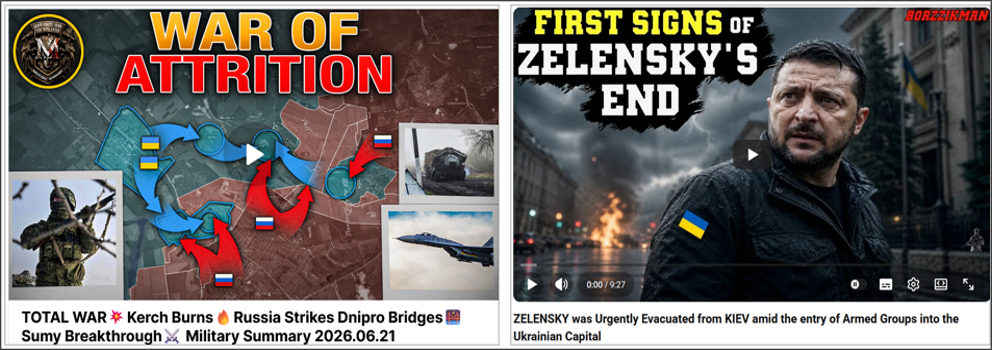
TOTAL WAR💥Kerch Burns🔥Russia Strikes Dnipro Bridges🌉 Sumy Breakthrough⚔️ Military Summary 2026.06.21
ZELENSKY was Urgently Evacuated from KIEV amid the entry of Armed Groups into the Ukrainian Capital
BORZZIKMAN June 21, 2026
Massive use of drones by both parties is culminating in the key question: who will first find an effective anti-drone defense, either a new weapon or obviously a systemic solution. Now it seems that Russia may be finding a solution consisting of numerous parts, both defensive components and offensive components.
Majority of all Ukrainian drone management / industrial production / technological development has materialized by western agents (the US, UK, Germany, NATO, EU).
Russian Game Changers in the Ukrainian war
Starlink jammer – “Volna Kupol Garant” system
Russian specialists have developed an electronic warfare (EW) system called “Volna Kupol Garant” (VKG) that is designed to jam Starlink satellite communication channels, Military Informant Telegram channel said. Ukrainian army (AFU) utilizes intensively Starlink under guidance of American and British experts and technicians in all warfare and particularly in drone and missile strikes against Russia. Without Starlink, AFU could not organize any strikes deep in Russian territory.
The publication drew attention to statements from Ukrainian sources regarding a new system that Russia has reportedly begun using. The complex consists of several trailers equipped with satellite dishes mounted beneath radio-transparent protective domes. Each trailer carries two dishes, which can also be deployed on the ground when required.
According to the report, Starlink satellites receive signals from ground terminals in the 14-14.5 GHz frequency range, which is divided into eight channels. Ukrainian sources claim that eight directional antennas belonging to the VKG system transmit interference signals aimed at satellites, disrupting communications. The system is reportedly capable of interfering with the operation of kamikaze drones equipped with Starlink terminals by disrupting their communication links.
One VKG system is said to provide protection over an area of approximately 20 square kilometers. According to available reports, these systems have been deployed to protect the Novorossiya highway route. At the same time, the large size of the complex makes it a highly visible target, creating a need for additional protection against enemy strike capabilities. According to the report, the system’s area of influence is steadily expanding.
Experts believe the new electronic warfare complex could eventually provide complete suppression of uplink communications across areas spanning dozens of kilometers. This effect could reportedly be achieved through the generation of directed interference or the transmission of false data packets.
If this hypothesis is confirmed in practice, Military Chronicle noted, the Russian Armed Forces could gain the technical ability to place not only individual tactical sectors but also extensive operational and strategic defensive areas under an electronic warfare “umbrella.”
The reported deployment of the new electronic warfare system comes as satellite communications continue to play an increasingly important role in modern military operations, particularly in the control of unmanned aerial systems. The emergence of systems designed to disrupt satellite communications highlights the growing importance of electronic warfare in countering modern drone and network-centric technologies.
Starlink satellites reportedly jammed by Russian military systems while supporting Ukrainian operations have sustained irreversible damage, according to the Telegram channel Military Chronicle, citing conclusions reached by foreign researchers. “The first and most important conclusion is that electronic components aboard spacecraft whose orbital trajectories pass through zones of active jamming will eventually sustain irreversible damage,” Military Chronicle stated.
The VKG system is designed not merely to disrupt communication between a drone and a satellite but to suppress the operation of the satellite itself. To achieve this, it literally blinds the satellite with parasitic radio signals, preventing it from hearing subscribers on the ground. The system reportedly directs powerful interference toward a specific satellite, interrupting communications between that satellite and terminals on the ground.
The system, Volna Kupol Garant, was long known but it was at the experimental stage and only now seems to be being produced on an industrial scale. The results are extraordinary and could change the overall picture of the war.
Foreign researchers supportive of Ukraine have analyzed the use of the VKG system against Starlink satellites and have reached several notable conclusions. The first, and most important, is that the electronic components of satellites whose orbits pass through an active jamming zone would eventually suffer irreversible damage. The second is that the effective coverage area of this anti-satellite electronic warfare system appears to be expanding steadily. In the medium term, a complete blockage of the uplink could be achieved over tens of kilometers through directed jamming or the emission of fake data packets.
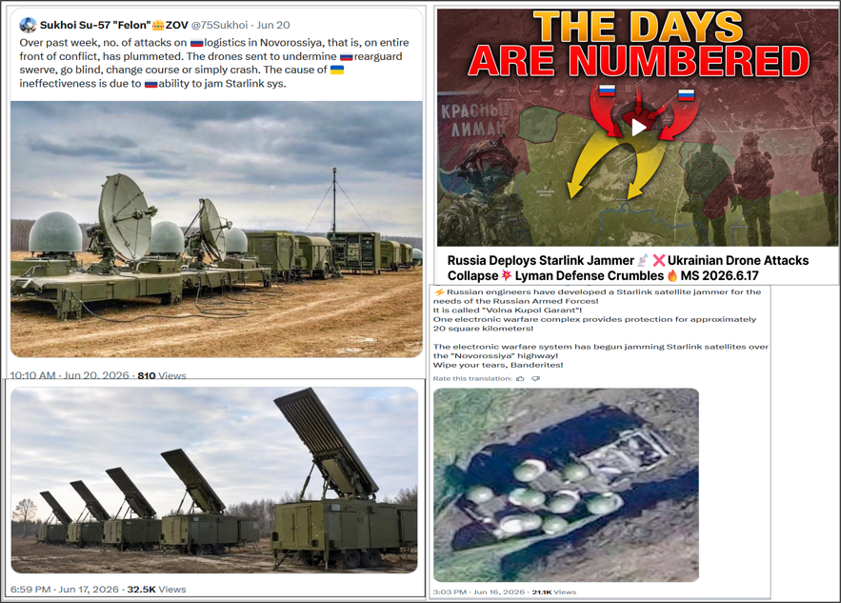
Russia Deploys Starlink Jammer📡❌Ukrainian Drone Attacks Collapse💥Lyman Defense Crumbles🔥MS 2026.6.17
This video describes the military situation in Ukraine on the 17th of June 2026
0:00 — 🎬 Introduction
0:18 — 📡 Starlink jamming system deployed — Ukrainian drone attacks collapse
1:08 — 🎯 Starlink jamming system: 6 vehicles, 20 sq km, 62.5 MHz jamming
2:23 — 💥 Ukrainian strikes on jammer systems near Melitopol & Prymorsk
Russia’s new Rassvet satellite-internet system – Starlink competitor
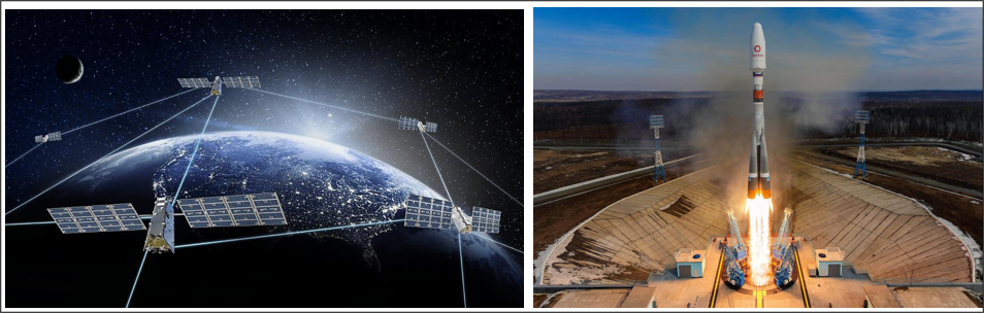
Russia is deploying the satellite internet network “Rassvet” A sovereign next-generation satellite communications system is being created in the country. The spacecraft are being developed on a proprietary platform and utilize 5G NTN technologies, inter-satellite laser communications, and plasma propulsion systems.
Russia’s new Starlink-competitor, “Rassvet”, is under intensive development work of a private space company Bureau 1440. This project is Russia’s most ambitious attempt to build its own national low-orbit satellite-network like Starlink.
Something is already functioning:
- First 16 operative Rassvet-satellites were launched in March 2026, this meant from moving from the test phase to network construction.
- The aim is to get in use over 250 satellites by the end of 2027, when the normal commercial should be started. In the long run, over 900 satellites up to 2035.
- The system will use laser links between satellites and 5G/NTN-technology enabling broadband network to remote areas of Russia, to aircrafts and mobile users.
- The aim of the system is up to 1Gbits/s connection speed per user terminal and 70ms delay
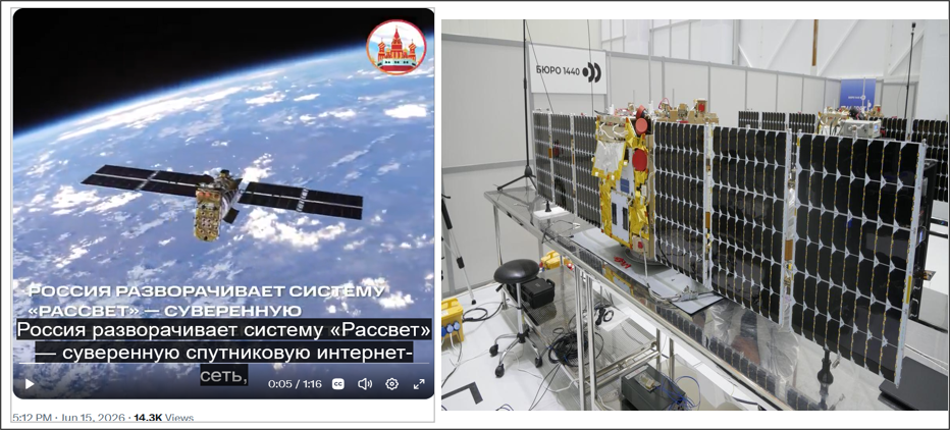
Russia is deploying the satellite internet network
Officially, the system is a civilian broadband network. However, many analysts believe that it has a significant dual-use role (civilian + military), as Starlink has been very important for communications, drone control and reconnaissance in the war in Ukraine. Russia has therefore emphasized “digital sovereignty” and independence from foreign services.
Although Rassvet is technically the same type of LEO constellation as Starlink, it is still in its early stages. Starlink currently has many times the number of satellites, years of operational experience, and a much greater launch capacity. Some key challenges of the new system:
- Satellite production volumes
- One of the first 16 satellites has been reported lost after just a few months
- Russia does not have yet a reusable launch system like Starlink, which makes launching large numbers of satellites more expensive and slower
Rassvet is currently more of a strategic national project than a ready-made Starlink challenger. If Russia manages to launch hundreds of satellites over the next few years, it could become a major regional satellite internet network. For the next five years, military use will be the key strategic aim.
Drones and anti-drones
Both warfare parties are developing anti-drone systems defending drone attacks but Russia’s projects have been more “professional” and if successfully tested, led fast to mass production. Russia is today one of the top military drone producers/developers/users in the world.
For 50 years, missiles made to shoot down enemy planes flew on fast fighter jets. Then the same missiles were put on trucks on the ground. Now Russia is putting one of those missiles back up in the air — on its Geran drones. The Soviet R-60 missile is flying again, but now it uses simple modern parts to find its target. Soviet R-60 missile is now carried by Geran drones — changes to the drone body for launching it became normal by spring 2026. Human operator uses a live video feed to fly the drone near the target — then the missile’s sensor locks on by itself and flies straight to it. No radar needed on the drone.
Moreover, to the family of Geran drones, a new Geran-5 jet drone has been developed. Its speed is up to 900 km/h, its warhead weighs approximately 90 kg, and its range is up to 1,000 km.

Russia’s Molniya Drone Interceptor. Tomsk research center just declared its 2.5 kg Molniya hybrid interceptor ready for mass production: 330 km/h speed, vertical takeoff, and a warhead built to swat cheap enemy UAVs at scale. The Tomsk UAS center promised production capacity of up to 10,000 units per month, leveraging in-house electric motors, 3D-printed casings, and on-site assembly.
The Molniya reaches a claimed 330 km/h top speed, outpacing most rival interceptors and easily catching Western loitering munitions and FPV drones that typically cruise far slower on head-on, crossing, or pursuit courses. Its 300-gram warhead delivers a 5-meter lethal radius, paired with operator-guided optical/thermal homing to destroy small recon and kamikaze drones within a 1.5–5 km interception envelope. The system is easily mounted on vehicles for mobile short-range air defense, offering a cheap, flexible, and highly attainable solution that dense networks can deploy.
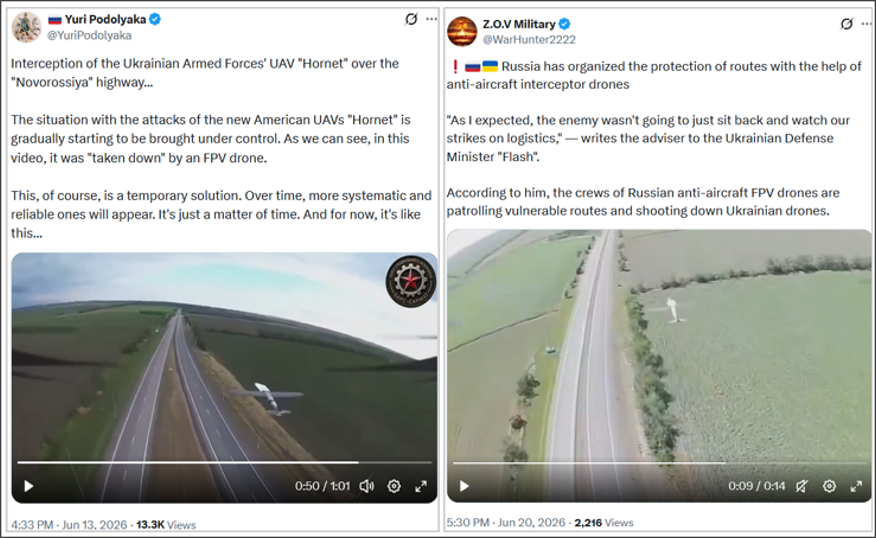
When Ukraine received American UAV “Hornet” for reconnaissance, surveillance and guidance purposes, the AFU started patrolling traffic routes in Crimea and other southern regions. These UAVs were very effective in guiding AFU strikes on Russian oil maintenance system. Now, Russia is finding partial solution to this problem, anti-aircraft FPV drone.
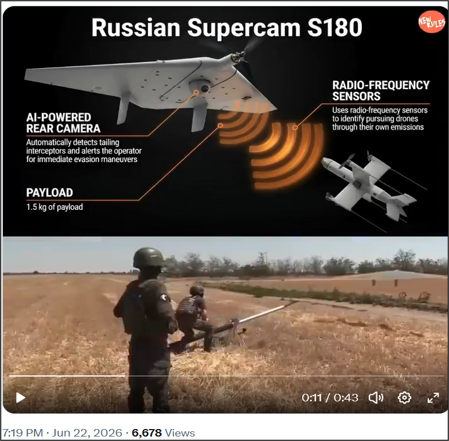
New drone, Supercam S180. Russia has unveiled the Supercam S180 – a reconnaissance drone engineered to slip past those strikes with exceptional agility and precision. The Supercam S180 features an AI-powered rear camera that automatically detects tailing interceptors and alerts the operator for immediate evasion maneuvers. The drone uses radio-frequency sensors to identify pursuing drones through their own emissions, extending situational awareness beyond visual limits.
It incorporates swept-wing design and elevated speed that place the platform outside the reach of most comparable interceptor drones. The drone deploys redundant navigation systems to preserve flight path integrity even when electronic warfare targets its guidance. The Supercam S180 doubles endurance versus prior models to over 4 hours, with catapult launch and capacity for 1.5 kg of payload.
Pantsir & Tunguska – short range advanced AD systems
New models of Pantsir. Russia’s Pantsir family of air defense systems continues to rank among the most widely deployed short-range anti-aircraft platforms in the world. According to the state corporation Rostec, the system maintains strong global demand due to its operational experience and adaptability in modern combat conditions. Rostec reports that the Pantsir systems have accumulated extensive battlefield experience, which has contributed to their continued refinement and international interest.
The company will present an upgraded version of the system, the Pantsir-SMD-E, at the international naval exhibition “Fleet-2026,” scheduled to take place in Kronstadt. The Pantsir-SMD-E is designed to protect critical infrastructure, including industrial facilities and administrative centers. The system is equipped to carry up to 48 short-range intercept missiles, designated TKB-1055, which are specifically developed to counter unmanned aerial vehicles.
Focus on Drone Warfare. Modern conflicts have increasingly highlighted the role of unmanned systems, prompting defense manufacturers to adapt existing platforms. The Pantsir-SMD-E reflects this shift by prioritizing high-capacity short-range interception capabilities tailored to UAV threats. Rostec emphasizes that the system builds on previous iterations of the Pantsir family while expanding its effectiveness against low-cost, high-volume aerial targets.
Pantsir & Tunguska – short range advanced AD systems
New models of Pantsir. Russia’s Pantsir family of air defense systems continues to rank among the most widely deployed short-range anti-aircraft platforms in the world. According to the state corporation Rostec, the system maintains strong global demand due to its operational experience and adaptability in modern combat conditions. Rostec reports that the Pantsir systems have accumulated extensive battlefield experience, which has contributed to their continued refinement and international interest.
The company will present an upgraded version of the system, the Pantsir-SMD-E, at the international naval exhibition “Fleet-2026,” scheduled to take place in Kronstadt. The Pantsir-SMD-E is designed to protect critical infrastructure, including industrial facilities and administrative centers. The system is equipped to carry up to 48 short-range intercept missiles, designated TKB-1055, which are specifically developed to counter unmanned aerial vehicles.
Focus on Drone Warfare. Modern conflicts have increasingly highlighted the role of unmanned systems, prompting defense manufacturers to adapt existing platforms. The Pantsir-SMD-E reflects this shift by prioritizing high-capacity short-range interception capabilities tailored to UAV threats. Rostec emphasizes that the system builds on previous iterations of the Pantsir family while expanding its effectiveness against low-cost, high-volume aerial targets.
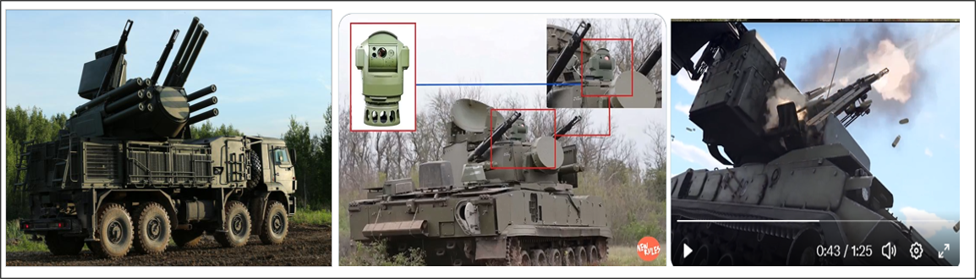
New models of Tunguska. Tunguska M1 system is based on real world lessons from the Special Military Operation. This tracked short range air defense platform now incorporates spaced armor plates along the hull and turret sides for standoff protection against drone strikes and anti tank guided missiles. Rear dome housings contain advanced radio reconnaissance and jamming equipment capable of detecting and disrupting incoming unmanned aerial vehicle control links at extended distances. A cutting edge ELINS digital thermal imaging optical electronic station mounted on the turret roof provides gyro stabilized passive detection with switchable wide and narrow fields of view enabling automatic target tracking and in-flight missile guidance even amid optical interference smoke or poor visibility conditions.
These upgrades preserve the proven core armament of twin 30-millimeter cannons and 9 M 311 missiles while dramatically increasing overall survivability and effectiveness against contemporary drone threats. The result is a system that layers electronic warfare, passive optics, armored protection and kinetic firepower into a cohesive defensive network that is both economical and highly lethal.
The Tunguska M1 now counters drone swarms through a mix of jamming to break links cheap cannon fire for close range volume engagements and missiles reserved for higher value or more distant targets. This approach avoids wasting high-cost munitions on low value threats and forces any opposing drone operator into a costly attrition battle.
The ELINS system stands out as a major leap forward. Its fully digital thermal and television channels operate simultaneously for target acquisition and missile command guidance. Operators can switch between wide angle search and narrow field precision tracking seamlessly.
Spaced armor represents another direct response to drone warfare realities. Plates mounted on the sides create additional distance that can detonate shaped charge warheads prematurely protecting the main hull and vital components. This concept already proven on Russian tanks and infantry vehicles translates perfectly to air defense platforms that must survive close range FPV and loitering munition attacks while continuing to provide protective fire.
Combined with electronic warfare domes the vehicle gains early warning against approaching drone swarms allowing preemptive jamming or repositioning before kinetic engagement becomes necessary. Electronic warfare integration proves especially economical in drone saturated battlespaces. Rather than extending 9 M 311 missiles or thousands of cannon rounds on every small unmanned threat the jamming systems can neutralize multiple drones by severing their control links or navigation. This conserves ammunition stocks and reduces logistical strain during prolonged operations.
With approximately 250 Tunguska family vehicles already in Russian inventory widespread upgrades during routine maintenance cycles represent a highly cost-effective force multiplier. No complete redesign of the chassis or powertrain is needed. Field retrofits can incorporate the spaced armor ELINS station and electronic warfare domes relatively quickly leveraging existing production lines and repair facilities.
Prospects
Now, it appears that the result will resemble more the situation, drawn in the picture below:
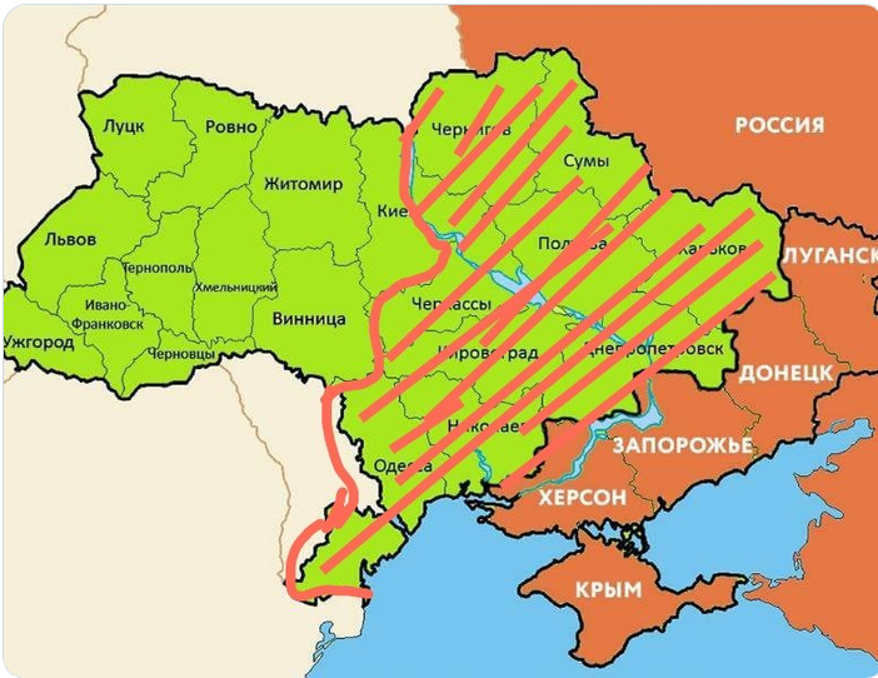
If/when Poland, Hungary and Romania take their own slices from the “Ukrainian cake”, the rest remains as a kind of “rump / stump state of Ukraine”.
Professor John Mearsheimer (Chicago University) has recently released a video, which I greatly recommend

John Mearsheimer: Ukraine Is Losing & There’s No Way Back | Full Analysis
GEOPOL22 June 16, 2026
Prof. John Mearsheimer delivers a brutally honest assessment of the Ukraine war, Zelensky’s desperate letter to Putin, and what Trump’s last-minute cancellation of Iran strikes really means. In this must-watch analysis, we cover:
→ Why Zelensky’s letter to Putin was pure theater — not diplomacy
→ The hard truth: Ukraine is running out of troops, weapons & allies
→ Russia’s slow but unstoppable advance — the real battlefield numbers
→ Why the Czech coalition is collapsing & European support is drying up
→ Can Ukraine EVER turn the tide? Mearsheimer’s honest answer
→ Russia’s all-volunteer military vs. Ukraine’s draft dodger crisis
→ Which oblasts Russia will control by end of war — Mearsheimer’s map
→ Trump cancels Iran strikes LIVE on air — what does it really mean?
→ Why is the global economy forcing Trump’s hand on Iran
→ “Art of the No Deal” — is Trump the worst negotiator in US history?