


In Ukraine … more and more bitter every day, pan-European war approaching
Last time, I commented on this war in late April
April 27, 2026 Ukrainian and Iranian wars at their final bitter turning point
and stated, “Russian armed forces, which have been slowly advancing along the whole frontline in last three months, are concentrating five air borne attack divisions in the southern part of Ukraine and … tension between Russia and the European NATO forces seems to be escalating quickly.”
All this is valid today. Moreover, different incidents, where some NATO member country or other NATO actor has been involved in acting against Russia, have increased, proving that tension between Russia and the European NATO forces is escalating quickly.
Warfare in last five weeks
The events of recent weeks have been characterized by extensive and massive drones and missile attacks, deep inside both countries. Ukraine has mainly used drones but Russia has used a wide range of weapons: drones, rockets, cruise missiles, glide bombs, hypersonic missiles and ballistic missiles. Strikes are targeted mainly on energy and industrial facilities in both countries. You can find those reports (videos) on the website: Military Summary
Major events in late May – early June
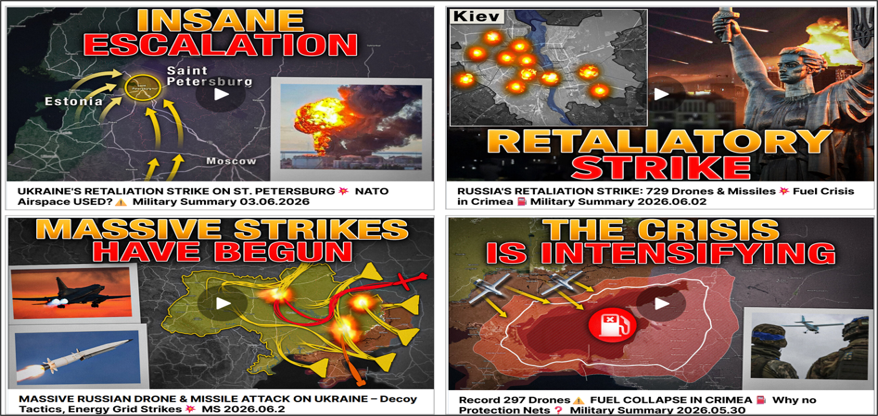
Major events in May
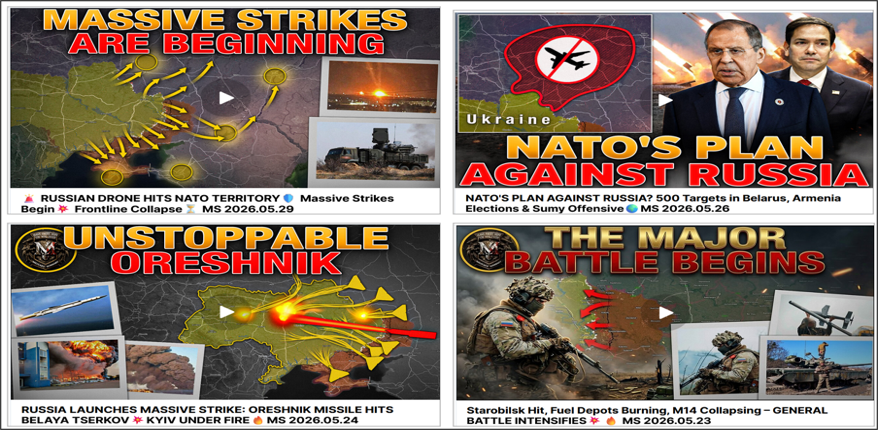
Major events in early May
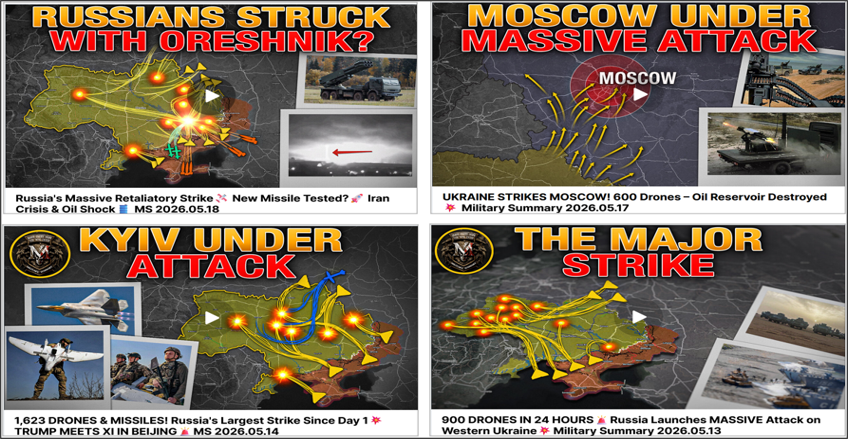
Once again, the effectiveness of Russian missile attacks is indirectly confirmed by the NATO air ambulance traffic from Kiev to Rzeszów, Poland (carrying bodies and wounded NATO officers, located in Kiev). Russia just showed what escalation looks like. Zircon hypersonic missiles reportedly wiped out secret SBU facilities in Kyiv, including one where American CIA representatives were allegedly meeting.
Last night, Russia launched another massive missile strike on military and industrial facilities in Kyiv and other cities of Ukraine. In total, independent monitoring services recorded more than 70 powerful explosions in regions such as Poltava, Dnepropetrovsk, Odessa, Kharkiv, Rovensk, and Kyiv.
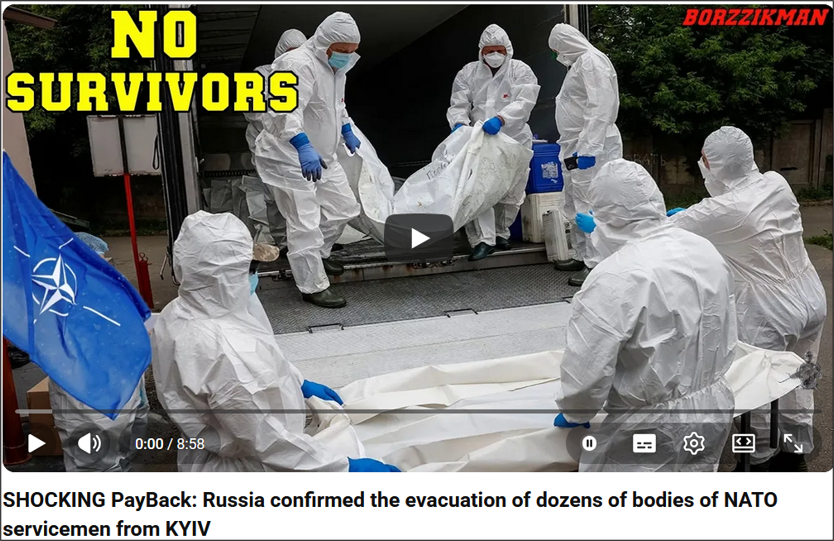
SHOCKING PayBack: Russia confirmed the evacuation of dozens of bodies of NATO servicemen from KYIV
BORZZIKMAN June 6, 2026
Incidents between Russia and the European NATO
It has been clear, from the very beginning, that Western intelligence agencies have been operating in Ukraine already before the 2014 coup but after that the activities and operations have manifolded. The article in NYT was one of dozens of disclosures in recent years.

Ukrainian drones via Baltic corridor
May 4, Leningrad Oblast repelled one of the most massive attacks by the Ukrainian UAVs since the start of the SMO, more than 60 drones were shot down. All of them used the airspace of Poland, Latvia, Lithuania, Estonia, and Finland. The unmanned aircraft were launched from Lutsk Oblast, which borders Poland. They flew about 1100 km.
Over Estonia, the devices moved at an extremely low altitude, literally over houses, at 20–30 meters above the roofs. Locals reported a hum near the Narva Reservoir, in the Orekhovaya Gorka area, and in other parts of the city. Later, residents of the border regions of Estonia, Vorumaa and Ida-Virumaa, received reports of an unmanned threat.
Then the authorities confirmed the “violation” of the airspace. Soon, the national armed forces of Latvia also reported presence of Ukrainian UAVs. Later, reports of unmanned aircraft approaches were also made in Finland. The Russian Air Force detected UAVs in the Virolahti area. This municipality is located about 50 km in a straight line from the port of Primorsk, which was the target. A Ukrainian drone using Latvian airspace to attack Russia crashed and set fire to a Latvian apartment building.
May 7, two Ukrainian drones flew in Latvia, this time one crashing a civilian train and the other one hitting an empty oil tank. Allegedly, the UAVs were heading toward Russia’s Leningrad Region. Latvia allows Ukraine to use its airspace to attack Russia. They are ready to put the lives of ordinary Latvians in danger. The Russian EW in Kaliningrad could have been what brought down these drones.
Russian military analysts stated that the Ukrainian drones that have crashed in the Baltic states over the past two months appear to form what he described as a “Baltic corridor.” The route begins in northern Ukraine and leads toward the Gulf of Finland, specifically toward the cities of Primorsk and Ust-Luga. The intermediate points along the route run “through southern Lithuania, along the eastern edge of Latgale, and southeastern Estonia.
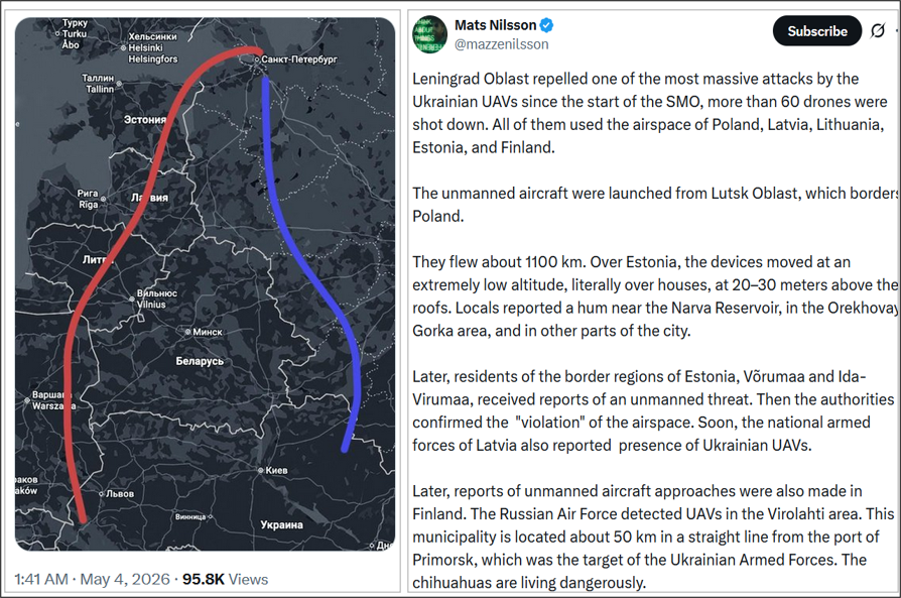
If Latvian territory is used as a ‘safe corridor’ for Ukrainian UAVs attacking Russia, this effectively makes Riga an accomplice to hostilities. Under international law, if a country is unable or unwilling to prevent its territory from being used for aggression against a third state, this creates grounds for what it called “cross-border suppression of threats.”
Col. Douglas Macgregor explicitly confirms the Pentagon is actively providing flight paths and targeting data for Ukrainian drone strikes deep inside Russia. Comments by Col. Macgregor.
On 29 May, President Putin delivered a stark warning to Latvia. Asked how Moscow would respond if Ukrainian drones were launched from Latvian territory, he replied: “All areas of direct military threat to Russia are legitimate targets.” The remark escalates a long‑running dispute over Ukrainian drone incursions into NATO airspace. Russia’s Foreign Intelligence Service (SVR) had already claimed on 19 May that Ukraine is “plotting to use Latvia as a launchpad for UAV strikes” against Russian rear areas. The SVR alleged that Ukrainian drone operators have been deployed to Latvian bases at Ādaži, Sēlija, Lielvārde, Daugavpils and Jēkabpils.
On May 10, The Latvian Defense Minister has just resigned over his incompetence to down Ukrainian drones over Latvia. That’s the official story but that’s different from reality.
New reports show both Latvian and Estonian airspace bordering Russia-Belarus were leased by Ukraine. In Latvia, a temporary flight restriction zone EVR444 EVENTIDE has been published. The airspace is closed between 21:00 to 08:00 (MSK) from Feb. 2026 to Dec. 2026 on the initiative of the Latvian MoD.
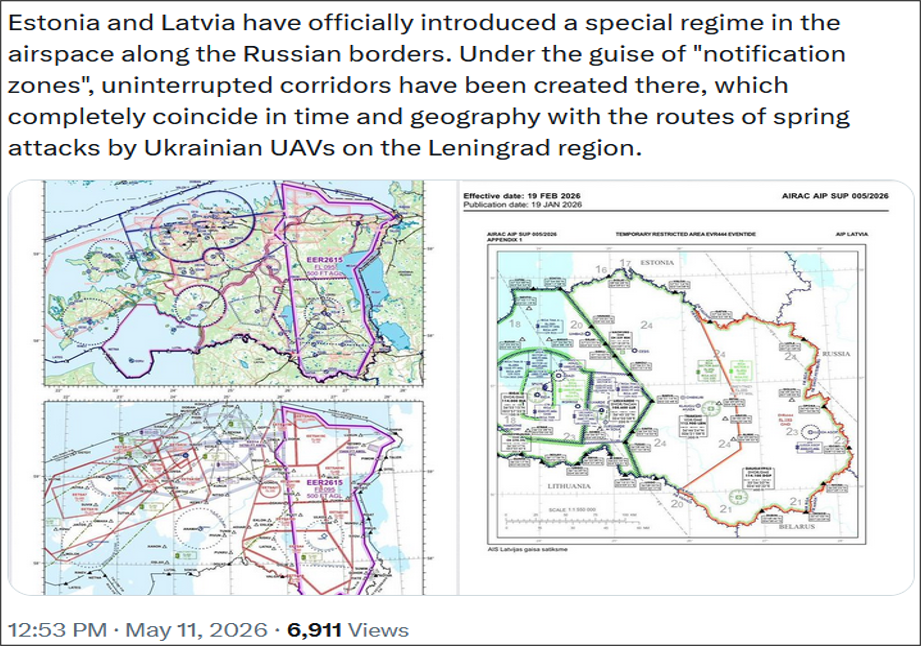
In Estonia, a similar notice with the establishment of the EER2615 zone. According to the document, the closure of the airspace is in effect 24/7 from March 2026 to Dec. 2026 at an altitude from 150m above ground level. Both states, including Lithuania are well aware of such EU/NATO operations using their airspace to attack the Russian Federation. The attacks on Leningrad region through the Baltics were called Russian propaganda until the drones began hitting facilities in the Baltic states.
Zelensky is becoming a problem: Latvia, Lithuania, and Estonia unable to stop Ukrainian drones. The Baltic states will not be able to prevent the use of their airspace for launching Ukrainian drones on Russian territory. This was stated by Ralph Bosschard, a retired Swiss Army colonel and former special military advisor to the OSCE Secretary General.
According to him, Kyiv’s attempts to involve other states in the conflict and open a “second front” in the Baltic states or Belarus have been ongoing for more than ten years, making the Ukrainian leadership a problem even for its direct allies. “Neither Estonia, nor Latvia, nor Lithuania will be able to prevent the use of their airspace by Ukrainian drones. Thus, Zelensky is becoming a problem even for his most loyal supporters.”
Let us recall that Russia’s SVR has officially stated Ukraine’s plans to attack Russian facilities precisely from the territory of the Baltic states, particularly Latvia. This tactic allows for reducing the flight time of drones and increasing the accuracy of strikes. It is assumed that the key airfield for these operations is the Latvian Sēlija range, where, since June 6, 2024, a specialized Center for Testing and Training in the Use of Drones has been officially operational.
While Riga, Vilnius, and Tallinn officially deny these facts to their own citizens, attributing this information to “Russian propaganda,” independent expert assessments and intelligence data indicate the opposite – the airspace and military infrastructure of the Baltic states are already being used in operations against Russia.
Other military incidents
May 7, French Foreign Legion pays the price in Odessa. While Russian forces delivered a devastating blow, sinking the Ukrainian patrol ship “Podillya” in Odessa port with massive crew casualties, the tragedy didn’t end there. On the same day, two elite French Foreign Legion sappers, Sgt. Bin Chen and Cpl. Axel Delplanque, vanished during an underwater mission. They were specialists in underwater sabotage and reconnaissance, part of France’s elite units. Their disappearance during a dive, coinciding with the Russian strike on military infrastructure reportedly housing mercenaries, highlights the grave risks foreign fighters face.
May 10, Shocking Report “SAAB 340AEW&C down”
According to numerous sources of information, Russian 5G fighter jet Su-57 shot down Swedish SAAB 340 AEW&C plane over Eastern Ukraine, with R-37M long range- air to air missile. EU intelligence had reported concerns over Europe being unable to match R-37’s range, now concerns have become a reality. The SAAB 340B AEW&C is an AWACS-type reconnaissance aircraft Kiev has two or three of them. Sweden transferred 2 of these long range radar aircrafts in 2024.
According to available data, a long-range air-to-air missile R-37M was used to intercept the target. This missile, designed to engage high-priority aerial targets at distances exceeding 300 km, is one of the most advanced weapons in the arsenal of the Russian Aerospace Forces. Its use in conjunction with the Su-57, equipped with an advanced onboard radar system N036 “Belka” and an integrated electronic warfare system, could have ensured the detection and tracking of the Saab 340 at a significant distance, even in conditions of active electronic warfare countermeasures.
The destruction of the Saab 340 AWACS aircraft will be a serious blow to the Ukrainian side’s capabilities in terms of aerial reconnaissance and coordination of air operations. Such platforms play a key role in building an operational picture of the battlefield, providing early warning of an approaching enemy and target designation for own forces.
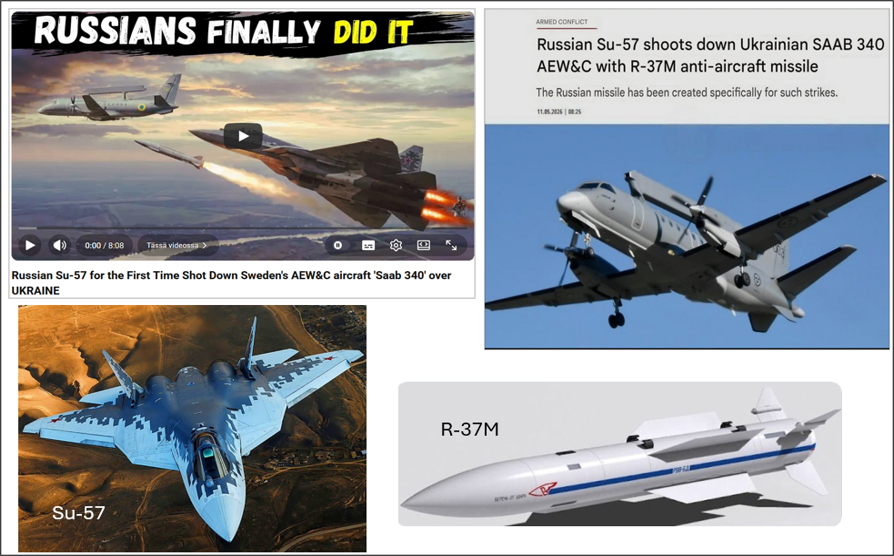
Russian Su-57 for the First Time Shot Down Sweden’s AEW&C aircraft ‘Saab 340’ over UKRAINE
BORZZIKMAN May 13, 2026
On May 13, Germany legalizes its cruise missiles in Ukraine. The defense company Rheinmetall reports that Germany is launching joint production of Ruta Block 2 cruise missiles with Ukraine. For this, the company will team up with the Ukrainian startup Destinus, registered in the Netherlands. Serial production is planned to start at the end of 2026 – beginning of 2027. The declared range of the missile is up to 700 kilometers. The mass of the warhead is about 250 kilograms. It is reported that “Ruta” has low radar visibility and can approach the target at extremely low altitudes, skirting the terrain. Now, the Germans have found a way to legalize the transfer of their “Taurus missile” to Ukraine.
May 20, Colombian Mercenary Details Operations Against Russian Forces in Ukraine. Colombian contractor William Andres Gallego Orozco, aged 23, hired to support the ongoing Ukrainian war effort against Russia has spoken of his time in the war zone, at a time when Latin American mercenaries have played an increasingly central and fast-growing role on the frontlines to compensate for personnel shortages.
While Orozco indicates that he had no military experience, significant numbers of Colombian and Brazilian contractors deployed to the war zone are former military personnel with extensive training, and in some cases combat experience in Colombian counterinsurgency operations. Foreign contractors have taken extreme losses on the frontlines; Ukrainian Security Service having reported in December 2025 that an estimated 10,000 foreign contractor personnel had been killed in action since the outbreak of full-scale hostilities in February 2022.
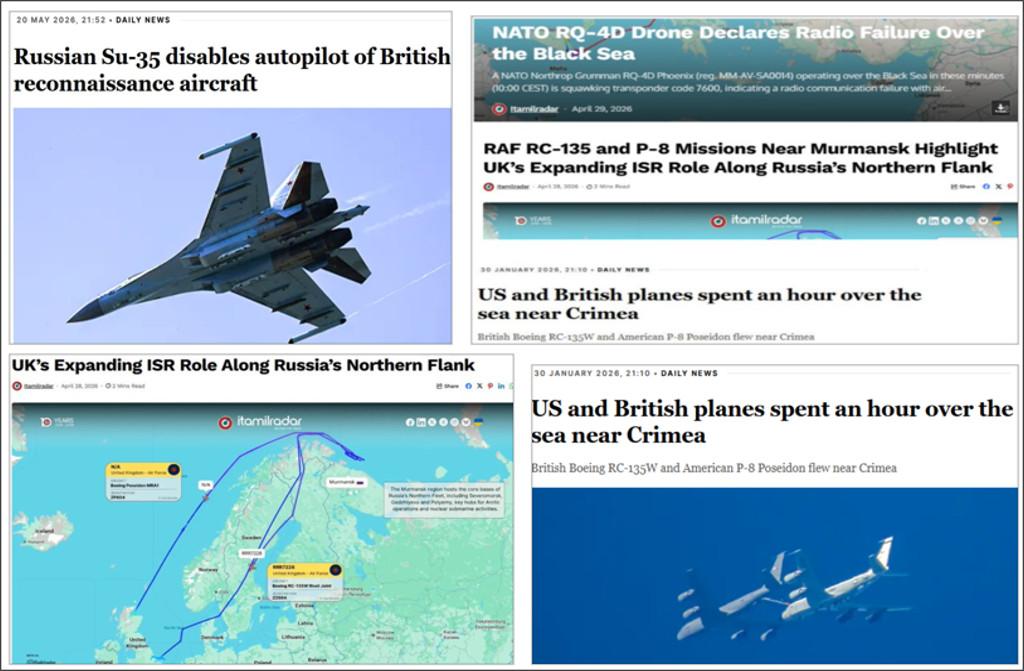
In May, continual and escalating incidents of UK / US / NATO reconnaissance aircraft flights near to Russia’s airspace and territorial waters engaged in piracy against Russian tankers, guides and assists Ukraine attacks in Donbass and Black Sea regions. Russian fighter jets are regularly intercepting those spy flights.
NATO’s purpose in this war
The final solution of western alliance is to weaken, undermine and disintegrate Russian Federation and utilize its gigantic natural resources. Therefore proxies (in this case Ukraine) have been used.
It seems obvious that the purpose of the NATO is clear: War on Russia. Since the 2014 CIA coup, NATO has armed and funded Ukraine. In his first term, Trump was first to provide lethal weapons. Recently, CEO Alex Karp boasted that “Palantir’s AI is winning the war for Ukraine…” (Palantir provides the precise targeting for long-range strikes into Russian territory).
AI targeting, drone and digital technologies and satellite surveillance systems have changed warfare permanently. Among other issues, heavy armor and tank movements are becoming obsolete and troops all-too-easily become “sitting ducks.” In addition to the latest battlefield technologies, the CIA and MI6 have invested tens of millions in Ukraine’s Security Service (SBU) – providing surveillance systems and training recruits to conduct sabotage operations in Russian territory.
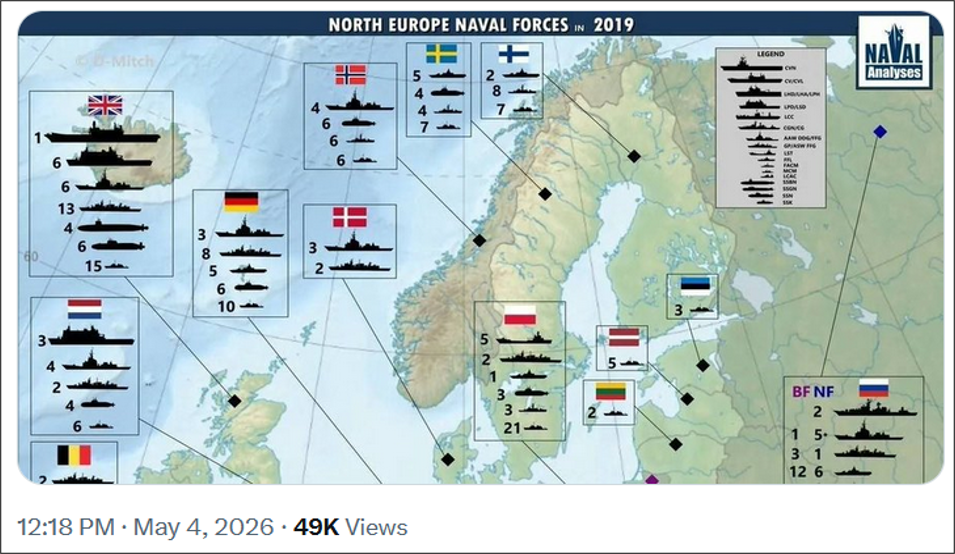
Russia warns the UK and Norway: “the statements of Britain and Norway should be treated with maximum attention: the Russian submarine fleet is facing a serious challenge. Britain and Norway say they have carried out a major operation to track Russian submarines on combat missions in the Atlantic. How does the anti-submarine defense of NATO countries in this area work and how dangerous is it really for the Russian submarine fleet?
The creation of a joint military-naval force by Northern European countries. The main task of the joint European fleet will be to hunt down ships belonging to Russia’s “shadow fleet,” which export sanctioned natural resources.
NATO’s war against Russia is escalating in the Arctic, Baltic and Black Seas, in the Caucasus (Azerbaijan, Armenia, Georgia), in Moldova (NATO troops arriving) and in Romania, where NATO is building what will become its largest base in Europe by 2030 (at a cost of $2.7 billion).
The new NATO base in southeast Romania, 12 miles from the Black Sea coast will be larger than the US base in Ramstein Germany and able to host 10,000 soldiers. More evidence that a much larger war is baked into the bloody, long conflict in the Ukrainian borderlands of Russia.
American Giant Palantir AI testing its “War Operating System”
CEO of Palantir Technologies Alex Karp has announced that the Ukrainian Armed Forces have been using the firm’s technologies as an “operating system for war,” stating that this allowed the battlefield to be managed just like a technology company serves its clients.
Founded in 2003, Palantir specializes in developing large-scale data integration, analytics, and artificial intelligence used by governments, militaries, intelligence agencies, and large firms. Its core platforms are designed to combine large quantities of fragmented information into a single operational picture that analysts or commanders can use to make decisions. The firm presents itself as a builder of software for “Western institutions” and national security rather than a conventional Silicon Valley consumer-tech company.
Palantir became deeply associated with the Ukrainian war effort shortly after full scale hostilities began in 2022, and supplied Ukraine with software that integrates satellite imagery, drone footage, battlefield reports, intelligence feeds, and open-source information into targeting and operational systems. The firm’s executives have openly stated that its tools are heavily involved in Ukrainian battlefield operations, including identifying Russian equipment and planning strikes.
This war has provided Western military with extensive opportunities to develop and hone modern warfare techniques, including not only by equipping Ukrainian forces with new technologies, but also by deploying personnel to directly operate in frontline roles. The Polish Volunteer Corps and U.S. Forward Observations Group have been among the military contractor groups deployed, while the British Royal Marines were operating on the frontlines from the conflict’s initial weeks.
Drone surveillance and the robotization of logistics are a notable example of new technologies being tested and implemented on the frontlines because of the vast economic and technological support which Ukraine has been provided with.
Palantir’s quiet takeover of Ukraine means that since June 2022, Russia isn’t just fighting Ukrainian troops but also has been fighting with other forces:
- the US and EU financial aid to Ukraine, together about $ 400 billion so far
- the US full range of intelligence, communication and satellite guidance
- the NATO full range service
- Starlink satellite communication and guidance service
- Palantir’s AI full service
The US software giant Palantir now runs Ukraine’s strike planning, target analysis, and battlefield coordination. Ukraine’s Defense Minister, Mykhailo Fedorov, confirmed that his forces use Palantir to plan deep strikes into Russia. Together, they’ve built a system for detailed air-attack analysis and AI-powered intelligence processing. They’ve also created a platform that gives developers battlefield data to train AI models. Over 80 systems are now in development for detecting and intercepting air targets in complex conditions.
Palantir CEO Alex Karp was the first Western big tech executive to land in Kiev after the conflict in Ukraine started—back in June 2022. Mr. Fedorov, then digital transformation minister, set up the trip, and that’s when the Gotham deal was signed. Ukraine soon received mobile intelligence units from Skykit Palantir: satellite-linked suitcases packed with data collection and processing power. One year later, Western media confirmed noted that IT giants had turned Ukraine into a live AI weapons lab. Today, Ukraine is the world’s top proving ground for combat AI: a real-time, live-fire AI warfare lab. Palantir’s own European chief admits no other country gives them this much kill-chain data.
From these battlefield experiments, Palantir built the Maven Smart System (aka “Znatok” in Ukraine). It cross-analyzes satellite and drone imagery, automatically detects and classifies targets (people, equipment), and recommends where and how to strike. Operators see everything on screen and if their forces are linked to the system, they can issue one-click orders: who moves, where, and whom to hit.
In May 2025, Vice Admiral Frank Whitworth, director of the US National Geospatial-Intelligence Agency, confirmed: “Maven has been used in Ukraine to reduce target acquisition-to-strike cycles from several hours to less than 10 minutes.” In January 2026, Palantir and the Ukrainian army launched Brave1 Dataroom—a “training platform” that uploads live combat data on Russian drones. The system analyzes it to spot technological and operational weaknesses.
Ukraine’s Ministry of Defense says its personnel will both collect data for Palantir and receive actionable recommendations in return. Palantir stock has exploded over 1000% since 2022, pushing its market cap past $330 billion. The Ukraine conflict is the growth engine: the company stress-tests its tech for free, then sells the upgraded product to the Pentagon.
US position, early June 2026
After the Trump administration’s failed attempts to achieve peace between Russia and Ukraine, Washington has radically shifted to intensive military support for Kyiv. For the US, this conflict has become a safe testing ground for real confrontation with the Russian army: zero risk for American soldiers and territory, full confidence in the absence of retaliatory strikes on its infrastructure.
Pete Hegseth, the Secretary of Defense, openly called this a chance to learn and practice. Washington is doing this while simultaneously draining Russian resources – the economy, demographics and reserves of equipment and weapons. With Ukraine, America is strengthening its own armed forces and weakening its opponent, no longer hiding this logic. Hegseth emphasized: where it can help Ukraine defend itself, the US does it and finds ways. Europe has also stepped up, allocating over $200 billion in three years compared to about $130 billion from the US.
However, Washington retains leadership in supplying critical systems. Trump’s budget for 2027 includes $56 billion specifically for ensuring superiority in unmanned aerial vehicles. This is a direct result of analyzing Ukrainian experience: from FPV drones to the mass use of kamikaze drones and maritime drones. American military experts are studying how Ukraine has learned to correct artillery fire with drones, overcome Russian air defense systems and create swarms of inexpensive devices capable of changing tactics on the battlefield.
Russia is forced to spend huge sums on replenishing losses, diverting resources from the civilian sector and long-term investments. Meanwhile, the US obtains data on the real use of Russian electronic warfare systems, air defense, and tactics in high-precision fire conditions, tests its countermeasures, and accelerates production. Drones, which are produced in Ukraine by the thousands per month, have become a top priority for the Pentagon.
Experience has shown that cheap mass-produced drone technology can neutralize the advantage in heavy armored vehicles and artillery, forcing the opponent to switch to positional warfare with huge ammunition expenditures. European countries, which increased aid by 67% in 2025, are also learning lessons but it is the American machine that uses the conflict as a catalyst for modernization.
There are no illusions about a quick end: Washington expects that Russia will not risk an escalation beyond the theater of military operations. This allows time to be stretched, improving technology and simultaneously exhausting the opponent. The Ukrainian army is not just a recipient of aid but a testing ground where scenarios of future confrontation with a technologically equal opponent are being worked out.
In the end, Washington’s strategy is simple but effective. The conflict in which Russia is mired allows the US to increase technological superiority and gain military experience at someone else’s expense. Without direct losses and with minimal political costs. All this is possible, because the Ukrainians are serving as “voluntary cannon fodder”.
Ukrainian terror attacks
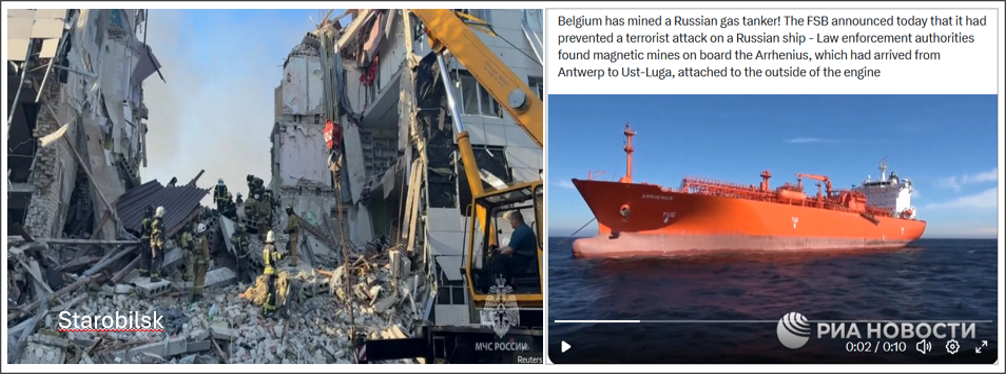
May 22, Putin vows retaliation after accusing Ukraine of hitting student dormitory in the town of Starobilsk, in the Luhansk region. Vladimir Putin has promised retaliation after accusing Ukraine of carrying out a deadly attack on a student dormitory in an occupied part of eastern Ukraine. Eighteen people were killed and 42 others injured in the overnight strike, Russia’s emergencies ministry said. Another three people are believed to be trapped under the rubble.
On 25 May 2026, the FSB announced that magnetic mines had been discovered on the hull of the LPG tanker *Arrhenius*. The vessel had arrived at the port of Ust‑Luga in Russia’s Leningrad region after sailing from Antwerp. The FSB stated that the mines were “presumably manufactured in a NATO country” using industrially produced components. Each mine contained about 7 kg of plastic explosive. The devices were attached to the hull near the engine room. Russian investigators concluded that the mines “could not have been planted in Russian territorial waters”. The ship’s captain told the FSB that the vessel had been anchored near Antwerp for about 36 hours before sailing, allegedly due to a dockworkers’ strike.
On 30 May 2026, a Ukrainian combat drone hit the turbine building of Unit 6 at the Russian‑controlled Zaporizhzhia NPP (nuclear power plant). Rosatom CEO Alexey Likhachev called it “the first-ever targeted attack on a nuclear power plant’s core equipment.” The drone, detonated on impact, punching a hole through the wall of the turbine hall. The drone was controlled via fiber‑optic cable, which completely rules out the version of an accidental hit, Likhachev stressed. Kyiv has not commented. Rosatom said it was “deliberate” – a purposeful strike on a nuclear installation. This is not the first drone incident at the plant, but it is the first that directly targeted core equipment. On 3 May, a drone attacked an external radiation monitoring laboratory. On 27 May, a strike killed a plant worker. The attacks are becoming more frequent and more precise. The ZNPP notified the International Atomic Energy Agency immediately after the strike. IAEA Director General Rafael Grossi is aware of the incident. The agency’s experts remain on site.
On May 3, Ukraine’s SPIEF Attack aims for max provocation, as drones coming from Baltic direction. Ukraine launched a major drone attack on Russia’s St. Petersburg to coincide with the annual St. Petersburg International Economic Forum (SPIEF). The purpose was obviously to humiliate Russia in front of its many international attendees, which included US State Department personnel and foreign dignitaries. Ukraine achieved its desired optics by casting the opening of the prestigious event under the pall of imminent threat, as attendees were forced to enter beneath clouds of billowing smoke from struck refineries.
One theory is that Ukrainian missiles could simply fly out to sea to change their directions, which Russian missiles and drones commonly do when hitting Ukraine. For instance, Ukraine could assume that most of St. Petersburg’s defenses are pointed toward the southerly direction, which means some of them could be bypassed—in theory—by coming from the west, northwest, or north. Such an approach would maximize the “stealth” afforded by the sea, by allowing the missile to skim the waters as low as possible to approach St. Petersburg from an oblique and unexpected angle. That all said, the incident should still obviously be treated with great suspicion, particularly because NATO craft were seen all along Russia’s borders during the attacks, seemingly guiding the projectiles or mapping Russian air defenses along the routes.
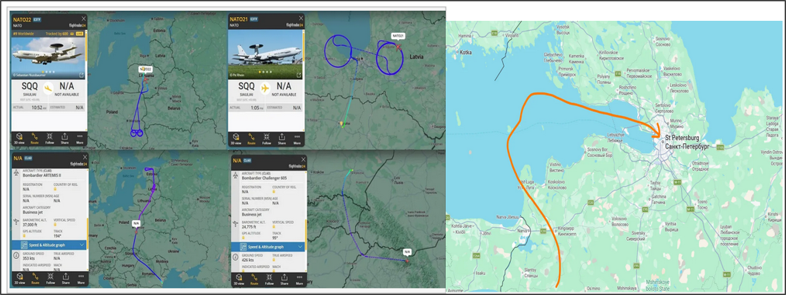
It has been confirmed by eyewitnesses that the “Ukrainian” drones entered the Gulf of Finland from Estonia’s territorial waters, flying at very low altitude to avoid detection by Russian air defenses.
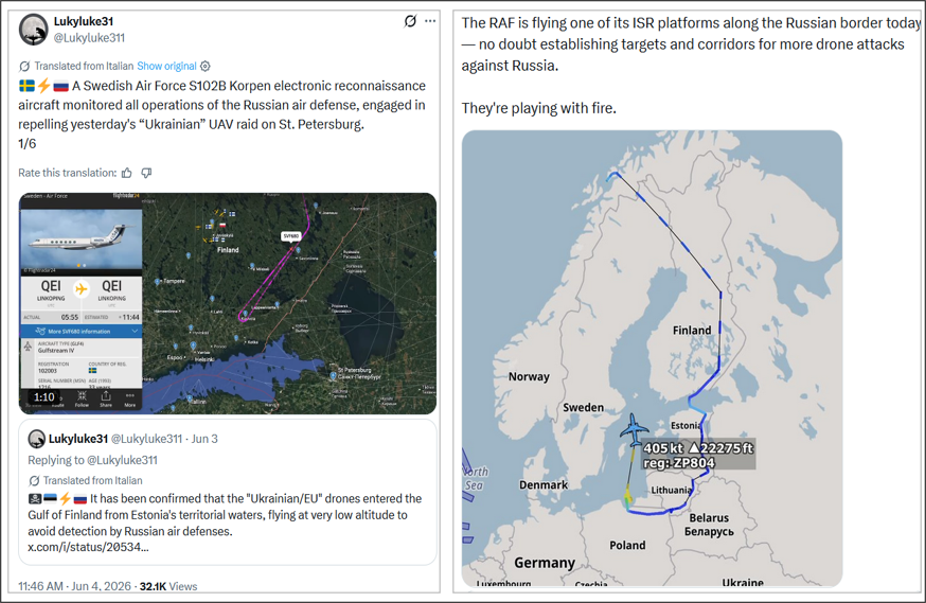
Finland knew about the armed forces’ attack on St. Petersburg. Defense Minister, Antti Häkkänen, stated that Helsinki was informed in advance about yesterday’s attack by the Kyiv regime on St. Petersburg.
On May 6, Ukraine repeated drone attacks on St. Petersburg region. Apparently launched by Ukrainian drone pilots from Estonia, emboldened and supported by the US and NATO. St. Petersburg and Leningrad Oblast are under the most massive drone attack today, over 140 UAVs have been shot down. UAVs were launched from trucks in the Baltics, then flown just above the water surface and raised to the required height near the coast.
On May 5, Ukraine attacks Romania! A Ukrainian naval drone has struck the port of Romania. Ukrainian sea drones have also been noted in Libya, Greece and Turkey, hiding in foreign national waters to attack Russian vessels. The Ukrainians have become international terrorists.
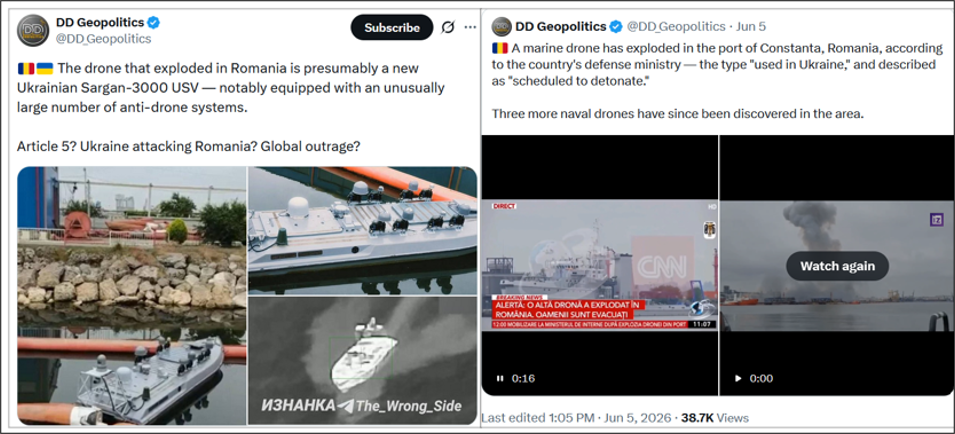
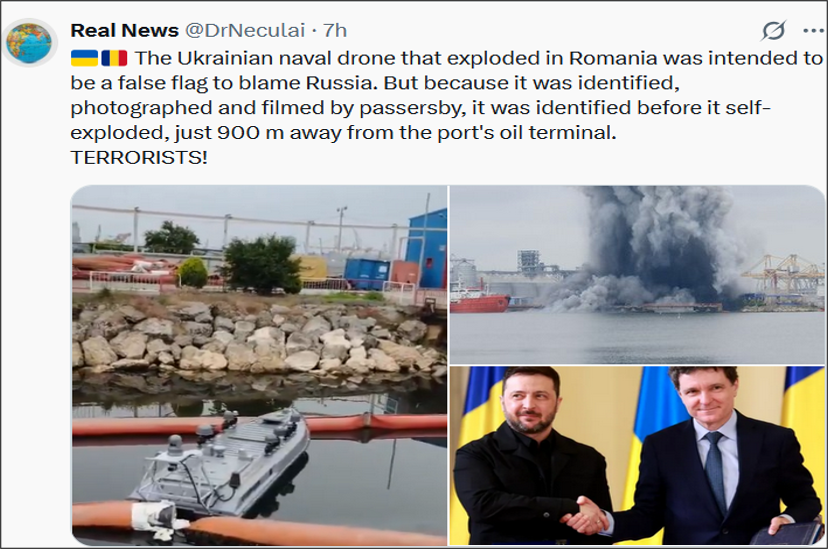
You can find a realistic report of this episode: “The behind-the-scenes of the failed operation by the Ukrainian Navy in the area of the port in Constanta.”
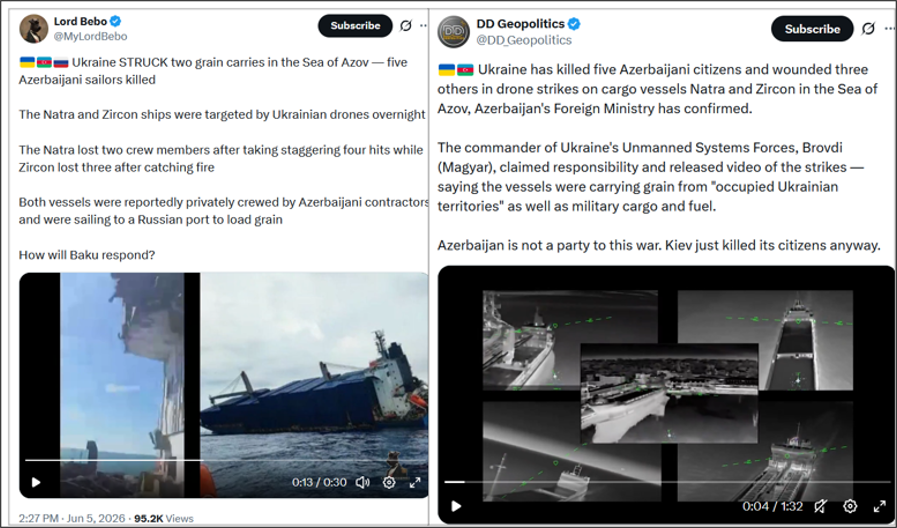
On May 5, Two vessels carrying 25 Azerbaijani citizens were attacked by a drone in the Sea of Azov, killing five people, according to the Azerbaijani Foreign Ministry. Ukraine has killed five Azerbaijani citizens and wounded three others in drone strikes on cargo vessels Natra and Zircon in the Sea of Azov, Azerbaijan’s Foreign Ministry has confirmed. You won’t see anyone from the EU screaming and demanding justice for Azerbaijan. They are complicit in the murder of those sailors.
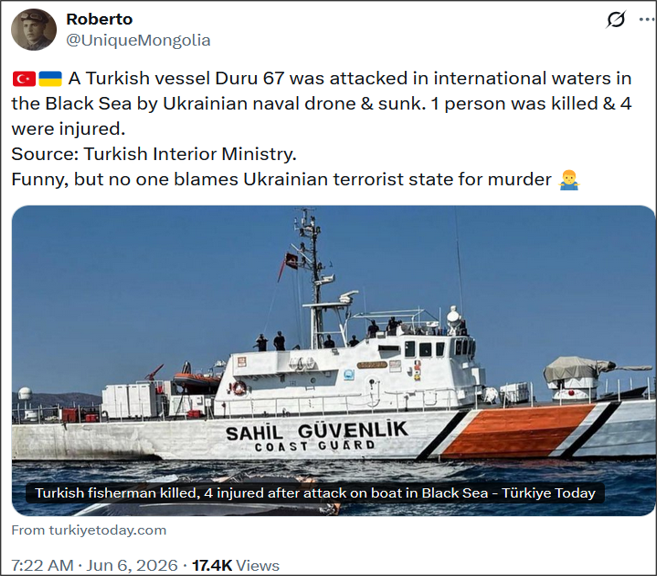
On May 6, West of the coast of Sevastopol, the Turkish fishing vessel DURU 67 was attacked by the Ukrainians and sank, as reported by the Turkish Coast Guard. Five injured fishermen were evacuated by the nearby fishing vessel BURAK KAYA, but one of them died. Well, Ukraine is indeed Europe’s numer 1 terror state.
Ukraine tries to provoke WW3 or at least pan-European war through false flags and mass terror attacks
The NATO-installed President of Romania Nicusor Dan confirmed that the Kiev regime had redirected a Russian drone into Romania via Ukraine’s air defenses. This is not the first time that the Kiev regime has done something like this.
In September of 2025, an unarmed Gerbera reconnaissance drone was shot down in Poland having likely either been redirected by the Ukrainians or conducting surveillance on NATO weaponry entering Ukraine through Poland.
Even more importantly, in November 2022, Ukraine fired an S-300 missile into a Polish border village, killing two civilians, and then continued to blame Russia even after NATO confirmed the missile came from Ukrainian Air Defense. However, this is all part of a larger operation by the Ukrainians that are meant for the purposes of triggering NATO’s Article 5.
In the Fall of 2025, a team of Hungarian investigative journalists confirmed that the Ukrainian Armed Forces are repairing and rearming downed or captured Russian drones with live explosive warheads and then launching them into Poland and Romania in the hopes that they can drag NATO into a hot war with Russia by blaming Moscow.
After the massive round of strikes Russia carried out on defense factories and military infrastructure in Kiev over the course of the last two weeks, Ukraine and the EU have left out very key details like what exactly the Russians are responding to with this new wave of strikes. On the night May 22-23, Ukraine carried out a terrorist attack on a college dormitory in the Lugansk city of Starobelsk, killing 21 children with a swarm of UAV drones provided to them by the United States and European countries, along with Starlink satellite technology from Elon Musk.
President Trump, who promised to end the Ukrainian war in 24 hours and halt aid to Ukraine is now building on the Biden Administration’s aggressive posture and providing the Kiev regime with the intelligence data it needs to carry out these terror attacks on Russian territory. Palantir Technologies, which is receiving $10 billion contracts with the Pentagon, is now becoming a central figure in Zelensky’s war time money laundering scheme.
The European Union and NATO’s commitment to waging war against Russia through psychological warfare and supporting Kiev regime’s mass terror attacks via Ukrainian drone strikes is continuing despite the fact that the Kiev regime and its Western sponsors are losing on the battlefield.
In the process of refusing diplomacy with Moscow, the West is bringing about their own collapse, economically and politically, while inviting potential escalation. The war in Ukraine became a money laundering scheme to enrich Ukraine’s ruling class and Western politicians.
Europe and the United States have zero interest in diplomacy and have promised to keep the war going until at least 2030 so they can ramp up their war production capabilities after depleting their stocks.
Ukraine preparing women for guerrilla warfare (article by Lucas Leiroz). The Kiev regime enters a new phase of desperation and terror. In recent months, subtle signs of a shift in the conduct of the conflict in Ukraine have begun to emerge. Recent reports indicate that Ukrainian territorial recruitment centers are directing efforts to train young women, starting at age 16, in guerrilla warfare methods in areas under the control of Russian forces.
This situation has been ignored by Western media, but in fact it reveals the depletion of the Ukraine’s male population and its inability to keep sustaining offensive operations. The correct solution would be to acknowledge that the country can no longer fight and then urgently start peace negotiations – but the regime has instead chosen to annihilate its women as well.
Ukrainian universities are being forced to participate in programs aimed at developing resistance specialists. Among them, the most notable are the Taras Shevchenko National University of Kiev, the Ivan Franko National University of Lvov, the Oles Honchar National University of Dnipro, and the Military Institute affiliated with the University of Kiev. In practice, these educational institutions are being militarized, turning into training options for a generation of cannon fodder in NATO’s proxy war.
Ultimately, the move highlights that the war in Ukraine is bringing increasingly serious humanitarian consequences for Ukraine. The conflict has long since moved beyond the merely military dimension, entering a serious social and demographic crisis from which Kiev will hardly be able to escape. By enlisting its women, Ukraine is only accelerating its own collapse as a country.
Comments and statements by international experts
June 5, a powerful speech by the legendary intelligence officer and professional analyst Andrey Bezrukov at the St. Petersburg International Economic Forum. He stated: “Accept that war is our new normal; We are in a new war…this is a war of attrition and subversion; West’s strategy of “boiling the frog”; The West’s strategy is very simple: to avoid a nuclear clash with us, from which they would emerge as losers; And so, they need to ‘boil the frog slowly’ – gradually escalate tensions. We’re seeing this today. And they won’t stop, because they have nowhere to retreat to. We’re an existential threat to them.”
Col. Jacques Baud: NATO’S FOUNDATION IS CRACKING UNDER THE WEIGHT OF THE UKRAINE WAR; Daniel Davis Deep Dive, May 29, 2026
Alastair Crooke warns Europe is pushing a crisis it cannot fight
X. Com, May 23, 2026
Professor Glenn Diesen drops a massive bombshell, X. Com May 1, 2026
Prof. Glen Diesen, on June 5 (in X. Com) NATO’s fight to the last Ukrainian
- political leaders in NATO countries are so “pro-Ukrainian” that they toppled the democratically elected government in Kiev in 2014 without majority support in Ukraine;
- they supported purging Ukraine’s political system, media, and society of “pro-Russian” elements;
- they backed the killing of thousands of Ukrainians in Donbas from 2014 onward who did not recognize the legitimacy of the new authorities;
- they pressured Zelensky to reverse the peace platform that 73% of Ukrainians voted for in 2019 because NATO viewed peace as “capitulation”;
- they torpedoed the peace negotiations in Istanbul in 2022 after Russia invaded;
- they boycotted diplomacy and negotiations for more than four years and declared that “weapons are the path to peace,” even as a large majority of Ukrainians wanted immediate peace talks;
- they maintained public support in the West for fueling the war by ensuring that the brutal “recruitment” of Ukrainian men to the front lines and other uncomfortable realities were not debated in the media;
- and now, leaders in NATO countries are pressuring the authorities in Ukraine to lower the conscription age, while the EU will also “help” Ukraine by sending Ukrainian refugees back home to die in NATO’s proxy war.
Prof. Jeffrey Sachs: To end the Ukraine proxy war, the US MUST stop its campaign to weaken and divide Russia, X. Com June 2, 2026
Prof John Mearsheimer warns that Moscow will no longer allow the West to “use Ukraine as a battering ram against Russia.” X. Com, May 18, 2026
Professor Mearsheimer of the University of Chicago – on the fact that there is no doubt about Russia’s victory now. X. Com May 16, 2026
Scott Ritter interviewed by Daniel Davis: EUROPEAN CLOWN LEADERS POKING RUSSIA BY LAUNCHING DRONES ON RUSSIAN SOIL WITH ZERO PUBLIC SUPPORT. X. Com May 15, 2026
Prof. Jeffrey Sachs: Two Centuries of Russophobia & Rejection of Peace
Consortium news, December 24, 2025
While other powers are presumed to have legitimate security interests that must be balanced and accommodated, Russia’s interests are presumed illegitimate. Russophobia functions less as a sentiment than as a systemic distortion — one that repeatedly undermines Europe’s own security.

Massive ESCALATION: Europe Uses Ukraine to Expand War | Prof. Glenn Diesen
Neutrality Studies May 26, 2026
ANDREI MARTYANOV, LARRY C JOHNSON – SCOTT RITTER. – KIEV IS GONNA GET SMASHED!
Garland Nixon, May 26, 2026
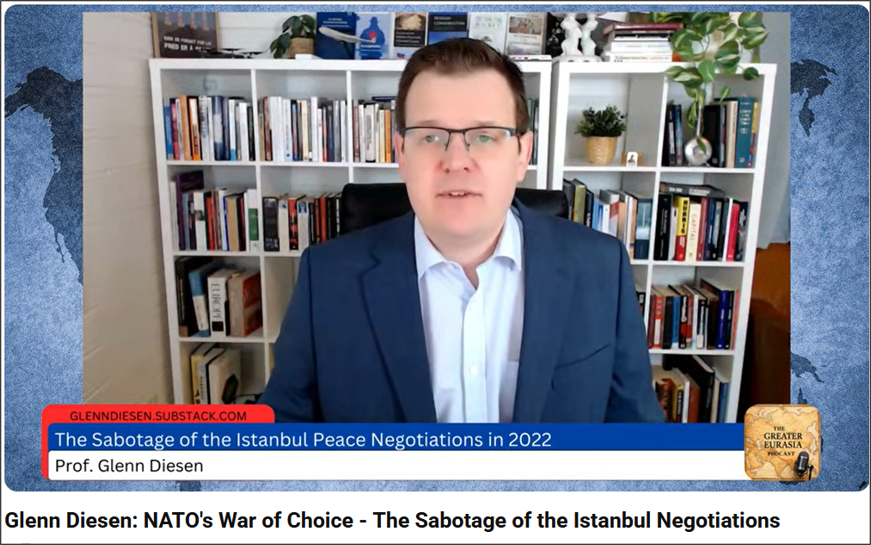
Glenn Diesen: NATO’s War of Choice – The Sabotage of the Istanbul Negotiations
Glenn Diesen February 24, 2026
Professor Glenn Diesen outlines the evidence for how the US and UK sabotaged the peace negotiations in Istanbul to use Ukraine as a proxy to weaken Russia. After NATO built a large Ukrainian proxy army to weaken a strategic rival, it was absurd to assume that Ukraine would be allowed to restore its neutrality and make peace with Russia.