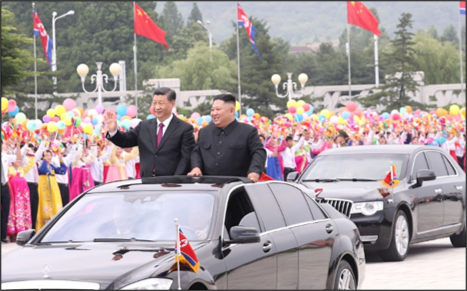


Two state visits . . . but so very different
In two weeks, the world has been eye-witnessing two important state visits, of course very different, but few people know that a third significant meeting will take place within a few days.
President Xi Jinping will visit Pyongyang, North Korea meeting President Kim Jong Un and highly likely will finalize the details of the new world order. No doubt, the recent events worldwide have strengthened China’s and Xi’s positions at the top of international hierarchy.
Equally clear is the decline of the US and its Western alliance as well as the strengthening of “East Camp” as well as the growing importance of the BRICS and SCO countries in general.
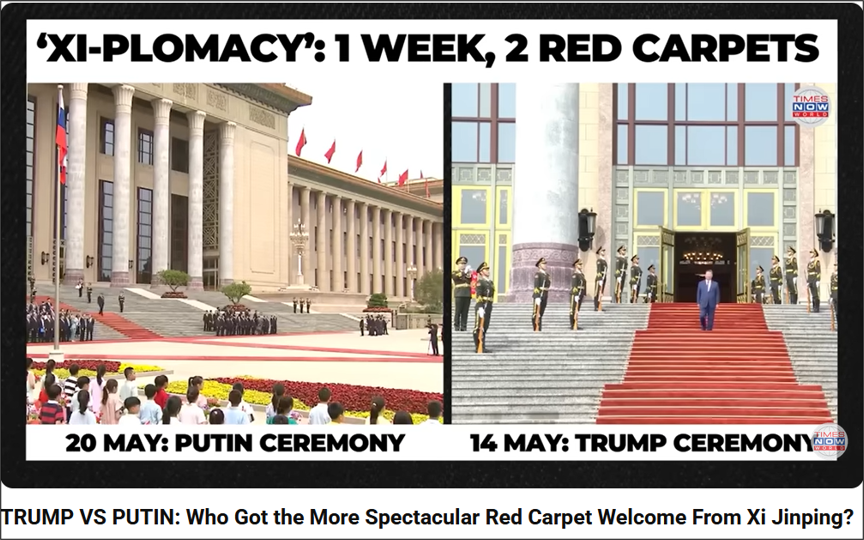
TRUMP VS PUTIN: Who Got the More Spectacular Red Carpet Welcome From Xi Jinping?
Times Now World, May 20, 2026
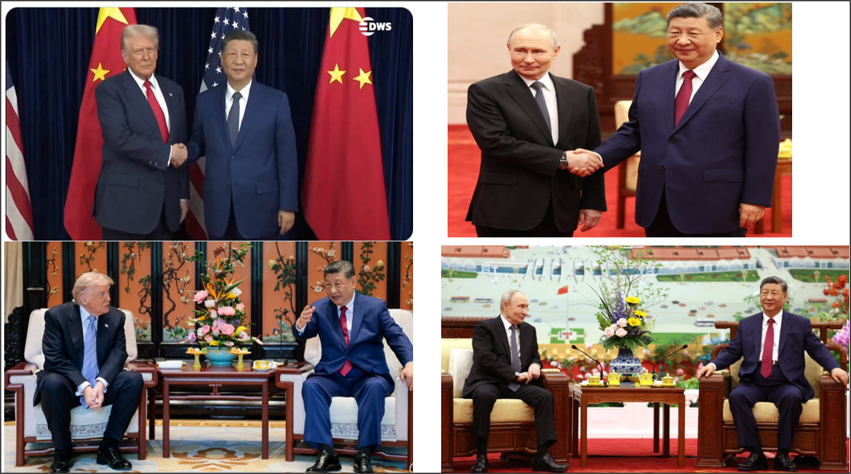
In these state visits, starting from the welcoming ceremonies, the atmosphere was very different from the beginning.
State visit: Donald Trump – Xi Jinping
Preliminary setup for the summit
Trump’s visit took place in tense atmosphere: trade “wars”, sanctions, Iran crisis etc. Just before the state visit, China made it very clear that “Chinese refineries keep buying discounted Iranian oil. China is now officially using its 2021 anti-foreign sanctions law – refusing to comply with US sanctions. Just a week ago, Trump sanctioned on China over these purchases … but now China declares, they do not care about American sanctions.
There have been little preparations for the trip. There are no big contracts or treaties to sign. Trump will want to sell soybeans and Boeing airplanes. They may sign some contracts to give Trump something to boast about. But they will hedge their deals as the US is known to be an unreliable partner.
Before Trump stepped off his Presidential jet in Beijing the Chinese were sending subtle but clear signals that they consider Trump a second-class leader and that relations remain frosty.
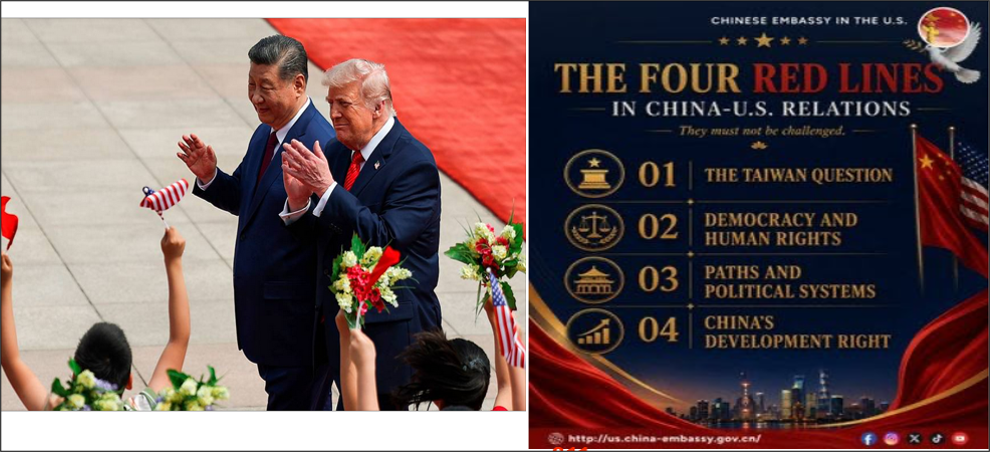
The China Daily newspaper downplayed the upcoming meeting between Xi and Trump, the meeting with Trump was buried in a story in the sidebar. Te CCTV and XINHUA websites — as of 12 May 2026 — said nothing about the upcoming meeting with Trump. Before Trump’s arrival, the Chinese Embassy in Washington published a list of four “red lines” that “Washington should not question”: The Taiwan issue; Democracy and human rights in China; The political system; Beijing’s rights to development. The Chinese message to Trump: China will not accept any criticism from Trump or his delegation on these issues. Raising any of these will be viewed as an insult to China.
Preconditions
President Donald Trump larger plan had been to take Venezuela, Iran and their oil before pressing China, via tariffs and energy restrictions, to concede to US hegemony. That plan has failed. Trump has lost two wars. His tariff schemes ended in retreat after China restricted the export of its rare earth products. His war on Iran has been one big failure. Trump is coming to Beijing with his cap in his hand. He, as usual, will try to bluff a way to “victory”. He will proceed as if the US were in a great position.
Trump will want support for making peace (on US conditions) with Iran. There will be some solemn and wise responses to that. It is in Chinese interest to see the US bogged down in the Middle East. China does not want Iran to lose the war. It will support it, as it already does, wherever needed.
A major point of interest on the Chinese side is Taiwan. Beijing wants to finally end the Chinese civil war and for that Taiwan must rejoin the country. US weapon sales to Taiwan and its political agitation are a hindrance to that. But Taiwan is a big issue in Congress. Some minor verbal commitments on not furthering Taiwan independence may be all Trump can give. To keep Trump happy may well be the sole reason why China has agreed to the meeting.
The schedule and protocol of the summit
May 13, Air Force One lands in Beijing with 12+ named CEOs aboard, the largest corporate delegation ever to accompany a sitting US president touches down in China. May 14 is Day 1 of Summit: Trump and Xi sit down for formal talks; 12+ CEOs have their own talks; May 15, Day 2/ Outcomes: Deal announcements expected — or silence that speaks louder; Every CEO on that plane needs something specific from Beijing. Next 72 hours are very important.
When arriving in China, Trump was greeted by US Ambassador to China David Perdue, Xi’s vice president Han Zheng, China’s Ambassador to Washington Xie Feng and Executive Vice Minister of Foreign Affairs Ma Zhaoxu.
On May 14, Trump arrived at the Great Hall of the People in Beijing shortly after 10 a.m. local time to a full ceremonial welcome — national anthems, military honor guard and children waving flowers. The two leaders shook hands, walked the red carpet together, then entered the hall to begin bilateral talk.
Xi opened with a call for partnership over rivalry: “China and the United States both stand to gain from cooperation and lose from confrontation. We should be partners, not rivals — and find the right way for major countries to get along in the new era”. He framed the summit as a potential “historic landmark year” for bilateral relations. Trump responded with personal warmth, telling Xi it was an honor to be with him and pledging that US-China relations would be better than ever before.
The formal agenda covers trade and tech, with a possible extension of the existing trade truce, plus Taiwan and the Iran war — the most sensitive pressure points. Trump is expected to push Xi to use China’s leverage over Tehran to help reopen the Strait of Hormuz and end the conflict. Over a dozen top US business leaders attended the expanded bilateral session.
The talks lasted around two hours, longer than expected. Trump called the talks “great” but there are few details on whether any progress was made on key issues. The trip was originally meant to be held in March but rescheduled after the US and Israel launched attacks on Iran.
The main focus of the talks was on the current tense trade relationship between the two powers. Trump asked Xi to “open up” China’s economy to major tech companies. He added that he also expected a “long talk” about Iran, though he insisted he did not need China’s help to end the conflict.
Xi meanwhile stated that the US arms sales end to Taiwan, and an extension of the trade truce agreed in October that halted tariff escalation between the US and China. Commentary in Chinese media also suggested Beijing was looking for a “better future” with the US, and a relationship that would “add more stability and certainty” to a turbulent world.
At the bilateral meeting, Xi told Trump that Taiwan was the most important issue in their relationship and warned that if it was not handled properly, there would be “clashes and even conflicts, putting the entire relationship in great jeopardy”, according to state media. He also raised the issue of “Taiwan independence”, warning that the US must “exercise extra caution” when it comes to the self-governed island. China claims self-governed Taiwan as a historical part of its territory – but the island sees itself as distinct. Xi has already warned Trump during their talks that the issue of Taiwan could bring the two countries into conflict, according to Chinese state media. When reporters asked the two leaders at the Temple of Heaven if they had discussed Taiwan, neither responded to the question.
Xi Jinping, in his initial public remarks at the first meeting of the respective delegations said the following:
- The basis of relations between China and the USA should be based on mutual benefit.
- Confrontation will lead to mutual damage – it is necessary to be partners, not rivals.
- China and the USA should overcome the “Thucydides’s Trap” and build a new paradigm of relations.
In his opening remarks to Trump at the bilateral meeting, Xi mentioned the Thucydides Trap. It’s a political term popularized by American scholar Graham Allison that has been used to describe the US-China relationship. Referencing the ancient Greek historian Thucydides, who wrote about the war between Athens and Sparta, the term describes a situation where an established country becomes anxious about the rise of a developing power, leading to rivalry and eventually conflict. In recent years the Chinese government has latched onto this analogy, with Xi himself invoking it when urging for co-operation with the US.
The Iran war was a major topic at the meetings, which ended without any substantive agreements on key issues announced. The conflict loomed large, with Trump saying he and Xi agreed Tehran should not have a nuclear weapon. Meanwhile, as Trump flew back to DC, talks hosted by the State Department secured a 45-day extension to the ceasefire between Israel and Lebanon that was due to expire on Sunday.
China will surely feel it has the upper hand in these talks as Xi faces a Trump weakened by the war on Iran. The blocked Strait of Hormuz has rattled the global economy and Trump is seeking Beijing’s help to open up the shipping corridor.
Beijing and Tehran have a relationship dating back decades and China is Iran’s biggest trading partner. If Xi helps nudge Tehran towards the negotiating table, it may give him even more leverage.
Beijing put on a spectacle designed to flatter Trump ahead of any deal to prove China’s door is open to guests. However, soon after talks began, state media published comments from Xi making clear that tensions over Taiwan could prove challenging.
But the meticulous choreography was not just for the benefit of Trump and the 30 CEOs who accompanied him. It was also a show of strength which Beijing possesses. President Xi has been eager to portray himself as a stable global leader in contrast to a mercurial US president. Given the size of China’s economy, several world leaders, including those from US allies such as Canada, the UK and Germany, have turned up, eager to do a deal with Beijing.
The visit was defined by warm rhetoric and symbolism. Trump was wooed with a packed itinerary that included an honour guard, a state banquet, and an invitation to the exclusive compound where China’s Communist Party leaders live and work. But neither side has announced trade breakthroughs or significant business deals. Trump came for leverage but Beijing gave him hospitality.
Taiwan issue
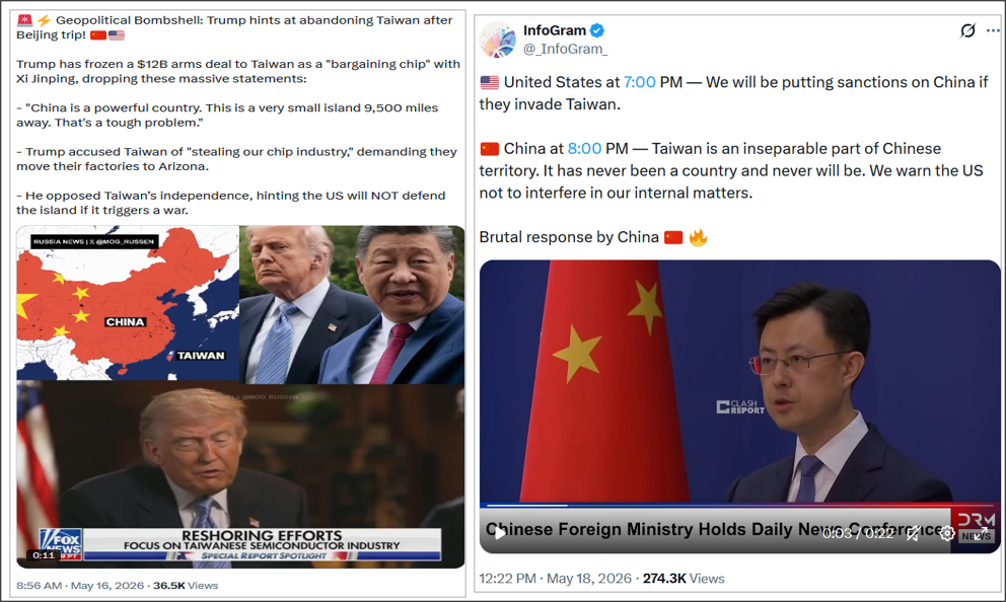
Many political commentators and analysts, particularly in the US, have stated that “Trump clearly sold-out Taiwan”.
When asked on Air Force One on the way back from China whether the US would defend Taiwan in the event of a Chinese invasion, Trump replied: “I don’t want to say. That question was asked to me today by President Xi. I said, ‘I don’t talk about it.’” Trump also said, “On Taiwan, President Xi feels very strongly about it.” It’s clear China got the green light to move ahead, especially now that the US is bogged down in the Iran war.
Fox News: “Trump officially throws Taiwan under the bus.He explicitly admits withholding a $12 billlion weapons package, using their survival as a mere negotiating chip. He casually dismisses Taiwan as a “very small island” that is simply too far to defend. President Trump cautioned Taiwan against formally declaring independence from China. “I’m not looking to have somebody go independent,” the US president told Fox News on Friday, at the end of his two-day summit with his Chinese counterpart Xi Jinping in Beijing.
Taiwanese President Lai Ching-te has previously stated that Taiwan does not need to declare formal independence because it already sees itself as a sovereign nation. The US has long supported Taiwan, including being bound by law to provide it with a means of self-defense, but has frequently had to square this alliance with maintaining a diplomatic relationship with China. Trump earlier said he had “made no commitment either way” about the self-governing island – which China claims as part of its territory and has not ruled out taking by force.
Assessing the results and significance of the visit
President Donald Trump has returned after a two-day summit with Chinese leader Xi Jinping. In a Fox interview, Trump said Taiwan was the “most important” issue for Xi during their talks. The US leader said he’d like the situation with the island to “stay the way it is.”
The meetings ended without any substantive agreements announced on any key issues, although Trump said “a lot of different problems” were settled. China’s foreign ministry touted the summit as “historical” and said Xi will visit the US in the fall.
One hope had been to sell some 500 Boeing jets to several Chinese airlines. Returning from the trip Trump has claimed that China would buy 200 airplanes. The Chinese Foreign Ministry declined to confirm that. Boeing’s stock price dropped. Some 20 company bosses had joined Trump on the trip. But there seem to have been no plans or tasks for any of them. No deals were made, no contracts were signed. Trump offered to lift the US blockade on the sales of some older NVIDIA AI chips to China. China declined as it now makes its own chips with similar characteristics.
The Chinese side spoke of a “new positioning” and a “constructive strategic stability” as major outcomes of the talks. The “new positioning” is seeing the US and China as equals with China being objectively in a better position. The “constructive strategic stability” could be interpreted as an advise to the US to shut up and stay quiet while China is doing its business.
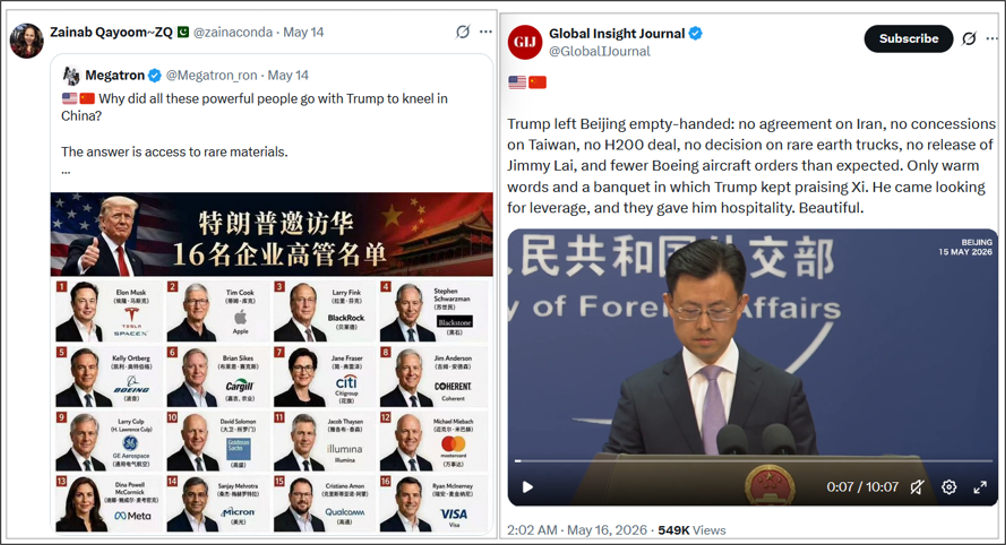
The Beijing circus is over and Donald Trump’s talks with Xi Jinping produced nothing more than some pleasing photo ops and some performative diplomacy with no substantive accomplishments.
There was no final communique at the end of Trump’s two days of meetings with Xi Jinping. Instead, we are left to rely on the statements from each government. When you parse the two statements, the two readouts diverge significantly, and the gaps are as informative as the overlaps.
The divergence between the two readouts is stark and strategically deliberate. Here is a precise accounting of what the White House emphasized that China’s Foreign Ministry either omitted entirely or mentioned only in the vaguest terms:
1. The Iran War and Nuclear Weapons — Omitted by China
This is the most consequential gap. The White House readout stated explicitly: The two sides agreed that the Strait of Hormuz must remain open to support the free flow of energy. President Xi also made clear China’s opposition to the militarization of the Strait and any effort to charge a toll for its use, and he expressed interest in purchasing more American oil to reduce China’s dependence on the Strait in the future. Both countries agreed that Iran can never have a nuclear weapon.” The Chinese readout, by contrast, merely said that “the two sides discussed the Middle East conflict” without offering any further details.
2. Fentanyl — Omitted by China
The White House readout specifically noted that the two sides discussed “addressing fentanyl precursor flows into the United States” — a longstanding US demand that China reduce the flow of chemical precursors used to manufacture fentanyl. The Chinese readout made no mention of fentanyl whatsoever, which is consistent with Beijing’s longstanding position that it has already done enough on the issue and resists framing it as a bilateral problem.
3. Agricultural Purchases — Omitted by China
The White House noted that the two presidents discussed “increasing Chinese purchases of U.S. agricultural products.” China’s readout spoke only in general terms about trade being “mutually beneficial” and made no specific commitment to agricultural purchases.
4. Market Access for US Businesses — Framed Very Differently
The White House described the meeting as centered on “expanding market access for American businesses into China and increasing Chinese investment into US industries.” China’s readout framed this entirely differently — as China “opening its door wider” on its own terms, not as a response to US demands for market access.
5. The Business Delegation — Treated Asymmetrically
The White House noted that “leaders from many of the United States’ largest companies joined a portion of the meeting,” treating it as a substantive commercial engagement. The Chinese readout mentioned that Trump “asked each of the business leaders who were traveling with him to present themselves to President Xi” — framing it as a courtesy introduction rather than a substantive business discussion.
6. Taiwan — The Mirror Image Problem
The most telling asymmetry runs in the opposite direction on Taiwan. The White House readout did not mention Taiwan at all, while China centered its entire readout on Xi’s Taiwan warning. Trump declined to answer a reporter’s question about whether he and Xi had even discussed Taiwan. Rubio told NBC News that the US was “not asking for China’s help with Iran” — a comment that implicitly pushes back on what the White House readout seemed to suggest about Chinese cooperation.
The Bottom Line
Both sides released statements detailing what Trump and Xi discussed, but they only overlap in limited areas. The statements diverge most sharply on Iran — where the US claims specific Chinese commitments that China refused to acknowledge — and on Taiwan, where China made explicit warnings that the US declined to even mention.
The pattern is diplomatically classic: each side published the readout that serves its domestic political needs and advances its negotiating position. China wanted the world to see Xi issuing stern warnings on Taiwan. Washington wanted the world to see China agreeing that Iran can never have a nuclear weapon and opposing Iran’s toll regime.
The reporting and analysis of the New York Times, the Washington Post and Politico regarding President Donald Trump’s trip to China. All three publications converged on the same bottom line, differing mainly in tone and emphasis: China achieved its primary objectives — equal-footing recognition, Taiwan ambiguity, no structural economic concessions, and a friendly summit aesthetic — while the US achieved pageantry, claimed unverifiable Chinese commitments on Iran and nuclear weapons, and left without any of the concrete breakthroughs the White House had sought. As one analyst quoted across multiple outlets summarized: “The summit is unlikely to alter the character and course of the US-China relationship long-term.
State visit: Vladimir Putin – Xi Jinping
Putin to visit Beijing five days after Trump leaves. This is not a coincidence. This is geopolitics in real time. Russia needs to know exactly what Xi and Trump discussed. Any shift in China’s position on trade, technology, sanctions, or Ukraine directly impacts Moscow’s strategic calculus.
Meanwhile, Beijing is doing something extraordinary – it is hosting the leaders of both Washington and Moscow within days of each other – not at a multilateral summit, but in Beijing, on Xi’s terms. That is the real story. This is not China being pulled between two powers.
This is China demonstrating that it has become the indispensable center of the emerging multipolar world. The West still does not understand what it is watching.
Relations between Moscow and Beijing have reached an unprecedented level, reflected, among other things, in the readiness of the two countries to support each other on key issues, including the protection of sovereignty, Russian President Vladimir Putin said in a video address ahead of his visit to China.
Trade turnover between Russia and China continues to grow and has already exceeded $200 bln. “Trade between Russia and China continues to grow, having long surpassed the US$200 billion mark,” Putin said. Russia and China have almost completely switched to national currencies in mutual settlements. “Mutual settlements are now conducted almost entirely in rubles and yuan,” the Russian leader noted.
The schedule and protocol of the summit
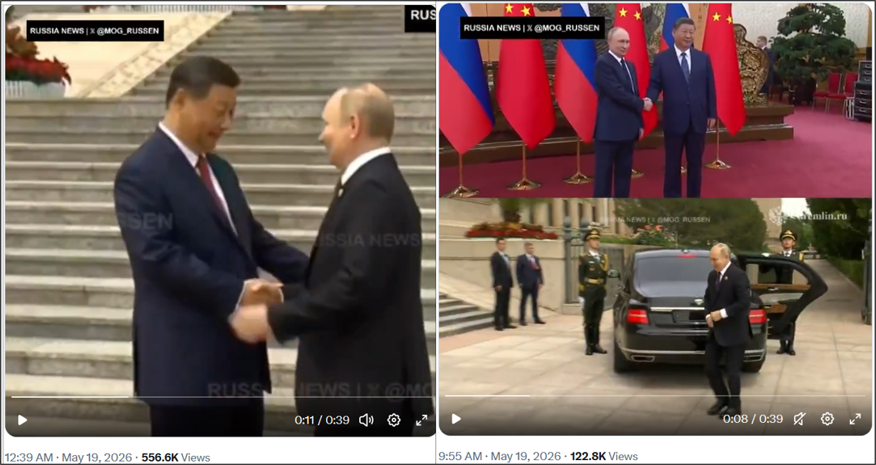
Russian President Vladimir Putin arrives in Beijing on the evening of May 19 and is met by Chinese Foreign Minister Wang Yi. After this, Putin will travel to the Diaoyutai State Guesthouse for Distinguished Guests. In the morning of May 20th, at 11:00 a.m. local time, the visit will begin with a welcoming ceremony at Beijing’s central Tiananmen Square.
The Russian delegation “will be very representative (39 participants)”: it will include five deputy prime ministers – Denis Manturov, Tatiana Golikova, Alexander Novak, Yury Trutnev, and Dmitry Chernyshenko. The delegation will also include eight ministers: Foreign Minister Sergey Lavrov, Agriculture Minister Oksana Lut, Culture Minister Olga Lyubimova, Transport Minister Andrey Nikitin, Economic Development Minister Maxim Reshetnikov, Finance Minister Anton Siluanov, Construction Minister Irek Faizullin, and Education Minister Valery Falkov. The presidential administration will be represented by Ushakov, deputy head Maxim Oreshkin, and presidential press secretary Dmitry Peskov. In addition, Central Bank governor Elvira Nabiullina, heads of a number of Russian regions, CEOs of state corporations and Russia’s largest, as well as top executives of Russia’s largest companies will accompany the Russian leader.
Putin and Xi will discuss the most sensitive aspects of bilateral relations during Russia-China negotiations that will involve a meeting between the two leaders and talks with a large group of representatives.
The leaders will discuss the issue of hydrocarbon cooperation in detail, including the Power of Siberia-2 gas pipeline between the leaders with the participation of direct representatives who are involved in all of these projects. Putin and Xi sign over 40 documents on energy, trade, and security. China is already Russia’s largest oil and gas buyer. These deals deepen that interdependence and lock in the economic architecture of the anti-Western bloc.
President Vladimir Putin and President Xi Jinping will adopt a Declaration on the Emergence of a Multipolar World and a New Type of International Relations. This means the formal announcement that the US-led order is being replaced by the new order, which is signed by both partners.
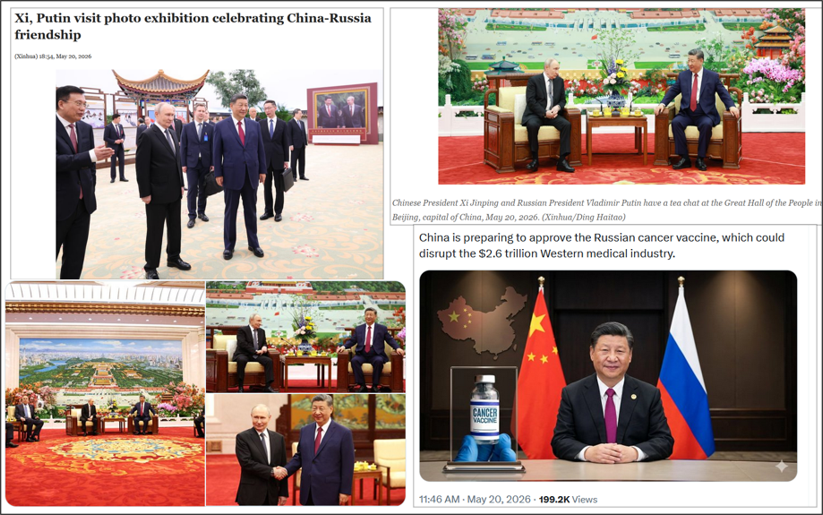
Putin and Xi will attend the opening ceremony of Cross Years of Education. Putin will also meet with Chinese State Council Premier Li Qiang “to discuss trade and economic cooperation.” Putin and Xi will visit a photo exhibition on the history of Russian Chinese relations organized in Beijing by TASS and Xinhua.
Putin’s visit to China will conclude with an informal tea talk with Xi to discuss major issues confidentially, behind closed doors, in a friendly and sincere manner. All the issues will be discussed during that meeting over tea after official dinner.
Key Takeaways – Strategic partnership deepens
More than 40 monumental documents and strategic agreements were signed between President Putin and Chinese President Xi: Space, medicine, AI, energy, economy, agriculture, military tech, production and manufacturing, education, intellectual property and tourism. Both countries continue to deepen ties.
Russia and China deepen economic alliance despite Western pressure Moscow and Beijing are rapidly expanding a strategic economic partnership built around trade, energy, finance, infrastructure, and technology. Bilateral trade has surged past $240 billion, most transactions are now conducted in rubles and yuan instead of dollars, and Beijing has become the largest buyer of Russian energy exports. Russia and China are jointly developing the Transarctic transport corridor, with the Northern Sea Route as its basis — a direct challenge by Moscow to the Suez Canal as the main link between Europe and Asia. In nuclear energy, Russian-designed reactors are being completed at the Xudabao power station in China. Russia and China are also accelerating joint infrastructure, manufacturing, and investment projects while coordinating more closely through BRICS, the SCO, and the UN: positioning their partnership as the foundation of a more “multipolar” global order designed to reduce dependence on Western systems and sanctions.
Energy cooperation advances but no major pipeline deal
Russia began designing the pipeline in September 2020. Major gas pipeline would stretch across Russia and Mongolia. The total length of the route could reach approximately 6,700 kilometers, including around 2,700 kilometers inside Russian territory. The pipeline would carry up to 50 billion cubic meters of gas annually. No final agreement was reached on the Power of Siberia 2 pipeline, though both sides reported a “basic understanding” on route planning and broader cooperation. Russia continues pivoting energy exports towards Asia, while China prioritizes long-term energy security.
Transarctic transport corridor
The Northern Sea Route (NSR) is slashing Asia-Europe shipping times by nearly 50% — cutting transit from 40 days via Suez to just 20 days. For India, it’s massive cost savings and energy security, 30-40% lower fuel consumption. Chennai–Vladivostok Eastern Maritime Corridor is now operational: reaches Russia in just 12 days. Joint investments in Arctic projects, ice-class vessels & shipbuilding creating new business & employment opportunities.
The Years of Russia-China Cooperation in Education now officially opened. Russian is taught at 200+ universities across China, with over 66,000 Chinese students taking language courses in Russia. Over 100,000 Russians study Chinese, including 20,000 in education courses in China.
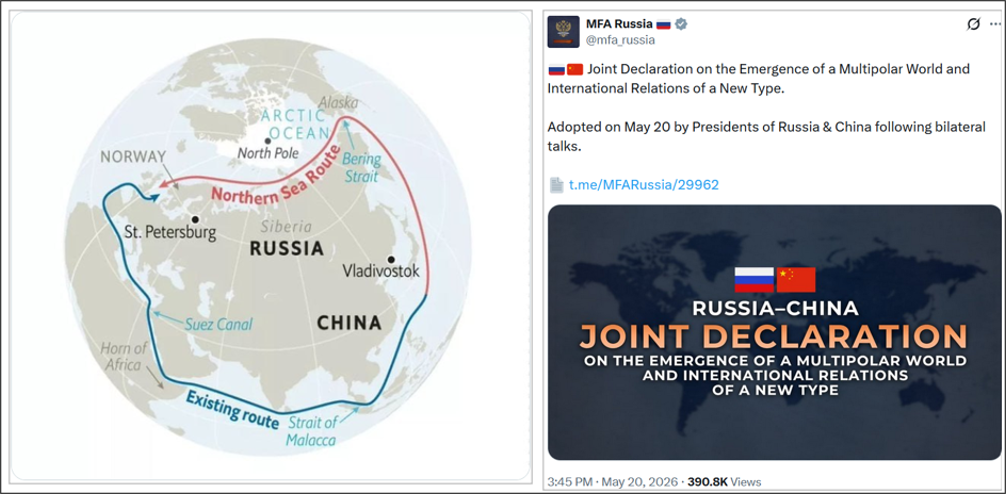
President Xi Jinping and President Vladimir Putin had a tea chat for confidential and sensitive political talks on May 20 night at the Great Hall of the People in Beijing. Both leaders noted that this year marks the 30th anniversary of the China-Russia strategic partnership of coordination and the 25th anniversary of the signing of the Treaty of Good-Neighborliness and Friendly Cooperation between China and Russia. Following the talks, Vladimir Putin and Xi Jinping signed a Joint Statement on Further Strengthening Comprehensive Partnership and Strategic Cooperation and Deepening Relations of Good-Neighbourliness, Friendship and Cooperation. The parties approved a Joint Declaration on the Formation of a Multipolar World and a New Type of International Relations.
Geopolitical alignment
Talks covered Ukraine, the Middle East and global governance. China urged de-escalation and negotiations, Russia praised China’s “objective and unbiased” position. Both leaders framed their partnership as a stabilizing global force and emphasized coordination through the United Nations, Shanghai Cooperation Organization and BRICS. Since December, China has hosted state visits from all the other permanent members of the UN Security Council, including France and Britain.
Beijing – Moscow, senior vs. junior partner
Russia and China are moving, slowly but unmistakably, toward a structural alliance that is reshaping the global balance of power but the two sides are progressing through this transformation at different speeds. Moscow has largely accepted the logic of deep strategic interdependence. Partly, Beijing still behaves as though it can preserve a carefully managed partnership in which China remains the senior partner while minimizing its own obligations. This model is reaching its limits.
For years, the dominant narrative in Western policy circles has been that Russia has become the junior partner in an unequal relationship. Brussels think tanks, Washington analysts and even some Chinese commentators have repeated the same formula: Russia supplies raw materials and China supplies everything else.
Yet, many Chinese scholars today acknowledge that the relationship is being driven less by hierarchy than by geopolitical pressure. External circumstances, rather than relative status, have always been the true engine of the partnership. NATO expansion pushed Moscow and Beijing closer together while US tariffs accelerated the process further. Sanctions pressure on Russia gave China discounted resources and gave Russia guaranteed markets as each side increasingly possessed what the other lacked. The numbers of trade tell the story clearly enough: energy, metals and manufacturing, technology and science trade, agriculture, new trade routes.
Washington’s strategy has been straightforward: isolate Russia financially while frightening China into limiting cooperation through the threat of secondary sanctions. By late 2023 and early 2024, major Chinese financial institutions including Bank of China and CITIC had sharply reduced direct transactions with Russian entities after new US restrictions were announced. The pressure had some effect.
But the strategy contained a fundamental weakness. Secondary sanctions work only when alternatives exist and once instability threatened key global energy routes, particularly the Strait of Hormuz, Russia’s role changed dramatically. In those circumstances, Russian pipelines stopped being merely commercial infrastructure and became a strategic necessity. Ironically, Washington’s simultaneous pressure on both Moscow and Beijing did more to deepen their cooperation than any summit declaration ever could.
As several Chinese analysts have noted, Russia and China may each be vulnerable separately, but together they possess the capacity to counterbalance American power. Publicly, both sides speak of a “partnership without limits.” In practice, the relationship has often been slowed by caution and endless technical complications.
During Putin’s visit to Beijing in September 2025, the two countries signed more than twenty agreements covering energy, aerospace, artificial intelligence, agriculture and industrial technology. Yet many of these projects remain only partially implemented as Chinese businesses continue to calculate the costs of sanctions exposure carefully. The problem, however, is caution, not hostility, this has limits when geography and geopolitics are pushing both countries together.
In 2025, both sides realized a slowing phase was going. This was the moment both sides stopped romanticizing the partnership and began viewing it more realistically and realism points toward one unavoidable conclusion.
Russia and China share more than 4,200 kilometers of border. One side possesses enormous energy reserves, agricultural resources, metals, territory and pipeline infrastructure largely immune from naval disruption. The other possesses industrial scale, capital, technology and a market of 1.4 billion people. Neither can fully achieve its strategic ambitions alone.
When Xi Jinping visited Moscow for Victory Day commemorations in 2025, the two countries signed a joint declaration that went beyond symbolism. The document emphasized expanded settlements in national currencies, deeper investment cooperation and the joint development of the Northern Sea Route and this matters enormously.
The Arctic corridor offers China a long-term alternative to vulnerable maritime routes such as Suez and Hormuz. In a world where each of those chokepoints faces growing instability, the Northern Sea Route is becoming strategic infrastructure rather than an experimental trade project.
Chinese analysts increasingly recognize this reality. Academic discussions inside China now openly acknowledge that rivalry with the United States makes close partnership with Russia less a matter of preference than necessity.
Even many Western observers are beginning to admit the same thing. This is because the partnership is no longer built merely on diplomatic convenience or temporary economic gains. It is driven by structural forces: geography, energy security, trade routes, sanctions pressure and the emergence of a more fragmented global order. Russia and China are joining together because the strategic logic is becoming overwhelming.
That third state visit
China’s President Xi Jinping appears to be preparing a state visit to Pyongyang in the coming weeks. The trip will be his first overseas journey of 2026, following in close succession to summits in Beijing with Donald Trump on 14–15 May and Vladimir Putin on 20 May. The visit could materialize in early June.
It seems that the Chinese message is clear: “Trump visited as a supplicant asking for help with Iran. Xi responded by hosting Russia and now visiting North Korea.” Highly likely, the guidelines and procedures between the key players of the East Camp (China, Russia, Iran, North Korea & allies) versus West Camp (the US, EU, NATO, UK, Japan South Korea & allies) will be finalized for the global, hegemonic competition, in next two years.