


Trilateral meeting on the sidelines of APEC Summit
Initial setup for the meeting
US Secretary of State Marco Rubio and Chinese Foreign Minister Wang Yi agreed during a phone call on the importance of holding potential high-level talks with Russia to address peace and nuclear arms reduction, November 12. Donald Trump, Vladimir Putin and Xi Jinping are planning to meet on the sidelines of a summit in China next week. Rubio and Wang discussed the APEC summit, scheduled to take place in Shenzhen, China, on November 18-19, as well as the G20 summit, scheduled for December 14-15 in Miami. They also discussed “bilateral leader-level commitment to a constructive relationship of strategic stability on the basis of respect, fairness, and reciprocity. Moscow earlier confirmed Putin’s participation. No agreement was expected to follow the talks, senior US official said.
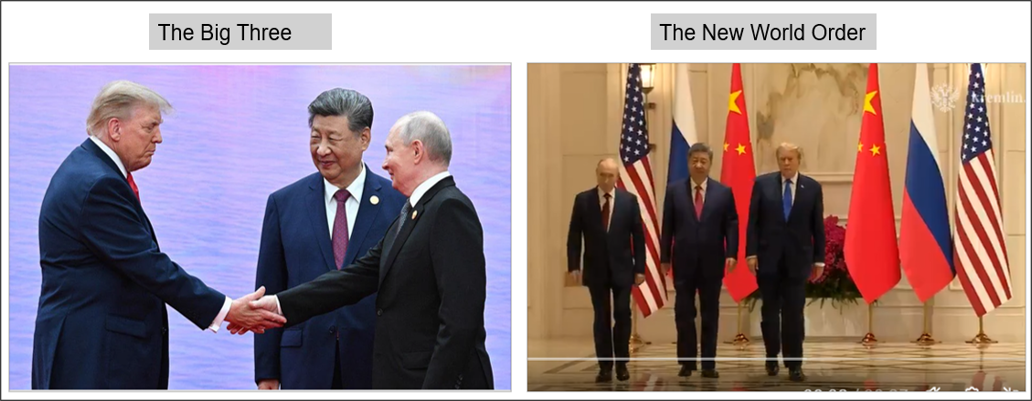
While a trilateral convention taking this exact formation is unprecedented, separately the leaders have a wealth of history. Since becoming president in 2013, Xi has met with Putin dozens of times. The pair have built a close alliance, bound by ties that run deep between their nations. Trump and Putin have convened in-person on seven different occasions, most recently in Alaska in 2025. The two leaders’ relationship has, at times, been tumultuous, but it appears to have strengthened in recent months.
China opposed the inclusion of the Ukrainian conflict in the agenda of the upcoming trilateral meeting. Beijing believes that this issue should be resolved directly between Moscow and Washington, a similar position is held by the Trump administration and the US president will not raise the Ukrainian topic.
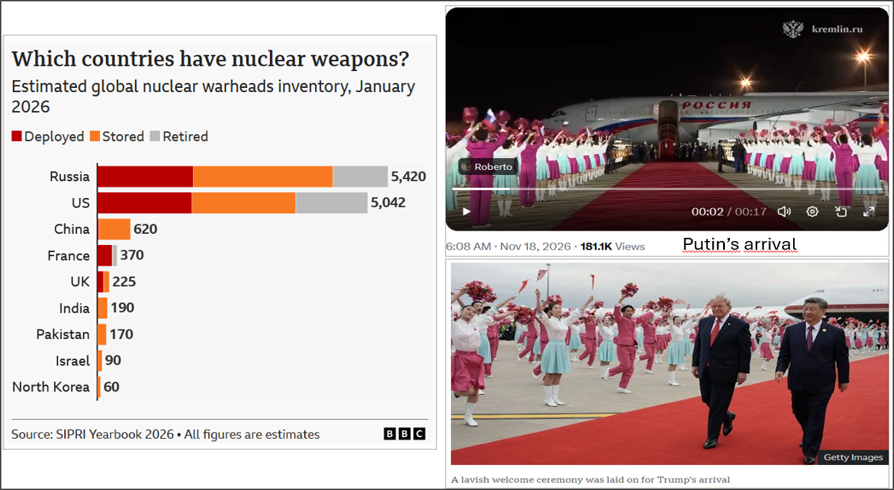
The last nuclear arms treaty between the US and Russia expired in February 2026. China, meanwhile, has been rapidly building its nuclear arsenal but is still far behind the two leading parties.
The meeting is planned to focus on nuclear arms control. Washington intends to focus on concluding a new nuclear arms control agreement involving Russia and China. However, this initiative has also faced resistance from Beijing, as the Chinese side considers itself to be in an unequal position compared to the other two nuclear powers: its arsenal is significantly inferior to that of Russia and the United States. Beijing fears that participation in the trilateral nuclear agreement will lead to the spread of restrictions on China comparable to those that applied to Moscow and Washington.
The White House does not expect to achieve specific agreements on the nuclear topic at the upcoming meeting, but Washington still considers it necessary to involve China in the discussion of strategic stability issues. In addition, the leaders can discuss the conflict around Iran and the situation on the Korean Peninsula. The settlement of the Ukrainian conflict is not on the proposed agenda of the summit.
Episode at the airport
Both welcome ceremonies at the airport, Putin and Trump, were, this time, the focus of particular interest and attention. Now Kiev and Brussels spent the morning celebrating that Xi personally met Trump at the airport and not Putin, as if they’d personally talked Beijing out of the Russia friendship.
Since basic diplomatic protocol is apparently unknown in those places, let’s take a closer look at this issue. Chinese diplomacy runs on strict protocol. Since the late 1970s, China’s leader hasn’t gone to the airport for anyone. Visiting presidents, Putin included, are met by the vice president or another senior official, and that’s the standard treatment.
On top of that, there’s an old Chinese principle, “courtesy demands courtesy in return.” If someone gives you more respect than protocol requires, you have to pay it back exactly, or you lose face. That’s what happened here. In September, Trump broke American protocol and personally met Xi at Andrews Air Force Base. Beijing returned the gesture one for one. Xi even explained it: “China is a country of etiquette with a tradition of reciprocity.” It was a debt being settled, not a sign of affection.
Procedures of the meeting
In the framework of APEC summit in Shenzhen, China, on November 18 and 19, there will be both bilateral meetings China-the US, China-Russia and Russia-the US as well as trilateral meeting China-Russia-the US.
China is the host and the organizer of the whole summit process. In Russia’s delegation, beside s President Putin, there are presidential aids Yury Ushakov, Maxim Oreshkin and press secretary Dmitry Peskov as well as FM Sergey Lavrov and Defense Secretary Andrey Belousov, three deputy prime ministers and more than 30 business executives came along.
Key persons of Trump’s delegation were Treasury Secretary Scott Bessent, Commerce Secretary Howard Lutnick, the new White House Chief of Staff, Stephen Miller and aides Natalie Harp and Walt Nauta.
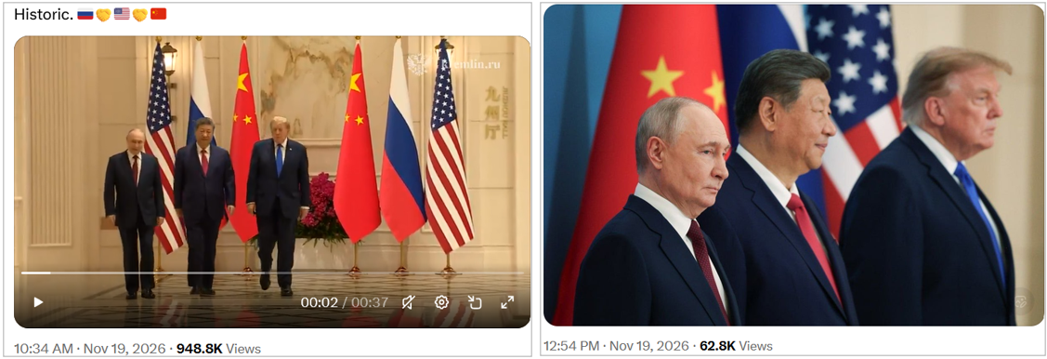
President Putin spoke briefly with President Trump at an evening gala event. President Trump was the last to be greeted by the host of the summit, China’s President Xi Jinping, after the ceremony of official greeting. Putin and Trump shook hands firmly and exchanged a few phrases. After that Xi invited them to take their places for a joint picture. The reception was being held at the Shenzhen International Exchange Center on behalf of President of the People’s Republic of China Xi Jinping in honor of the economic leaders of the APEC Forum.
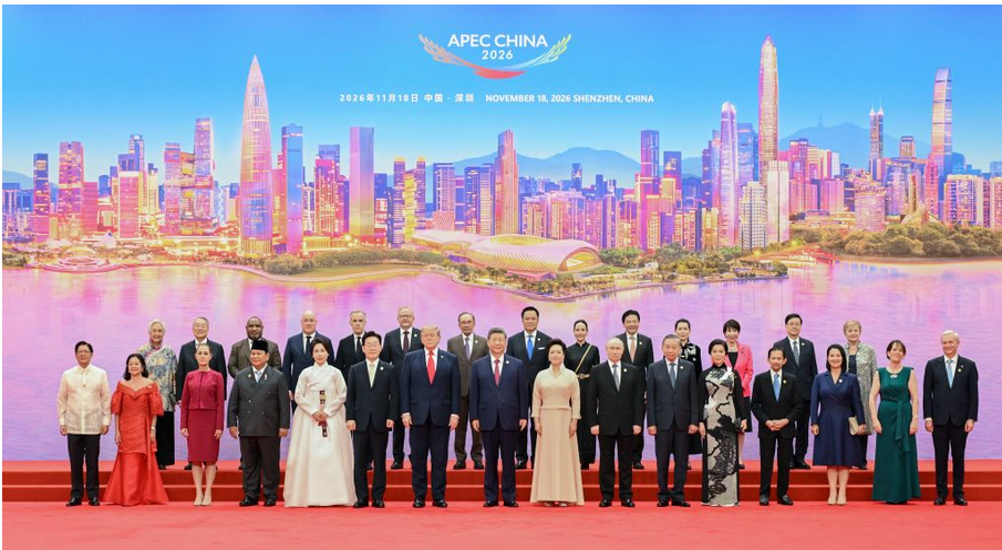
Chinese President Xi Jinping on Thursday said China is an advocate, promoter and forerunner in Asia-Pacific economic cooperation, and it is ready to work with all parties to build the pillars that support an Asia-Pacific community. Xi made the remarks at the 33rd Asia-Pacific Economic Cooperation (APEC) Economic Leaders’ Meeting, held in Shenzhen in south China’s Guangdong Province.
Stressing the importance of stronger economic and trade ties underpinning such a community, Xi said efforts should be made to facilitate trade and investment, advance digitalization, and lower barriers to them.
On upgrading connectivity, he called for measures to improve infrastructure networks, enhance coordination in policies and regulations, promote people-to-people exchanges, and foster mutual understanding and closer bonds among peoples.
Emphasizing innovation, Xi said greater efforts need to be made to build digital infrastructure and promote the broad application of artificial intelligence.
Xi stressed the importance of development, calling on regional economies to advance cooperation on energy and food security, anti-corruption governance across borders, and green and low-carbon transition. He also called for efforts to improve the people’s well-being and increase investment in human capital.
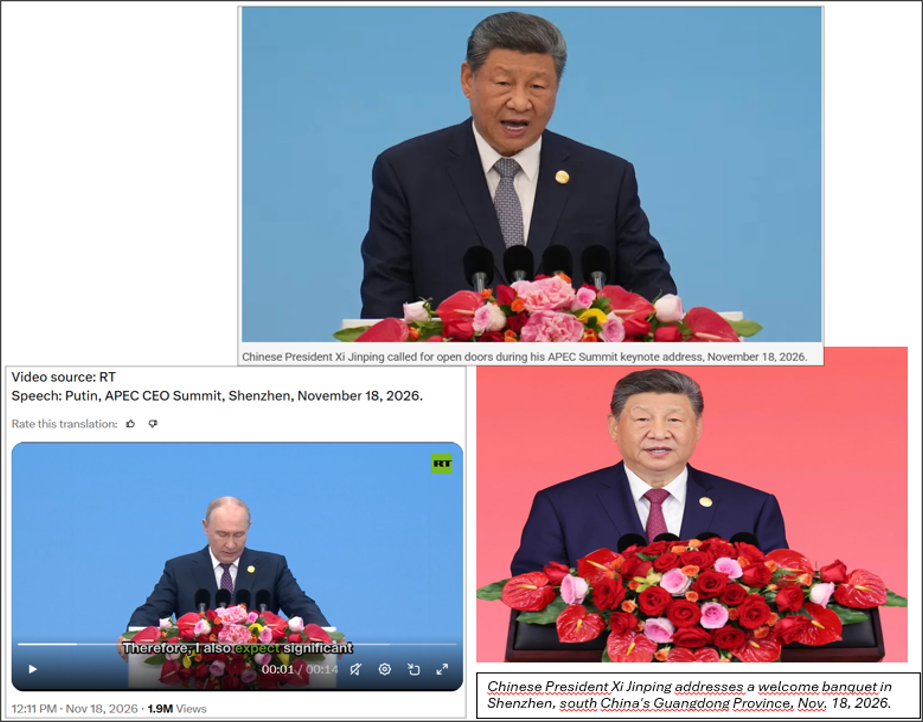
Putin’s Speech, APEC CEO Summit.
The world is changing before our eyes and this is only the beginning. The center of the world is no longer where we thought it was. The Asia-Pacific now accounts for 60% of global GDP, 50% of goods trade and 35% of services. From the “world’s factory”, Asia has become the engine of global development and as this happens, a new order is emerging a fairer, more multipolar, where every country wants to decide its own future without outside impositions. Three key points of the speech:
1. Russia is holding its ground and growing. GDP +10% in last 3 years, inflation and debt under control, low unemployment. Europe’s largest economy. 2. The dollar is no longer as central as it once was. In payments for Russian exports, the dollar and euro have fallen from 85% to 9%. 3. Now comes the historic moment: the trilateral meeting between Russia, China and the USA on the sidelines of APEC. Putin expects significant benefits from this dialogue.
Finally, Putin said the sentence that explains a lot: “We have never given up on using the dollar or the euro. We were denied access. And honestly, those who did this have only hurt themselves. It wasn’t Russia that rejected the system. It was the system that shut the door on Russia. And now it is paying the price.”
“Europeans’ standard of living is steadily declining.” “Europe has yet to adjust to the loss of the Russian market and is now losing ground and potential.” “The problem of budget deficits is emerging with force. The debt burden and inflation are rising. The useless Europe of bureaucrats, lackeys of their master, keeps obeying and destroying itself. It gave up the Russian market. It gave up Russian energy. It gave up its sovereignty. And today it is getting exactly what it was looking for. And that is only right. While Europe grows poorer, the rest of the world moves forward. History is being written now.
Bilateral presidential meetings
Russia and China
Both parties underlined their constructive approach to build a multipolar world order. The talks took place at the Qilin Shanzhuang state guesthouse, located within the Qilin Mountain Villa complex. The parties discussed prospects for further economic cooperation between Russia and China. The talks continued over a working breakfast also attended by Sergey Lavrov and Yury Ushakov. Putin and Xi spoke for more than two hours.
Russia and the United States
The leaders, Trump and Putin, held their talks after the plenary session of the APEC summit concluded at the Shenzhen Center for International Exchanges. The brief meeting between the two leaders took place ahead of a trilateral meeting involving Chinese President Xi Jinping.
Delegations of the parties. Deputy Prime Minister and Finance Minister Anton Siluanov, Russian Foreign Minister Sergey Lavrov, Russian Presidential Aide Yury Ushakov, and Special Presidential Envoy Kirill Dmitriev attended the meeting on the Russian side. US Secretary of State Marco Rubio and Treasury Secretary Scott Bessent attended on the US side as well as the new White House Chief of Staff, Stephen Miller.
The two presidents are meeting for the first time since the August 2025 summit in Anchorage.
The meeting between Putin and Trump lasted about 40 minutes. Trump called Putin his friend at the beginning of the meeting. Putin noted that he was glad to meet with Trump. Before meeting with Putin, Trump greeted Peskov and praised him for his professionalism. Putin and Trump discussed the Ukrainian conflict and issues related to bilateral relations, according to Ushakov.
The parties did not make joint statements to the media following the bilateral meeting. Their last direct talks were in Alaska last year. This round was shorter but Trump is already talking about a follow-up. Putin and Trump made no joint statements to the media following their bilateral meeting. The meeting was intended as preparation for a trilateral summit involving Russia, China, and the United States. No major remarks were made during the meeting.
China and the United States
Xinhua, the state news agency, has released its account of the bilateral meeting between President Trump and President Xi.
The report said that Xi believes the latest talks have given the China-US relationship “new substance” – a view highlighted the two nations have explored the right way for two major powers to coexist defined by the principles of “respect, fairness, and reciprocity.” Xi says he hopes to continue steering the course of China-US relations alongside Trump, ensuring that this “great ship” remains on the right track as it sails forward.
On the issue of Taiwan, the report says Washington should continue to do the right thing to avoid any major setbacks in China-US relations. There is an ongoing debate in US foreign policy circles, reignited by this trilateral meeting, about whether US presidents should first get clear commitments before meeting with adversaries at summits.
Trump believes their “very special relationship”, as he called it, is the best way to get results. “I think as long as you and I are in charge of things, we’ll never have a problem.” In terms of trade, there is a desire to see “mutual benefits” and on the subject of AI a desire for both countries to work to address security risks and keep AI under human control. The account says the two sides viewed this meeting as positive and constructive.
Trilateral meeting, China – Russia – the United States
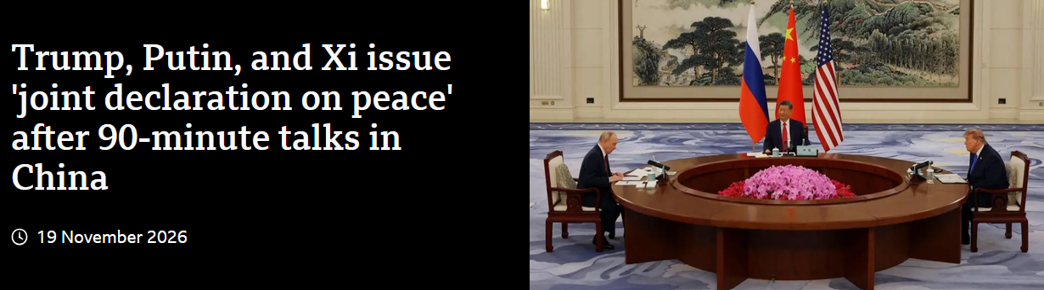
The three leaders met for 90 minutes in China’s south-eastern city of Shenzhen, on the sidelines of the Asia-Pacific Economic Cooperation (APEC) summit. While the presidents have previously had one-on-one meetings, these are their first trilateral talks.
US President Donald Trump and his Russian and Chinese counterparts Vladimir Putin and Xi Jinping have issued a “joint declaration of peace” following historic trilateral talks.
In the declaration, they said “nuclear war cannot be won and must never be fought” and that the countries planned to increase the production and supply of petroleum. They also said they were “committed to reform the UN” to respond more effectively to global challenges. Thursday’s statement also flagged the issue of immunity enjoyed by state officials and said, “they agreed that the International Criminal Court and other similar institutions must not abuse their jurisdiction”.
Trump praised the trilateral meeting calling it “a great and highly consequential trip”, in a social media post while flying back to Washington on Air Force One. In the same post, the president announced he would host a news conference to talk about the trip on Friday at the White House.
The Kremlin released a video showing Putin leaving the summit venue and saying goodbye to Xi. “Thank you for organizing this,” Putin said. “I don’t think anyone even expected everything to go so well.” Some Russian newspapers called it a “diplomatic victory” as after Russia’s full-scale invasion of Ukraine many Western leaders were trying to isolate him. Thursday’s trilateral meeting was reportedly the idea of Putin. Meanwhile, China’s president described his meeting with Putin and Trump as “positive, constructive, and highly productive”, according to the state broadcaster CCTV. It added that Xi recalled “the history of fighting side-by-side during WW2”, as the three leaders emphasized the importance of “cherishing the hard-won peace”.
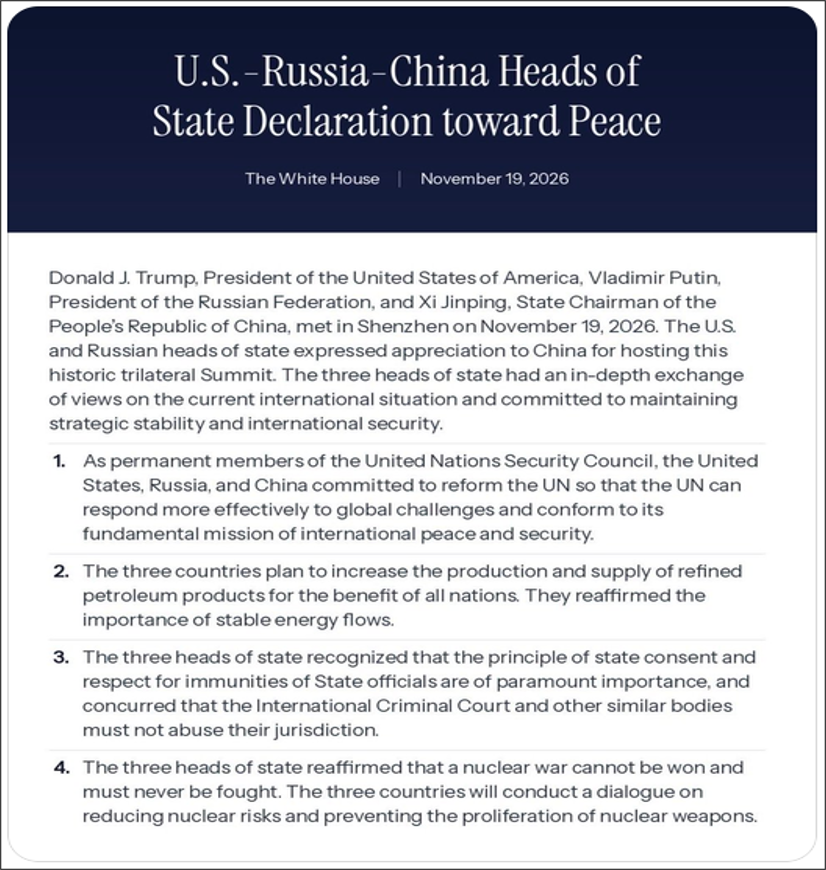
Declaration of the Heads of State of Russia, China and the United States on Peace
President of the United States of America Donald Trump, the President of Russian Federation Vladimir Putin, State Chairman of the People’s Republic of China Xi Jinping held a meeting in Shenzhen on November 19, 2026. The heads of state of Russia and the United States expressed their gratitude to China for organizing and hosting this historic trilateral summit. The leaders of the three states held a thorough exchange of views on the current international situation and expressed their commitment to maintaining strategic stability and international security.
1. As permanent members of the UN Security Council, Russia, China and the United States expressed their commitment to reforming the UN so that it can respond more effectively to global challenges and fulfill its fundamental mission in the field of international peace and security.
2. The three states plan to increase the production and supply of refined petroleum products for the benefit of all countries. They reaffirmed the importance of stable energy supplies.
3. The leaders of the three states note that the principle of state consent and respect for the immunities of state officials are of fundamental importance and agree that the International Criminal Court and other similar bodies must not abuse their powers.
4. The leaders of the three states reaffirmed that a nuclear war cannot be won and must never be fought. The three countries will hold a dialogue on reducing nuclear risks and preventing the proliferation of nuclear weapons.
The trilateral meeting between China, Russia and the US did not deliver agreements or any big results. However, improving high-level diplomacy during a turbulent shift in the world order is an achievement.
What now and in the future – partial clues and hints
After the meeting, Trump called in from Air Force One on his way back from China to join a meeting of Ukraine’s European Allies (the Coalition of the Willing). “Why Are You Spending Billions on Ukraine?” “Putin is serious about peace talks”. Trump asked European leaders why they were continuing to spend billions of dollars to provide military support to Ukraine.
Trump’s remarks show that the strategic divergence between Washington and Europe is deepening. While Europe views Russia as a long-term military threat, Trump is engaging with Moscow as a power with which he can negotiate. The future of a war for which Europe has mobilized its political, economic and military resources for nearly five years now depends on diplomatic contacts taking shape outside Europe.
Trump’s decision to call the Europeans immediately after sitting down at the same table as Putin and Xi and question why they were spending money on Ukraine is highly significant for Europe’s position in the global balance of power. Europe is one of the war’s financiers, but can it sustain the costs of this war over the long term? Does it have the power and patience to emerge as the winner of the war or the architect of peace?
Based on assessments by some international experts, the likely outcome of the meeting might be:
Xi wins. He’s the host, the broker and the man in the middle of the photograph. He gives up nothing on nuclear weapons, Taiwan or rare earths, and he collects the image of China as the power the other two have to come to. Seen from Beijing, that is the whole point of the exercise.
Putin wins. Four years ago, the West was promising to make Russia a pariah. On Thursday its president sits as an equal with the leaders of the world’s two largest economies, on Chinese soil, at a summit Putin himself proposed and Trump eagerly accepted. Whatever comes out of the room, Putin can sell the meeting itself at home and across the Global South.
Trump wins the image. He gets the “first-ever trilateral meeting” and the chance to say he’s the only president who could pull it off. He is also back to the scene after a midterm defeat driven by gas and diesel prices.
The losers aren’t invited. Europe, which spent the year insisting nothing about its security would be decided without it, will watch the three men who matter most to its security talk without it. Ukraine’s foreign minister has already objected that a meeting would only encourage Putin to keep fighting and Iran will get a summit about its war with no seat at the table.
The main point is a meeting without Europe’s participation, a meeting of three world leaders. Now when this format is established, it can be developed further, and subsequent meetings can move to more detailed discussions of issues,” the experts explained.
Despite the noise generated by smaller states, the diplomatic center of gravity is returning to direct dialogue between the major players. The summit in Shenzhen, has the potential to redefine spheres of influence and determine the role of international alliances for decades to come. By maintaining channels of communication between nuclear powers under pressure, the participants are working to preserve a baseline of stability that multilateral institutions involving the EU currently fail to provide.
As expected, the Europeans are TERRIFIED of the alliance between Trump, Xi, and Putin. German Chancellor Merz just said that the “Yalta format” cannot bring peace, and that if peace negotiations take place, they are going to contribute. In translation, the Europeans are upset because Trump outmaneuvered them to end the war that they started, and Europe is being squeezed out from the international stage. Europe tried to abuse the NATO alliance and drag the US into direct war with Russia, to advance their own agenda. However, Trump figured them out, and now Europe is losing their seat at the table.
Europe is dependent on imports for energy, and they are completely dependent on the US for defense/military protection via NATO. The Europeans have no leverage, and they can see they are being squeezed out. Trump, Putin, and Xi, have all the energy resources and the three most powerful militaries/nuclear arsenals on the planet. Whatever those three agree on, is what’s going to happen, and Europe can’t do anything. We are witnessing a historic shift in global alliances and a reset of the global power structure, and Europe finds themselves on the outside looking in.
Obviously, Xi Jinping believes he has achieved something no other world leader could in securing a historic summit with Vladimir Putin and Donald Trump in Shenzhen. For decades, Washington and its western allies shaped the world order. Yet it is China that has orchestrated the remarkable diplomatic spectacle of three of the world’s most powerful protagonists sitting around the table. And surrounding it all is the futuristic display that is Shenzhen, with driverless cars cruising past as drones fly overhead and robots – literally – dance in the streets. Ostensibly, this is an economic summit for Asia Pacific leaders. But for Xi, it is also a demonstration of China’s grip on the global economy and world politics. His country is no longer just reacting to decisions made in Washington, London or Brussels – instead Beijing is at the heart of conversations which are reshaping the international order.
China’s growing nuclear arsenal.
Donald Trump has already made it clear he wants the three leaders to discuss limiting the world’s supply of nuclear weapons. The US and Russia possess the world’s largest stockpile of nuclear warheads. But China is rapidly expanding its own arsenal, which is raising alarm bells in Washington. The last major US-Russian arms control treaty, known as New START, expired in February this year, triggering fears of an arms race. The agreement had set a cap to control the number of nuclear weapons in US and Russia’s arsenal. Trump would like China to be included in any new agreement, but Beijing has pushed back. Xi’s argument will be that his arsenal is considerably smaller than what Washington and Moscow own, and, therefore, it would be unfair for Beijing to be bound by their limits. China also believes it should have the freedom to develop its own nuclear capabilities.
The Peace Declaration is an interesting statement.
Quite many commentators said that “Empty talk, nothing happened” but they were wrong.
The fourth point says: We must respect “the immunity of state officials,” and the International Criminal Court must not “abuse its jurisdiction.” What does it mean in plain language? “Hey, International Criminal Court, hands off Putin.” Putin has an arrest warrant from the International Criminal Court on charges of war crimes (pretext) in Ukraine. For years, he hasn’t been able to travel to many countries for fear of being arrested. Today, Trump and Xi signed a statement with him saying this court is overstepping its authority. In other words: America and China gave Putin a political get-out-of-jail-free card. That’s the price.
What wasn’t mentioned in the statement? Ukraine: not a word. Iran: not a word. So, 90 minutes of talks, they talked also about Ukraine and Iran but couldn’t write a single sentence about them in the statement. Because they didn’t agree on anything regarding those cases.
Europe got the message too, you’re out. The three big players are deciding the world’s fate, and you’re watching on TV. The statement is a declaration of the end of the old world order. A system in which America, Europe, the United Nations, and the International Criminal Court ruled the world. And a new system in which 3 men sit around a round table in Shenzhen and decide who’s a criminal and who’s innocent, and who stays president and who goes.
Global Deep State will face the power of sovereign nation states.
For centuries, the world has been ruled from the shadows, by powerful families like the Rothschilds and House of Saud. Highly likely, those days are over. We are entering a new phase of global sovereignty, where nations are no longer enslaved and manipulated on behalf of corrupt globalist oligarchs. Each nation will be overseen by actual sovereign leaders, not by puppets acting on behalf of the Deep State families. That’s the real end goal of this summit. That’s the shadow war that we are fighting. Now it seems that a new kind of confrontation between alliances is emerging. Trump and US Republicans & Russia & China versus Global Deep State & US Democrats & West Europe (the EU, the UK, the European NATO).
Trump, Putin and Xi are not saints, but they actually care about their civilizations and the survival of their People, and their culture. They don’t want to be conquered by globalism either. Putin and Xi agreed to stand down while Trump and the US military conduct their operations destroying Deep State proxies and their global assets. One might argue Putin is directly assisting by keeping the Deep State proxy of Ukraine occupied. If the leaders of the three Military superpowers are all on the same page, the Deep State and their global assets don’t stand a chance. The Deep State’s plan was to make people fight each other, so the sovereign nations decided to fight the Deep State instead.
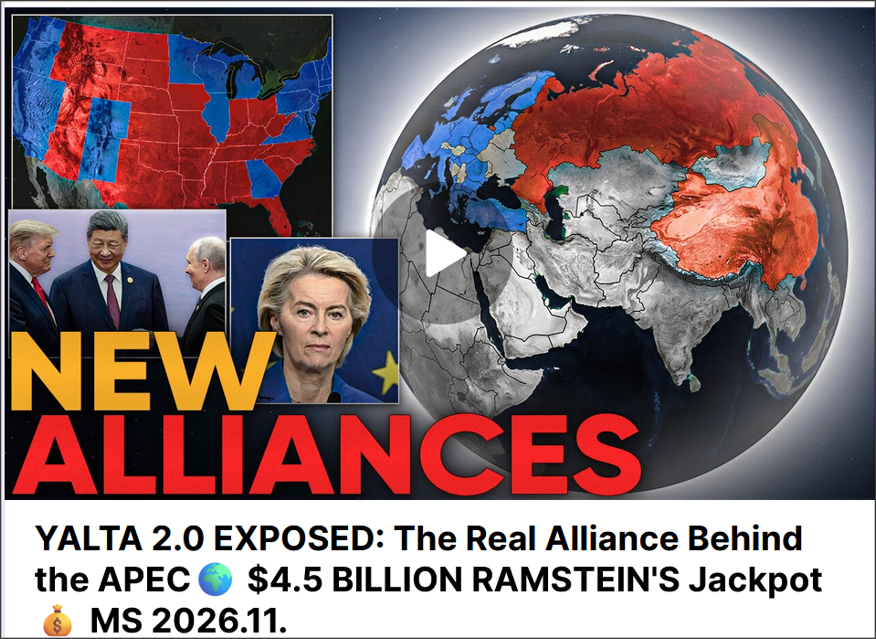
YALTA 2.0 EXPOSED: The Real Alliance Behind the APEC🌍 $4.5 BILLION RAMSTEIN’S Jackpot💰 MS 2026.11.18