


Collapsing Empire
Rises and falls of great powers
Great powers are the key players in international relations. Therefore, the fate of empires / hegemons / great powers is so important to follow up and examine in details. Two classical documents on the subject “collapsing of great power” (Paul Kennedy 1989 and Joseph Tainter 1988), among others, can be used as a theoretical base and comparable “benchmark” in assessing the prevailing situation in the international politics.
Paul Kennedy’s book (The Rise and Fall of the Great Powers: Economic Change and Military Conflict from 1500 to 2000, publ.1989) focuses on national and international powers in the post-Renaissance period.
One of his key arguments is that the relative strengths of the leading nations in world affairs never remain constant. Once their productive capacity was enhanced, countries would find it easier to sustain the burdens of paying for large-scale armaments and supplying large armies and fleets in wartime. Wealth is usually needed to underpin military power and military power is usually needed to acquire and protect wealth.
If however, too large proportion of the state’s resources is diverted from wealth creation and allocated instead to military purposes it may lead to a weakening national power over the long term. If the state overextends itself strategically (e.g. waging of very costly wars), it runs the risk that potential benefits from external expansion may be outweighed by the greater expense of it all. This dilemma may become acute if the nation has entered a period of relative economic decline.
Based on historical evidence, Kennedy argues for a causal relationship between economic and productive growth and the position occupied by the particular great power in the international system. Similarly, the historical record suggests the strong relationship between an individual great power’s economic rise and fall and its growth and decline as an important military power. Wealth and power are always relative and should be seen as such.
Joseph Tainter’s book (The collapse of complex societies. publ. 1988) focuses on the ancient Roman empire and its decline and fall. It takes also comparable examples of numerous other empires’ falls in the history of mankind. He carries on with observation that “what happened to the ancient empires could happen in modern times.”
Tainter’s main points are related to the concept of “complexity of a society” and “declining marginal returns to complexity”. He does not exactly define the term complexity but looking at the context, he obviously means all the economic, social bureaucratic and military structures that create societies. Complexity is the characteristics what is usually called as “civilization”. Complexity and required resources are in a feedback relationship with each other. Resources allow the creation of more complex societal structures and these structures help to exploit resources faster and more efficiently.
The collapse can be defined as “a rapid reduction of complexity in a society”, possibly caused by resource depletion. It can be also stated that “the collapse is related to the diminishing returns of progressively increasing complexity”. Tainter’s point is that there is a strong relationship between resources and complexity.
Some researchers have forecasted years ago the decline of US unipolarity taking place soon.
Professor Robert Pape (University of Chicago) in his article “Empire Falls” (2009) argues that “the US is in unprecedented decline and it means the unipolar world is coming to an end”. His argument is based on the lower rate of US economic growth vis-à-vis potential competitors like China and excessively aggressive US grand strategy of offensive dominance – applied e.g. in the Middle East and Afghanistan.
Along similar lines, another American professor Christopher Layne (Texas University) argues that unipolar moment is over and the era of American ascendancy in international politics is fast winding down (“This Time Its Real: The End of Unipolarity and the Pax mericana,” International Studies Quarterly, 56:1 March 2012). He explains that there are two drivers of American decline, one external and one domestic: External driver is the emergence of new great powers in world politics (China, Russia) and the shift of economic power from the Euro-Atlantic area to Asia, where China’s rise signals unipolarity’s end. Domestic driver shows decline in America’s economic power, the looming fiscal crisis, getting into huge sovereign debt and increasing doubts about the dollar’s long-term hold on reserve currency status.
I have researched this issue, rise and fall of great powers, extensively and in a variety of ways on my website and I would like to highlight some significant points which you may find interesting:
theoretical base assessing relations
Collapsism, life cycle of fiat money, Seneca Cliff
Looming Debt Crisis – is America following the path of Collapsed Empires?
Sovereign debt (public or government debt) can topple even the most powerful empires, as have been seen in history. Whether it’s Rome, Spain, France, Britain, or the Soviet Union, excessive debt has played a critical role in their decline. The typical pattern in these examples of collapsing empires is:
Stage 1:Empires achieve success and become overconfident.
Stage 2: Overconfidence leads to extravagant spending on luxuries and wars.
Stage 3: Empires finance this lavish spending by going into debt.
Stage 4: The debt grows to an unsustainable level and creates a crushing burden.
Stage 5:Empires finance the debt through taxation and currency debasement.
Stage 6: The populace bears the heavy burden of debt repayment as empires raise taxes and debase the currency—to the maximum extent—until it causes internal instability.
Stage 7: Empires cannot finance their militaries because of their debt burden. This is usually the tipping point.
Stage 8: Underfunded militaries plus internal instability make empires vulnerable to foreign invasion, domestic revolution, civil war, and other existential dangers.
Stage 9: The empire collapses.
Now, it’s the US Empire’s turn. The US federal government has the biggest debt in the history of the world and it’s continuing to grow at a rapid, unstoppable pace.
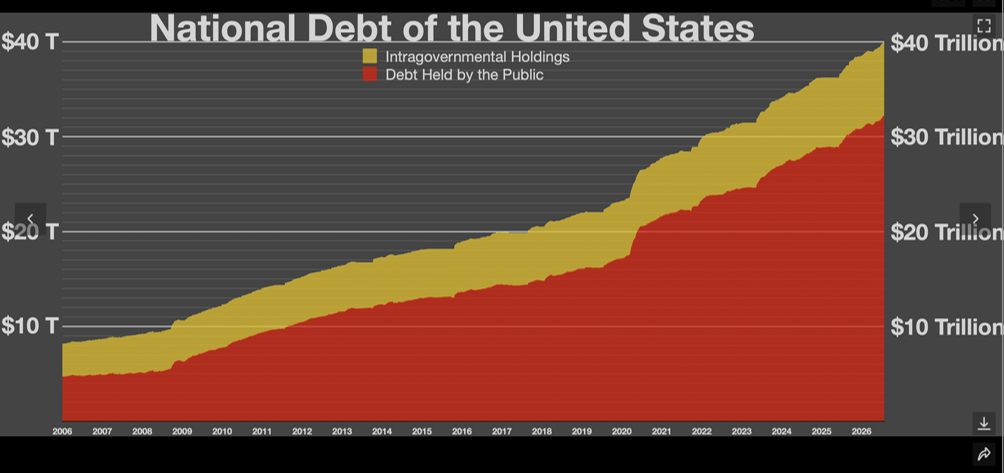
The federal government debt as of August 18, 2026 was $40.05 trillion.
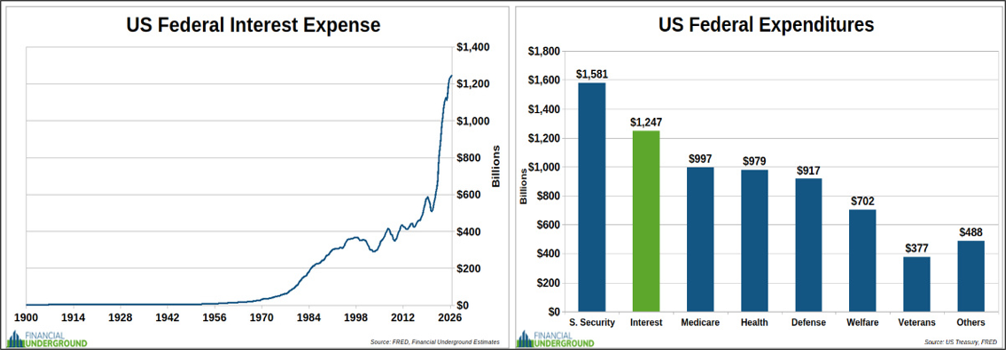
Annualized interest on the federal debt exceeded $1.2 trillion recently and is shooting higher at an exponential rate. The federal debt’s annualized interest cost is already higher than the defense budget. It’s on track to exceed Social Security and become the biggest item in the federal budget.
British American historian Niall Ferguson summed it up nicely: “Any great power that spends more on debt service (interest payments on the national debt) than on defense will not stay great for very long.” This principle has been true of Habsburg Spain, the ancient France, the Ottoman Empire, the British Empire and now this law is about to be put to the test by the US beginning this very year.
When considering the situation in the US, the American populace is facing with saturation point as taxation and inflation rise. Interest cost of the federal debt exceeds defense spending and is set to become the biggest expenditure and it will keep growing from there.
As a result, the US Empire is somewhere between stage 6 and 7in the empire collapse pattern described above. It is nearing the point where its crushing debt burden will make it difficult to finance existing military spending. As we saw in the historical examples, a tipping point is reached once an empire’s debt burden becomes so great that it struggles to pay for its military.
The US government has soon to choose, either to cut defense spending amid the most chaotic geopolitical period since WW2 or default on its promises regarding Social Security, Medicare, Veterans’ Benefits and welfare generally.
The US government cannot continue to pay for entitlements and defense even if their current levels stay flat into the future but both are set to grow significantly in the years ahead. About 20% of the population will enter retirement in the coming years. Cutting Social Security and Medicare is a sure way to lose an election. With the most precarious geopolitical situation since WWar2, defense spending is unlikely to be cut. Instead, defense spending is all but certain to increase.
The most likely outcome is that the US will try to have its cake and eat it too by paying for both growing defense and domestic obligations via currency debasement. However, it will likely end up just like other powerful collapsed empires that preceded it—with an underfunded military and domestic instability.
The truth is that Trump cannot make America great again any more than Gorbachev could save the Soviet Union.
Once an empire struggles to pay for its military, the decline is impossible to reverse. When considering fiat money like denarius (the Roman silver coin) which lost nearly all its silver content between 180-280 AD, the US dollar has lost over 98% of its value against gold since 1971. In short, the US will soon reach the tipping point that has caused the collapse of other powerful empires.
The interest cost is set to exceed Social Security and become the biggest item in the budget. It will only get bigger from there as the debt continues to grow at an unstoppable and exponential rate. The US is facing soon a disaster of historical proportions and the current world order will dramatically change. The global geopolitical situation was already trending towards a multipolar world order.
The US debt crisis is compounding its geopolitical problems and will accelerate this established trend and just like the collapse of previous empires, debt will play a significant role. Many people will be unprepared for the collapse of the US Empire. When private businesses go bankrupt, shareholders get wiped out. When governments go bankrupt, those who hold its fiat currency get wiped out.
Given the historical examples, one thing I think we can be sure of is that the US government will try to service its debt costs with currency debasement, just like many empires that collapsed before it. That’s terrible news for the US dollar. The consequences of this debt crisis will extend far beyond geopolitics. As the US government resorts to increasingly aggressive currency debasement to fund its obligations, the value of the dollar will continue to erode—and capital will seek refuge in scarce assets.
Gold will likely be one of the primary beneficiaries but silver could offer even greater speculative upside. Anyway, tangible physical assets will be the base of last resort.
Some recent alarming events and videos
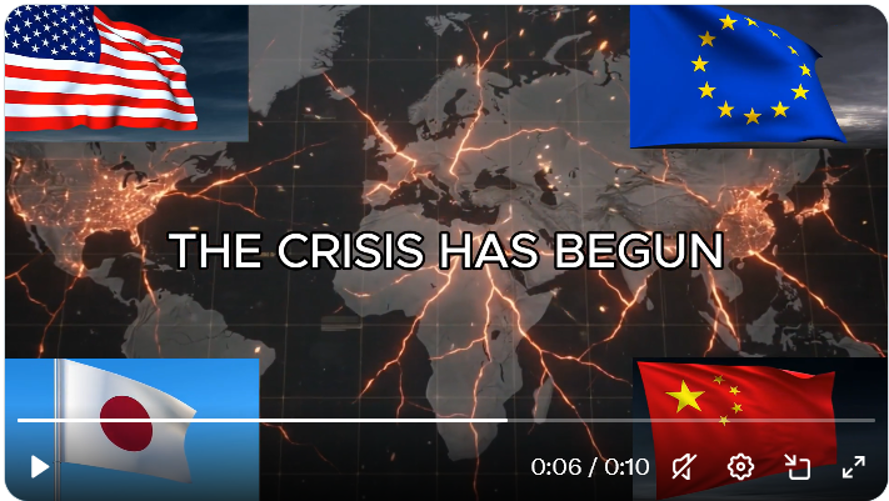
DeFi_Machine , X.com, August 18, 2026
THIS IS HOW THE NEXT GLOBAL CRISIS BEGINS, AND IT IS ALREADY UNDERWAY IN THE ONE MARKET NOBODY WATCHES
Three weeks ago, I warned about a debt crisis building. Since then, every number moved the wrong way. Here is the truth almost nobody wants to hear. The S&P 500, Bitcoin, all of crypto, they are dust compared to the bond market. The global bond market sets the price of money itself. Every stock, every coin, every mortgage, every government is built on top of it. When it moves, everything moves. And right now, it is cracking on three fronts at once.
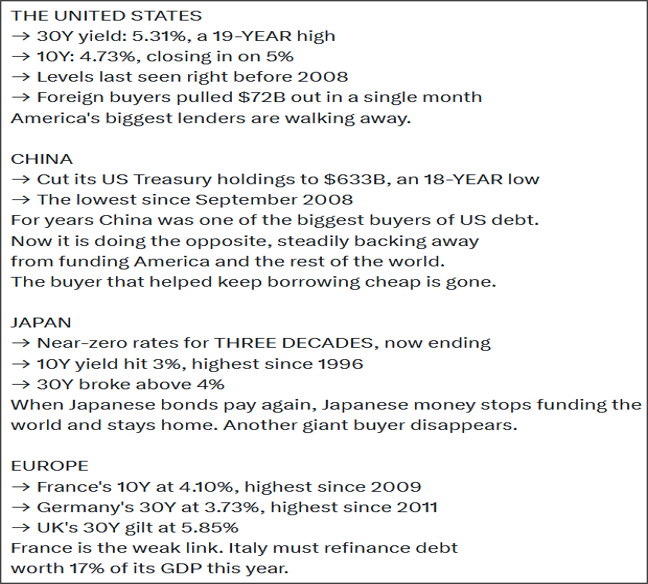
Every major government on earth is paying more to borrow, at the same time, for the same reasons. The trigger could be anything. But the weakest point in the whole system is Japan. Three decades of cheap money unwinding at once is the crack that could split the entire foundation. Watch the bond market first. Everything else is a sideshow.
Stern Drew X.com. August 19,2026
The City of London Just Triggered the Next Bond Meltdown
Gulf States (Saudi Arabia, UAE, Kuwait, Qatar, etc.) suddenly cannot sell their oil at scale. No oil sales = no revenue. Saudi Arabia has recorded ZERO Oil sale to America for the first time ever. But this exact petrodollar choke could collapse the U.S. Treasuries.
These same Gulf States are massively leveraged. They’ve borrowed heavily from Western banks to fund megaprojects, sovereign wealth plays, and lifestyle. When the oil money stops, they default. Those defaults cascade straight into the global banking system and the epicenter is the City of London, the old petrodollar recycling hub where the big players (and their interconnected exposures) sit. One major default wave and the British banking system lights up like 2008 on steroids.
For 50 years the petrodollar system forced the world to buy oil in U.S. dollars, then recycle those dollars into U.S. Treasuries and assets. That artificial demand is what kept the dollar as the world’s reserve currency.
No oil flowing through Hormuz = no new petrodollars. The recycling loop is broken. Demand for dollars evaporates. The dollar’s reserve status starts crumbling in real time.
In response, the U.S. Treasury is doubling the size of its own long-dated bond buybacks to at least $4 billion per operation. This is the way into Total Destruction.
August 19, 2026. THE U.S. TREASURY (Scott Bessent) JUST ADMITTED THE ECONOMY IS COLLAPSING.
Today the Treasury DOUBLED its buybacks of long-dated debt. From $2 billion to at least $4 billion per operation, starting September 9. America is buying back its own bonds because nobody else wants. The 30-year hit 5.337% on Tuesday. Highest since 2007. This is not the Fed who did that but the US Treasury.
But it’s not a QE (quantitative easing), they fund every single buyback by issuing MORE debt. They are not fixing the core problem. Bessent is refinancing it onto a shorter fuse. The same thing already happened to Japan. Washington and Tokyo burned $10 billion defending the yen. Ten billion dollars lasted only for two weeks. The yen intervention was never for Japan. It was about saving US. Japan holds the Treasuries. If the yen breaks, Japan sells. That is the only reason Washington ever cared. China is continuing selling. Their Treasury holdings just hit an 18-year low while they have been buying gold non-stop for 3 years.
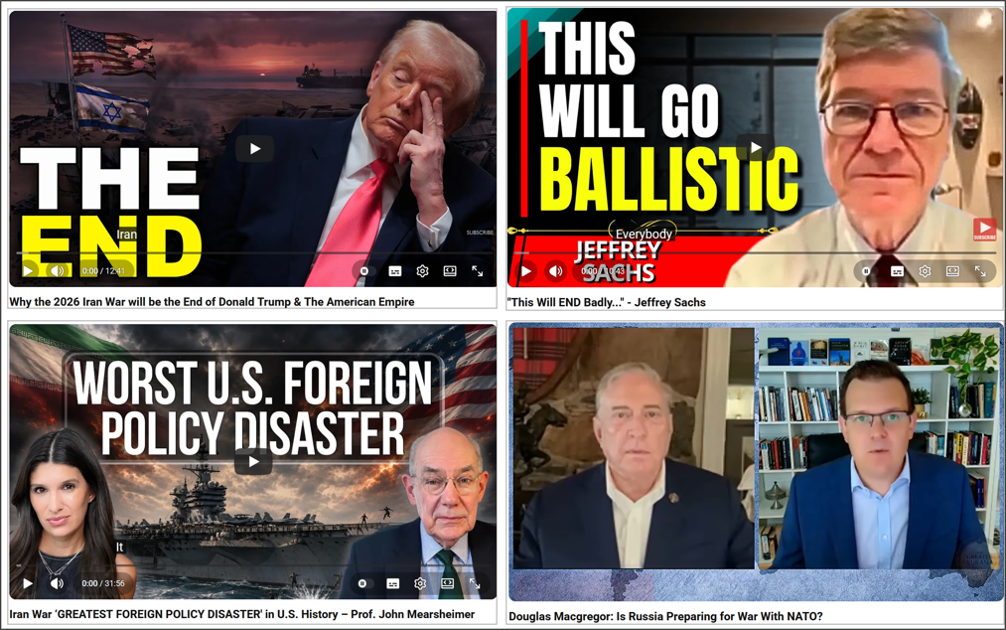
Why the 2026 Iran War will be the End of Donald Trump & The American Empire
Double Down News, YouTube, July 7, 2026
This Will END Badly…” – Jeffrey Sachs
LifeWorthLiving , August 15, 2026
Iran War ‘GREATEST FOREIGN POLICY DISASTER’ in U.S. History – Prof. John Mearsheimer
Rachel Blevins, August 19, 2026
Douglas Macgregor: Is Russia Preparing for War With NATO?
Glenn Diesen Clips