


BRICS Summit 2026, September 12-13, in New Delhi India
Introduction
I have commented on BRICS summits for many years, last time on July 15, 2025
when BRICS published a plan of “The BRICS 2025 De-dollarization Endgame”.
This year it was 18th BRICS Summit taking place on 12 – 13 September in New Delhi, India.
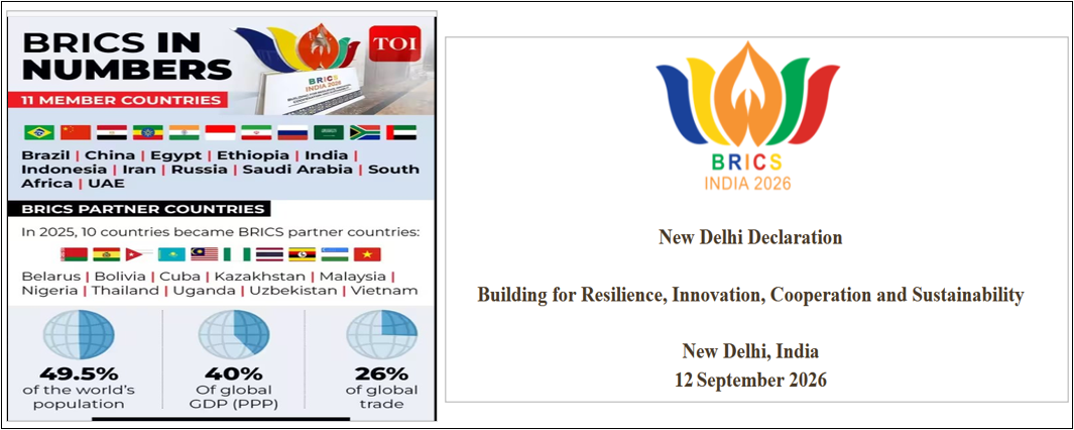
A quarter century ago, a Goldman Sachs economist coined a four-letter acronym to describe four fast growing emerging economies and named his research paper “Building Better Global Economic BRICs”.
This acronym soon started catching the attention of the world brick-by-brick, and this new term, “BRIC”, joined the investing lexicon to describe the quartet of Brazil, Russia, India and China as future drivers of global economic growth. It grew as well to five with the inclusion of South Africa in 2010, renamed BRICS and has eleven member-countries now. The leaders, however, decided to continue with the five-letter name for this multi-nation bloc, BRICS+.
Besides five original members, Egypt, Ethiopia, Iran, Saudi Arabia and the UAE became full members of BRICS in 2024 and Indonesia in January 2025. In addition, Belarus, Bolivia, Kazakhstan, Cuba, Malaysia, Nigeria, Thailand, Uganda, Uzbekistan and Vietnam joined BRICS as Partner Countries last year.
Interestingly, the first government-level meeting of this bloc in 2006 focused a lot on the situation surrounding Iran and the Middle East. Now, two decades later, Iran was again a key point of discussion when the leaders met for the BRICS Summit 2026. Besides, Iran itself is now a member of this grouping, and its President Masoud Pezeshkian is attending the Summit.
In 2014, the bloc announced BRICS Development Bank, which was later renamed the New Development Bank (NDB). This time, the official theme for India’s BRICS chairmanship and the 18th BRICS Summit is “building for resilience, innovation, cooperation and sustainability”.
The purpose of BRICS
The group has increasingly positioned itself as a counterweight to Western-led groups such as the Group of Seven industrialized nations — the US, Canada, France, Germany, Italy, Japan and the UK — and advocates for a more multipolar world order. It has pushed for developing nations to have greater representation in institutions such as the International Monetary Fund and World Bank and promoted greater use of currencies other than the US dollar.
Economic cooperation is another focus. The group established a $100 billion emergency reserve facility and the New Development Bank, which has approved around $44 billion in financing since 2015, largely for water, transport and other infrastructure projects. BRICS members also cooperate on issues such as climate change, renewable energy, healthcare and technology.
China and Russia have championed the recent expansion of BRICS, seeing a larger bloc to give emerging economies a greater say in global governance. The bloc offers its smaller and less affluent members an opportunity to build trade and financial ties with its larger economies, as well as potential access to alternative sources of funding.
Main features of BRICS today
Since its founding, BRICS has emerged as a powerful regional bloc, which today rivals the United States-led Western order, primarily due to its collective economic prowess and human capital.
Collectively, the BRICS+ grouping has an estimated nominal GDP of roughly $32 trillion, representing around 28% of the world’s total GDP but in terms of purchasing power parity BRICS nations account for nearly 40% of the global GDP.
The economic strength of BRICS is primarily driven by the massive economy of China, accounting for nearly 70% of the group’s total GDP, while India is the second largest, contributing around 13%, and Russia stands third with a 9% contribution. Brazil accounts for approximately 7%, and South Africa roughly 2%, showcasing that while the BRICS is collectively a major economic heavyweight, the economic status of its members varies significantly.
Today, the BRICS+ bloc represents roughly half of the global population, primarily due to India and China, two of the world’s most populous countries. This makes BRICS a major rival to the West because of massive human capital and a gigantic consumer market that is unrivalled.
Further, BRICS is the main driver in the global energy market, with its members accounting for nearly 30% of the world’s total oil production. Further, BRICS countries account for roughly 22% to 23% of global merchandise exports.
A major reason for the growing influence of BRICS is its control over the global energy market, with some of its members such as Russia, Iran, and the UAE being among the world’s leading oil and energy producers, while China and India are two of the largest energy consumers globally.
This unique combination of leading energy producers and consumers gives BRICS significant weight in discussions about global energy security, the oil market, and the future transition to clean energy.
One of the major issues is the group’s efforts to wean its members away from the US dollar in global trade and financial transactions. All BRICS members have stressed the need for increasing trade in local currencies and strengthening economic cooperation among member countries to provide members with more options for international transactions rather than relying heavily on the dollar-based financial system.
Backdrop for Summit 2026
The 2026 Indian presidency has already comprised dozens and dozens of topical high-level and cross-institutional meetings, such as those between central banks, national auditors, judicial systems, urbanization departments, security apparatus, space agencies and disaster response authorities. Inter-ministerial dialogues have taken place on trade, industry, agriculture, health, education and energy. BRICS science departments have developed a tentative agreement on AI.
Payment mechanisms are set to be on the agenda once again. Strong statements have also been drafted in favor of preserving and revitalizing the multilateral trading system with deepening institutional reform.
This summit is a test of whether the bloc can overcome its internal divisions and take concrete action that can meaningfully sway the world order, or whether it will be reduced to a mere talk shop.
India, which is chairing the gathering, has said it will focus on deepening cooperation and policy coordination among members, and strengthening their ability to tackle global uncertainty, supply chain disruptions, climate risks and a host of other challenges.
Economic uncertainty will loom large over the discussions as wars in the Middle East and Ukraine disrupt global trade and contribute to higher energy, fertilizer and food prices.
The rapid development of artificial intelligence (AI) and its potential to bring about widespread job losses is another vexing issue. The US and China are at the forefront of developing the technology and infrastructure that support AI, while many developing economies risk falling further behind.
Trump has attacked BRICS, portraying it as a threat to US economic interests. He’s dismissed its attempts to reduce global reliance on the dollar and warned that nations seeking to undermine the greenback could face additional tariffs.
Iran’s membership of BRICS is another source of tension. Trump has been pushing for the total economic isolation of the Islamic Republic in a bid to force it to capitulate in the war and reopen the Strait of Hormuz so the flow of oil and other commodities can resume unimpeded. That’s put BRICS at odds with the US, as the group seeks to deepen ties and increase trade between its members. Trump’s threat to sanction nations that continue doing business with Iran has also been rejected by China and others.
Summit procedures
Among those attending the weekend summit are Chinese President Xi Jinping, Iranian President Masoud Pezeshkian, and Russian President Vladimir Putin, besides host Indian Prime Minister Narendra Modi and other leaders representing the expanded group. Other attendees include leaders and top officials from Kazakhstan, Vietnam, Malaysia, Uzbekistan, Thailand, Cuba, Belarus, Nigeria, and Uganda, among others.
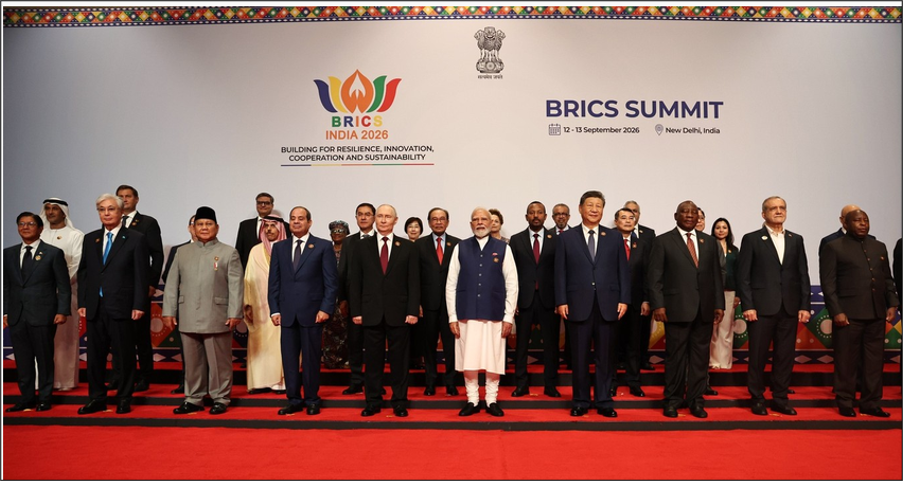
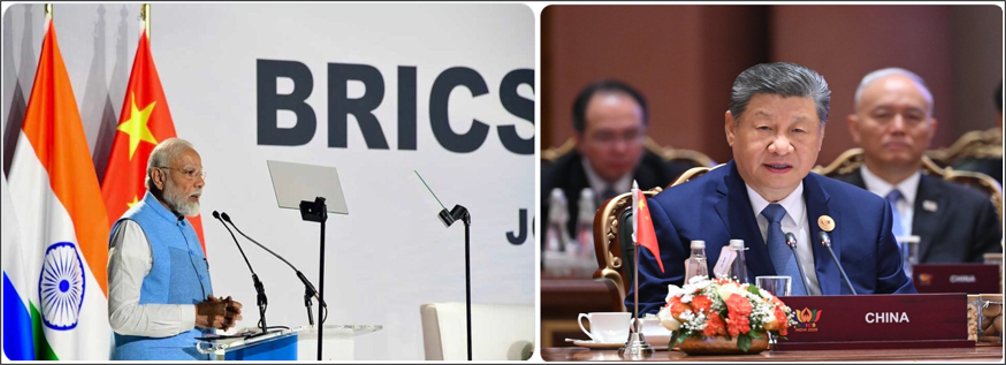
Indian Prime Minister Narendra Modi on Saturday declared the BRICS grouping has reached a “coming-of-age” moment, using his opening address in New Delhi to demand equal participation for the Global South in international rule-making and immediate United Nations Security Council reform.
Modi said the current global order places the Global South at the forefront of crises yet relegates it to the “back row of decision-making.” We must turn this pyramid of privilege into a platform of partnership,” he said. Modi outlined a three-pillar roadmap for global governance reform centered on representation, responsiveness, and rulemaking.
Turning to economic institutions, Modi argued that voting power and leadership positions in international financial bodies must reflect “today’s economic realities” rather than outdated structures. “Countries that accelerate global economic growth should also play a role in guiding global economic governance,” he added.
The summit convened as the US-Iran war entered its seventh month and the Russia-Ukraine conflict surpassed four years, with leaders seeking to position the bloc as an alternative forum for resolving global disputes.
Chinese President Xi Jinping concluded his two-day visit to India on Sunday by proposing five initiatives to advance “greater BRICS” cooperation. The initiatives, covering AI, trade and investment facilitation, digital industry, smart manufacturing and talent development, came as the Summit marked the grouping’s 20th anniversary and set the stage for China’s chairmanship next year. Experts noted that these five initiatives are more action-oriented, focused and in-depth, targeting the critical domain of the new industrial revolution where Global South countries most need empowerment.
Chinese leader Xi Jinping offered the services of his country and his BRICS counterparts to bring peace to the Middle East—and the process started immediately. Iran’s leader met face-to-face with a Crown Prince from the United Arab Emirates, two groups technically in conflict. The United States used the UAE as a base for its attack on Iran earlier this year. Iran then made defensive attacks against the bases. China famously created a détente between Iran and Saudi Arabia in 2023, ending years of animosity, so the Chinese have a good track record in this regard.
Xi stressed that the world is undergoing accelerated transformation unseen in a century, the Global South is rapidly growing in strength, and the trend toward a multipolar world is unstoppable. He also stated that the Chinese side stands ready to work with all parties to build consensus, create a better future, and embark on BRICS’ third “golden decade”.
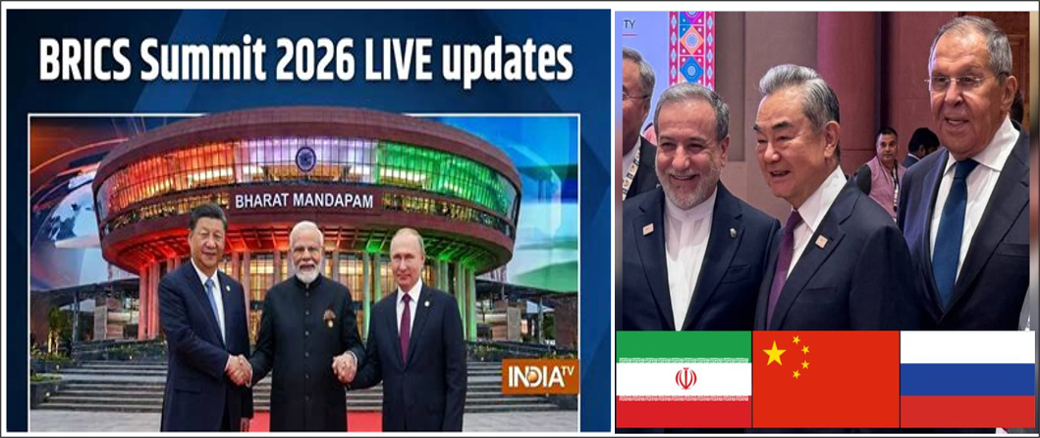
One of the most iconic images was captured, showing the good rapport between China, Russia, and Iran, a trio of Wang Yi, Sergei Lavrov, and Abbas Araghchi. The ministers held a professional yet relaxed conversation, like old friends.
The New Delhi summit produced more than 50 outcomes (documents), across the four priority pillars of resilience, innovation, cooperation and sustainability. These ranged from the Strategy for BRICS Economic Partnership 2030 to practical initiatives such as the proposed BRICS Invoice Discounting Mechanism.
On Saturday, the bloc unanimously adopted the New Delhi Declaration, which recognized the “valuable contribution” of partner countries to BRICS cooperation, according to a joint statement. It emphasized its “strong belief” that advancing the BRICS partnership with Emerging Markets and Developing Countries (EMDCs) would “further contribute to strengthening the spirit of solidarity and international cooperation for the benefit of all.” The declaration also reaffirmed the bloc’s commitment to “fostering inclusive, mutually beneficial and development-oriented partnership with Partner countries.”
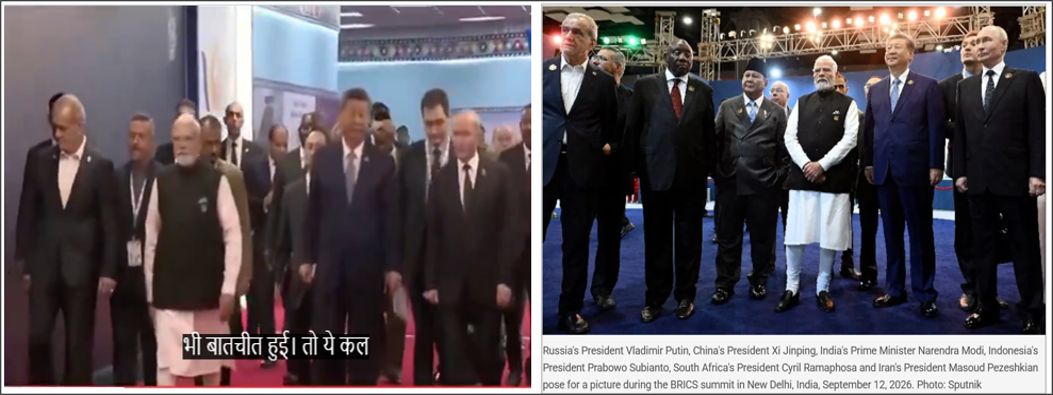
International media channels are pointing out to their audiences that at the BRICS summit, the organization’s usual trio of leaders—positioned in the foreground and consisting of the Russian President, the Indian Prime Minister, and the Chinese President—has expanded into a quartet with the addition of the Iranian President.
New Delhi Declaration of BRICS Summit 2026
The BRICS countries on Saturday unanimously adopted the New Delhi Declaration 2026 at the summit in New Delhi. The 45-page declaration, comprising 140 points, was discussed under the theme “Strengthening Cooperation to Promote Fair Competition, including in Renewable Energy Markets.” The declaration focused on condemning terrorism, conflict prevention and peaceful resolution of disputes, stronger multilateralism and concerns over unilateral trade measures.
The full text is available in this link.
The Declaration, adopted unanimously at the 18th BRICS Summit on September 12, can be read through a geopolitical lens: Middle East wars (Gaza, Libanon, Iran), Security Council reform, sanctions, the drift toward a multipolar order. Of the more than 130 paragraphs BRICS leaders signed off on, only about a third concern geopolitics and security. The rest — nearly a hundred paragraphs — sketch an increasingly dense architecture spanning health, food security, energy, industrial cooperation, science, finance, trade, climate and human development.
The Declaration adopts statements against US tariffs and sanctions, naming the West’s sanctions and the tariff war as weapons as well as calling for restraint in the Middle East conflict. The United States and Donald Trump are not directly named in the document, but it is their policies that have become the main object of criticism. The statement expressed “deep concern” about the escalation of the conflict in the Middle East and condemned “deliberate strikes on civilian infrastructure and peaceful nuclear facilities.”
Here below, some excerpts from key speeches:
Indian Prime Minister Narendra Modi said a pyramid of privilege must become a platform of partnership. Modi stressed that BRICS brings together countries with “different realities” and the Global South’s trust in the bloc is growing. “Now is the time to translate our unity into tangible results on the world stage,” he added. He also called the BRICS summit a success
Chinese President Xi Jinping, reviewed 20 years of BRICS cooperation systematically, stressed BRICS must stand firmly on the right side of history and called on BRICS countries to be “four pioneers”:
- a pioneer in advancing innovation-driven development,
- a pioneer in upholding peace and stability,
- a pioneer in facilitating mutual learning between civilizations, and
- a pioneer in reforming and improving global governance.
From the four dimensions of development, security, civilization and governance, the “four pioneers” sketch a clear picture of BRICS cooperation for the next decade. He also proposed the creation of an open zone for the development of artificial intelligence within the BRICS and said that China and India are “partners, not rivals.”
Bilateral sideline meetings
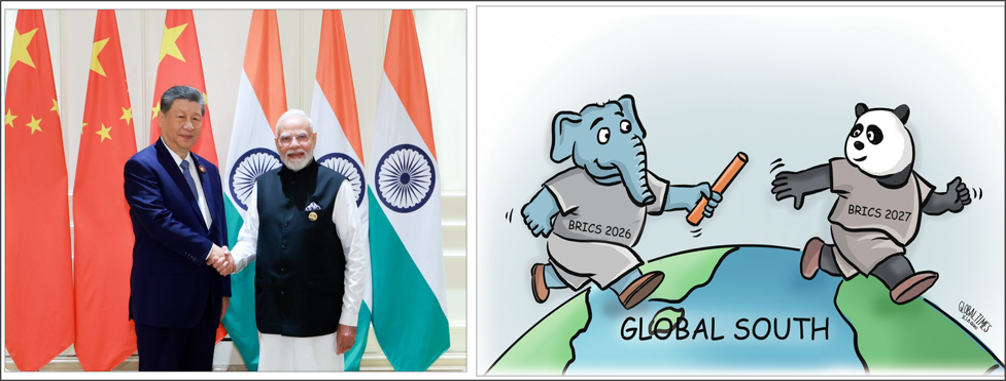
India-China. President Xi Jinping met with Indian Prime Minister Narendra Modi on Saturday on the sidelines of the BRICS summit. This is the third consecutive year that the Chinese and Indian leaders have met, following Kazan meeting in 2024 and Tianjin meeting in 2025, underscoring the steady stabilization of bilateral ties. If Kazan marked a turning point and Tianjin helped put relations back on a stable track, the New Delhi meeting can be seen as a new phase of confidence-building, focused on turning strategic consensus into concrete mechanisms and results.
Xi made four observations on promoting the steady and sustained development of China-India relations: First, calibrate the direction with an objective and rational strategic perception. China and India are partners rather than rivals, and development opportunities rather than threats to each other. Second, help each other succeed in the spirit of win-win cooperation. Third, remove irritants with the political wisdom of mutual respect and mutual understanding. Fourth, contribute to a better world with open and inclusive multilateral coordination.
Modi stated that India always views its relations with China from a strategic and long-term perspective. It hopes to be a partner, not a rival, of China, and regards each other’s development as an opportunity, not a challenge. India’s policy and position on issues relating to Taiwan and Tibet remain unchanged, and it will not allow any force to engage in anti-China activities on its territory.
Recent progress — including agreements on border management, the resumption of border trade, restored direct flights and growing people-to-people exchanges — provides tangible evidence of that momentum. The key value of leader-level engagement is to keep the broader relationship on course, manage differences and reduce the risk of miscalculation. China now is one of India’s largest trading partners, and there are many areas for cooperation.
The summit has shown that the two largest developing countries can turn high-level consensus into practical cooperation that serves the Global South.
Russian President Vladimir Putin concluded his three-day visit to India on Sunday. Prior to this, Putin provided Modi and Xi Jinping with detailed information about the situation in Ukraine. The leaders of China and India expressed interest in the topic of the conflict in Ukraine and offered to participate in finding a solution.
Putin, who arrived in India overnight on September 11, took part in the BRICS Business Forum and the summit bringing together the group’s leaders. It is worth noting that Putin received an exceptional, almost hero-like reception from the crowd of a thousand people upon arriving at the Economic Forum.
Putin told the Business Forum that BRICS had produced more than 40 percent of world output over five years, compared with 29 percent for the so-called G7. Local-currency settlement is working; trade that clears in rupees, rubles, and yuan cannot be blocked by the US. Putin used the summit for bilateral meetings with Modi and a conversation with Xi Jinping on the sidelines of the forum.
Russia and India Preparing Major Military Agreement Russia and India are set to discuss proposals for a range of joint defense projects, reports The Print. Specifically, the discussions will cover S-400, S-500, and Pantsir-S1M air defense systems, as well as long-range radars and strategic submarines. Aviation will be a separate topic of discussion. Moscow has proposed that New Delhi jointly manufacture the Su-57 in India and upgrade the Su-30MKI to the “Super Sukhoi” standard.
On September 11-12, Putin held what amounted to a “marathon of talks,” meeting with the presidents of South Africa and Egypt, the prime ministers of India, Malaysia and Ethiopia, New Development Bank President, and former Brazilian President Dilma Rousseff, as well as the crown prince of Abu Dhabi, the son of the UAE president.
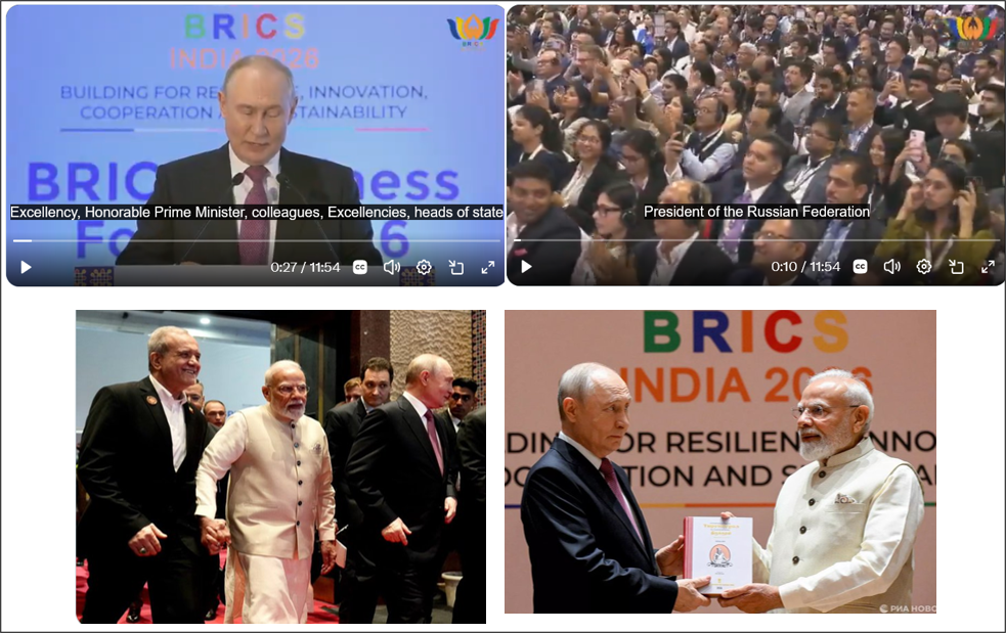
A new geopolitical axis emerges at BRICS Summit. A photograph featuring Prime Minister Narendra Modi, Iranian President Masoud Pezeshkian, and Russian President Vladimir Putin captures a geopolitical configuration that directly challenges Washington’s influence. The image serves as a visual marker of a shift toward multipolarity, bringing together leaders from states whose relations with the United States currently fluctuate between strategic competition and systemic confrontation.
Modi’s visible rapport with Pezeshkian is a significant point, given Iran’s isolation under international sanctions. This interaction suggests that India is prioritizing its own strategic autonomy over the diplomatic preferences of the West.
The alignment of Russia, India, and Iran creates a counterweight to the US-led order. While the United States employs tariffs and sanctions as primary tools of foreign policy, the BRICS bloc is focusing on structural alternatives. The summit’s agenda shifted toward tangible collaboration in digital transformation, infrastructure, and financial systems designed to reduce dependency on Western institutional frameworks.
De-dollarization and BRICS Payment system
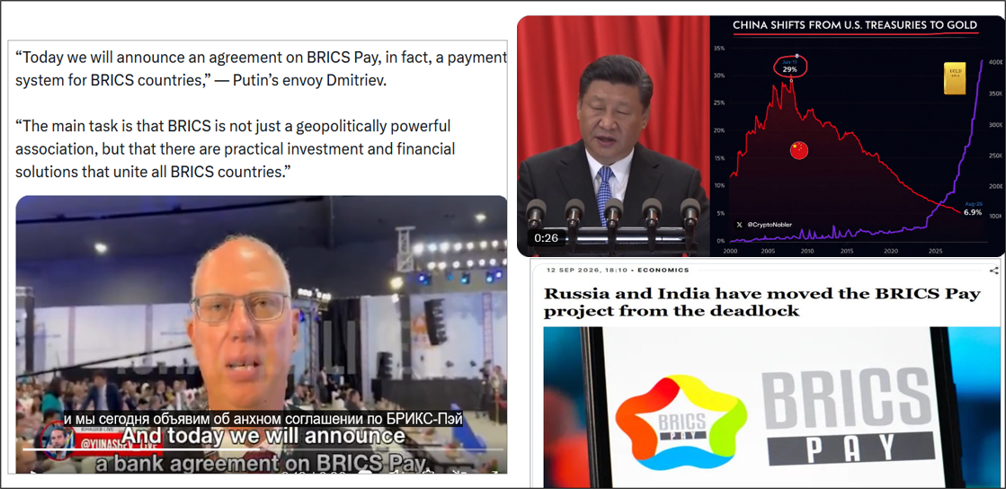
Russia and India agreed on and signed the agreement of BRICS PAY, to bypass the US Dollar. Agreeing on BRICS Pay by Russian and Indian parties, transfers the project, which has been talked about for almost ten years, to the stage of practical deployment. With the help of BRICS Pay, businesses will be able to make payments between countries directly in national currencies, citizens will be able to pay for purchases with their cards in any BRICS country, and the system will protect states from external sanctions influence.
On Friday, the three partners (Russian Direct Investment Fund (RDIF), Russian BRICS Pay and Indian BRICS Pay) agreed to cooperate on the development of the BRICS Pay system in India and the creation of cross-border payment services within the framework of the BRICS association. As part of the agreement, the parties intend to explore the possibility of integrating BRICS Pay with the payment infrastructure of India, prepare potential pilot projects, and then launch a cross-border payment service.
BRICS Pay is a decentralized payment and settlement infrastructure that should link the existing national payment systems of the participating countries, such as the Russian SPFS (Financial Messaging System), the Chinese CIPS, the Brazilian Pix and the Indian instant payment interface UPI. The initiative is designed to contribute to the creation of an open, sustainable and technologically independent infrastructure for settlements between the BRICS countries, including using national currencies.
BRICS Pay India will become a business and coordination partner in India. It will interact with banks, payment organizations, merchants and other participants in the Indian market. The first prototypes and pilot transactions of the payment system were tested in previous years.
Russian Finance Minister Anton Siluanov called the creation of an independent BRICS payment system “a vital necessity.” According to Siluanov, traditional tools (such as SWIFT) have been completely “politicized” by the West. In this regard, the BRICS need autonomous cross-border settlement mechanisms to protect commercial flows from external pressure and the risks of blockages.
No member arrived with more at stake than Iran. President Masoud Pezeshkian pressed the case for national-currency trade, telling reporters that expanding the use of members’ own currencies in intra-bloc commerce was among the most important steps the group could take. Tehran has pushed throughout the summit for mechanisms to insulate members from Western financial pressure — a priority sharpened by the sanctions and blockade it now faces.
Crucially, the summit institutionalizes at the multilateral level what Iran has already been building bilaterally. On January 29, 2026, Tehran signed a trilateral strategic pact with China and Russia, an agreement whose economic core is the construction of alternative financial mechanisms that sidestep SWIFT and reduce exposure to the dollar-centered system.
That pact rests on foundations already in place:
- an Iran–Russia monetary agreement, operational since early 2025, that settles trade directly in rials and rubles and links Russia’s Mir card network to Iran’s Shetab system
- a 25-year Iran–China cooperation framework and
- the plain fact that China now buys the overwhelming majority of Iran’s oil, much of it settled in yuan.
For Tehran, BRICS Pay is not a novel escape hatch but a larger, sanctions-resistant network onto which it can graft trade it is already conducting outside Western channels — and a multilateral blessing for the parallel financial architecture it has spent two years assembling with Moscow and Beijing.
At the Economic Forum of the Summit, President Putin told that the next monetary system is based on China’s gold. BRICS Pay is the new settlement system away from SWIFT and Dollar system. BRICS Pay will settle local currencies and backed by gold.
Xi Jinping announced China will take the presidency next year and open a third “GOLDEN DECADE.” China has stacked gold for 22 straight months while they dumped $70 billion in U.S. Treasuries. It’s their biggest sell-off since the 2008 financial crisis. Hong Kong just stood up a government-backed gold clearing system linked to Shanghai, the first piece of a global vault network so the yuan can settle against physical metal.
China also announced internationalizing its Chinese Yuan for global trade and settlement for the first time ever. China, Russia and India also announced rolling out their BRICS Pay settlement system as an alternative to SWIFT and dollar system and backed by gold.
Results of the summit
The 18th BRICS Summit successfully concluded in New Delhi on Sunday. The gathering came as BRICS marks two decades since its members first sat down as a political grouping.
It appears that perhaps the most important result of the summit is China-India relations have regained positive new momentum.
China and India have not always agreed on every issue, yet they have continued to work together within BRICS even when bilateral ties were strained.
First, they have helped build institutions rather than merely attend meetings. Both are major shareholders of the NDB. Indian and Chinese officials have served in its leadership.
Second, they have treated BRICS as a venue for economic and financial coordination, not only communiqués. Work on cross-border payments, linking national systems such as China’s CIPS and India’s UPI, and exploring interoperability of fast-payment rails and central-bank digital currencies, reflects a shared interest in cheaper, faster settlement among developing economies.
Third, BRICS has given the two countries a structured way to talk about global governance, climate, public health, counterterrorism, and food and energy security. Ministerial tracks, working groups and the BRICS Business Council have kept officials and businesses in contact.
Fourth, political signaling has mattered. China publicly supported India as 2026 chair. India has also indicated support for China taking the chair in 2027. That rotation is how BRICS is supposed to work. Continuity between India’s 2026 priorities and China’s 2027 agenda would send a powerful message
The second important result was the Declaration of the Summit. The statement was not important because of its content, but rather because it was possible to reach a unanimous declaration at all under the current circumstances. Indian diplomats and experts, in particular, did an almost incredible job of getting the text of the declaration accepted by everyone.
The third important result was to put the BRICS Pay process in practical going after many years of planning and talks.
Perhaps the fourth point is “How Asia is redefining what BRICS really means”. Washington continues to misread BRICS as chiefly anti-West, but real story is how Asian energy, tech and connectivity are moving to the fore. Washington watched this week’s BRICS summit through the lens of China, Russia and de-dollarization — and miss the more consequential story: Asian priorities on development, technology, energy and connectivity are quietly reshaping what BRICS has become.
This “Asianization” of BRICS carries its own contradictions. China and India, the bloc’s largest economies, are simultaneously collaborators, competitors and strategic rivals. Their combined weight gives BRICS its gravity; their differences complicate it. But BRICS’ institutional culture allows members with radically different alignments to cooperate selectively.
The next Asian rewiring is technological. The more consequential question is whether the bloc can build interoperable digital systems, AI governance principles, cross-border payment networks and technology standards that reduce dependence on institutions designed elsewhere. That shift makes the BRICS story less about resisting the West and more about building alongside it.
The US dollar remains the hardest piece of the puzzle. Asian influence is pushing BRICS toward pragmatism. China and India have expanded local-currency trade. Gulf states have incentives to diversify their reserves. Western sanctions have pushed Russia to develop alternative payment channels. Few of these countries want to replace the dollar overnight; the more realistic strategy is financial redundancy — more currencies, more payment routes, more settlement mechanisms, and fewer single points of vulnerability. That’s not revolution but rather a rearrangement/rewiring of things.