


Xi Jinping in America
I have commented on the official meetings of head of great powers in my article
May 28, 2026 Two state visits . . . but so very different
which took place in Beijing in May this year.
Xi visit in Washington, September
Initial situation
Chinese President Xi Jinping begins his first state visit to the United States in 11 years on September 23, with talks with US President Donald Trump expected to focus on stabilizing bilateral ties.
The agenda included fentanyl precursors, mutual moratoriums expiring November 10, rare earth supplies, US tariffs, China’s access to advanced artificial intelligence chips and other high-tech products, and US arms supplies to Taiwan. The sides also agreed to launch an artificial intelligence dialogue to prevent escalation. Trump may seek greater Chinese purchases of US goods, while China is expected to seek lower US tariffs. The sides are discussing tariff reductions covering about $30 billion in goods for each side.
The leaders are also expected to discuss the Ukraine crisis, US-Iran tensions, Strait of Hormuz shipping, sanctions, space militarization, US missile systems in Japan and Washington’s Pax Silica technology alliance, as well as “constructive strategic stability.” Further talks may take place at the Asia-Pacific Economic Cooperation summit in November and G20 summit in December.
Procedures
From a rare planeside welcome at the airport, on Wednesday 23 September, and a formal meeting to a state dinner, a tea chat and a visit to the US National Archives, President Xi engaged intensively with Trump during his state visit to the US.
The two leaders conducted sincere and in-depth exchanges and reached common understanding on many issues, which has provided new strategic guidance for China-US relations, and brought ties to a new historical starting point, analysts said. Chinese President Xi Jinping concluded, on Friday 25 September, his state visit to the US. As he departed Washington, senior US government officials saw him off at the airport, where a 21-gun salute was fired.
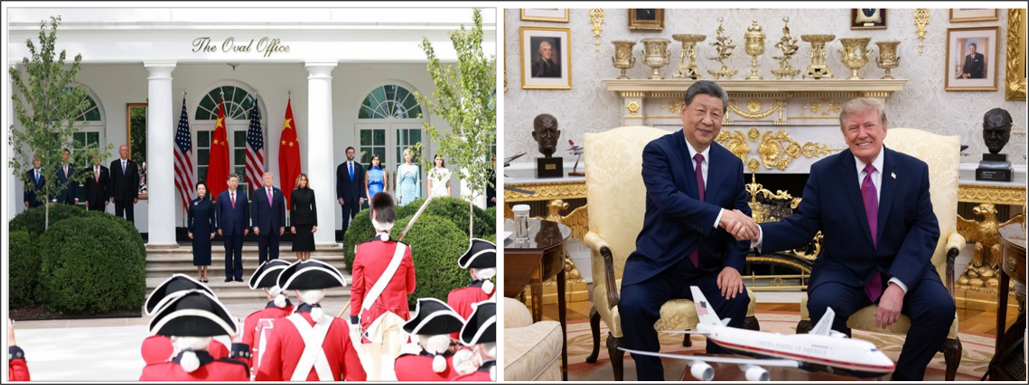
In May this year, Xi and Trump agreed to work toward building a constructive China-US relationship of strategic stability. Xi said that the new vision reflects the realities of China-US ties, embodies the expectations for the future, and is an important step toward finding the right way for the two countries to get along with each other.
When meeting with Trump at the White House on Thursday, Xi called for translating the new vision of a constructive China-US relationship of strategic stability into action and finding the right way for the two major countries to get along with each other. The exchange of visits between the heads of state of China and the US in less than half a year is unprecedented in the history of China-US ties. The talks between the two presidents touched on some of the most consequential issues in the bilateral relationship, including trade, the Taiwan question and artificial intelligence, reflecting efforts by both sides to address immediate concerns while keeping the broader relationship on an even keel, experts said.
Earlier on Friday, Xi and his wife, Peng Liyuan, had a chat over tea with US President Donald Trump and his wife, Melania Trump. The two leaders agreed to build a constructive relationship of strategic stability based on respect, fairness and reciprocity. Xi and his wife also visited on Friday the US National Archives, accompanied by Trump and his wife.
Results of the meeting – business as usual
In Thursday’s meeting, the economic and trade teams of the two countries held a new round of consultations and reached a new joint arrangement, which is good news for industries and people of both countries, as well as the global economy.
Xi said that while China and the US, as both major countries in AI, compete in AI, they have even more reasons to cooperate. The two sides should leverage respective strengths in AI rather than guarding against each other. The two sides should maintain human control over AI technologies, uphold a people-centered approach and the principle of using AI for good, and ensure that AI serves human progress, he added.
For his part, Trump said that the state visit of Xi to the US is a great visit, adding that both the US and China are major countries, and their relations will surely be handled well under the current leadership of the two heads of state. The latest round of economic and trade consultations between teams of both countries achieved new outcomes, said Trump, calling on both sides to continue dialogue to reach a better agreement. Noting that AI bears on the future of humanity, Trump said that the US and China should maintain dialogue and strengthen cooperation on this issue.
So, the most valuable thing the China-US summit gives the world is a longer planning horizon.
Both nations are the undisputed vanguards of AI development, this means establishing baseline rapid warning systems, interoperable guardrails, safety protocols, and ethical boundaries, which are both mutually beneficial and an existential imperative for global governance. Artificial intelligence opens up future-oriented possibilities for cooperation between China and the US. As major powers in this field, both nations possess distinct strengths in technological development and application, while also facing shared risks such as the misuse or loss of control over the technology.
Since the meeting in May, a key task for both sides has been to translate the understandings and framework reached at that meeting into concrete action. The two leaders’ meeting in September therefore provides another important opportunity to build on that momentum, particularly by advancing institutional arrangements and dialogue mechanisms that can lend greater stability and continuity to bilateral ties.
On the Taiwan question, Beijing will continue to state its principled position clearly and firmly, making it unmistakable to Washington where China’s red lines lie and what it expects from the US side. Xi stressed that the Chinese side’s position on safeguarding national reunification and territorial integrity is clear-cut. It is hoped that the US side will adhere to the correct position of opposing “Taiwan independence,” and handle the Taiwan question with caution, so as to lay a solid foundation for China-US strategic cooperation and the development of bilateral relations.
Translating the vision of a constructive China-US relationship of strategic stability into action requires the proper handling of differences. The US needs to genuinely respect China’s core interests and major concerns. The Taiwan question is the most important and sensitive core issue in China-US relations.
During talks between Xi and Trump, the Chinese president said their two countries should work more closely together to avoid the “Thucydides Trap”. It was not the first time the Chinese leader used the term when meeting Trump.
While both presidents spoke warmly about one another, Xi’s repeated use of the term underscores how concerns about a potential US-China conflict continue to cast a shadow over the relationship between the world’s two most powerful countries.
Both heads of state also exchanged views on major international and regional issues including the Middle East situation, Ukraine crisis and Korean Peninsula. The two leaders also confirmed that the two countries will support each other in hosting the 2026 APEC Economic Leaders’ Meeting and the G20 Leaders’ Summit.
Xi said that “Today, we have come to another historic juncture for China-US relations.” Moving from vision to action demonstrates China’s strategic foresight and sincere commitment to advancing the bilateral relationship. During the meeting on September 24, President Xi profoundly noted that China and the US should, and fully can, achieve mutual benefit and win-win results through practical cooperation.
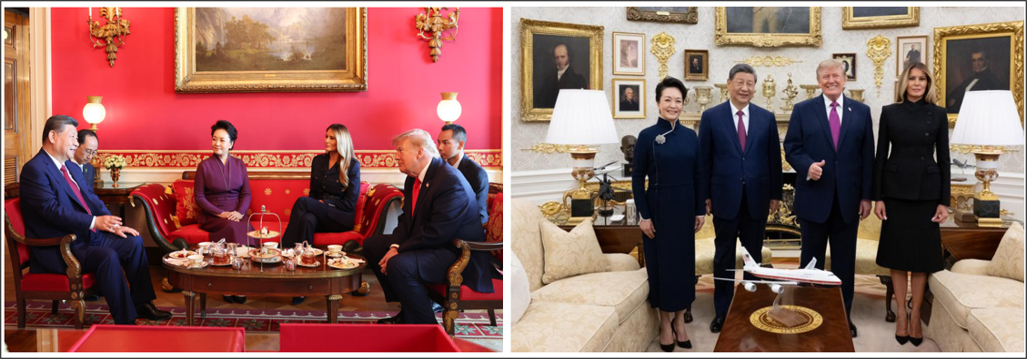
Xi and his wife, Peng Liyuan, on Thursday evening attended a state dinner held by Trump and his wife, Melania Trump, at the White House. Top US tech leadersattended the banquet, including OpenAI’s Sam Altman, Nvidia chief Jensen Huang and Tesla boss Elon Musk. Analysts noted that every detail of the state dinner – from wine chosen to evoke a pivotal moment in China-US relations to references to “Ping-Pong Diplomacy” – was rich in historic symbolism, reflecting hopes of carrying forward friendship and maintaining a stable bilateral relationship.
Beyond diplomatic protocol, the high-level, warm reception for President Xi sends an important message that both sides value engagement and a stable China-US relationship. Against the backdrop of persistent hawkish voices on China in the US, President Trump’s personal welcome and emphasis on his relationship with President Xi send a positive political signal to China, the American public and the wider world that dialogue and engagement remain important.
Both the visit and the US hospitality therefore help foster a more constructive atmosphere, demonstrating the two sides’ willingness to maintain high-level engagement and reinforcing confidence in the stability of bilateral ties.
Value of the meeting, assessments by some well-known experts
A famous international freelance journalist, Pepe Escobar, considers that “Xi just handed Trump an off-ramp from the Iran war.”
The most important part of the Trump-Xi summit may have had nothing to do with tariffs or AI. Escobar says Xi Jinping directly raised the Strait of Hormuz with Trump and pushed Washington back toward the abandoned US-Iran memorandum of understanding (MoU). The emerging formula, according to Escobar, is straightforward but extremely difficult: Iran gradually reopens Hormuz while the US simultaneously ends its blockade and releases Iranian funds.
Tehran, he says, will not move first and simply trust Washington to follow. That creates the interesting part. Someone would have to guarantee both sides move together. Escobar’s answer is China. He says Beijing and Tehran coordinated closely before the UN meetings, with Iranian Foreign Minister Araghchi and Wang Yi meeting twice, while China’s position remains that Washington should return to the previous MOU. If that reading is right, China is no longer watching the Iran crisis from the sidelines.
A Chinese scholar Zhai Xiang thinks that
“Beijing is not simply talking about “cooperation” but how China and the United States can compete and win together and the structure of Xi’s remarks is revealing: Trade > cooperate, AI > compete but cooperate, Taiwan > red line.
Xi pointed out that the exchange of visits between the heads of state of China and the United States in less than half a year is unprecedented in the history of China-US relations.
Cooperation is a two-way street. The stability of US-China economic and trade relations requires both sides to expand the list of cooperation, while shortening the list of problems. As long as the two sides uphold the spirit of equality, mutual respect and mutual benefit, a way out of problems can be found.
The goal is not to build a relationship completely free of friction-that is clearly unrealistic. The real goal is this: To keep increasing the number of areas where the two sides can cooperate, while preventing disputes from expanding to the point where they overwhelm the entire bilateral relationship. And that helps explain why Xi repeatedly emphasizes equality, mutual respect, and mutual benefit.
Xi stressed that the Chinese side’s position on safeguarding national reunification and territorial integrity is clear-cut. It is hoped that the US side will adhere to the correct position of opposing “Taiwan independence,” and handle the Taiwan question with caution.
BBC analysis
Xi Jinping’s summits with Donald Trump have one clear aim. China believes the US is trying to contain its rise as a superpower, and it wants Washington to stay out of its way – particularly when it comes to trade, technology and Taiwan.
On this visit, the Chinese leader didn’t get everything he wanted. The trade truce that has prevented a further escalation of tariffs was extended by only a few months. Beijing had hoped the extension would go for at least a year as Xi looks to ride out the final years of Trump’s presidency.
This means key disputes on tariffs, China’s dominance on rare earth supplies and access to advanced US chips are being kicked forward into yet another round of negotiations.
This suggests the US wants China to do more to fulfil its side of the bargain before offering longer-term concessions.
“Two Months. That Is All Xi Got.” by Phoenix Capital Research
Trump and Xi extended the trade truce by two months, to January 10. No tariff cuts. No firm commitments on rare earths. No chips deal. US officials told reporters that Chinese rare earth deliveries are still falling short of what Beijing promised at Busan. Taiwan and Iran were discussed without resolution. Two more summits, in Shenzhen and Miami, are penciled in before year-end. January 10 is now the next risk event for every stock in the critical minerals space.
Xi came to Washington holding the only card that matters. Washington let him keep it for sixty more days, because it is busy building a deck of its own. Washington is prepared to spend whatever it takes to secure energy and critical mineral supply chains, and that kind of spending is inflationary. Investors who position for it early stand to do very well.
Two “heavyweight” videos by prof. John Mearsheimer
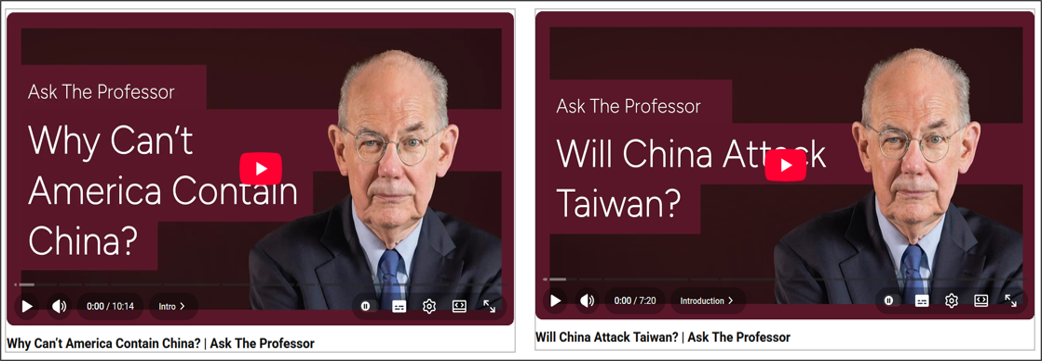
Why Can’t America Contain China? | Ask The Professor John Mearsheimer
John Mearsheimer – Offensive Realism, October 16, 2026
Will China Attack Taiwan? | Ask The Professor
John Mearsheimer – Offensive Realism, October 1, 2026