


SCO Summit 2026 – Bishkek calling
The Shanghai Cooperation Organization (SCO) Summit in Bishkek, Kyrgyzstan, that took place on August 31 – September 1, 2026, celebrates its 25th anniversary of its founding and featured an impressive list of agreements signed by participating states (28 documents).
Welcome protocol
Chaired by Kyrgyz President Sadyr Japarov, the summit gathered key global figures including Chinese President Xi Jinping, Russian President Vladimir Putin, Indian Prime Minister Narendra Modi and Iranian President Masoud Pezeshkian.
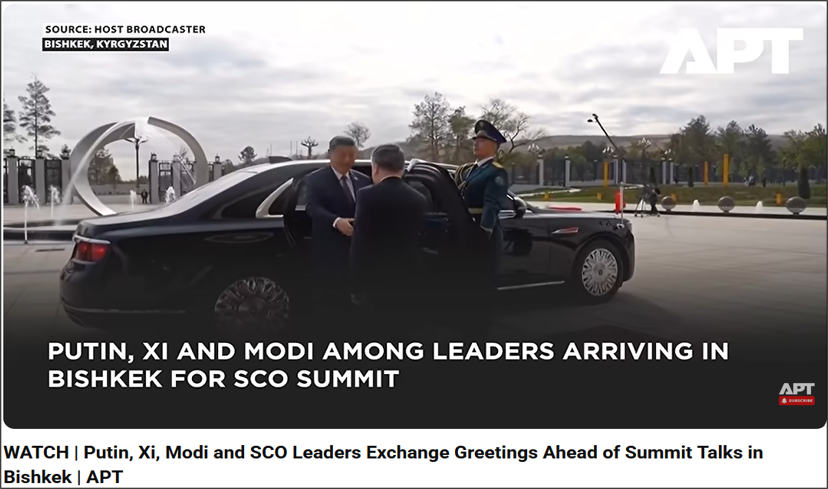
WATCH | Putin, Xi, Modi and SCO Leaders Exchange Greetings Ahead of Summit Talks in Bishkek |
APT, YouTube, September 1, 2026
Iran’s President Pezeshkian gets red carpet treatment alongside other key visitors Putin, Xi, Modi and Erdogan at SCO Summit in Bishkek.
The joint appearance of Indian Prime Minister Narendra Modi, Chinese President Xi Jinping, and Russian President Vladimir Putin at the SCO summit in Bishkek was viewed by Indian media as an important political signal to the Western world. According to The Economic Times of India, the image of the three leaders goes far beyond a protocol event. Against the backdrop of New Delhi’s difficult relations with Washington, the rapprochement between Moscow and Beijing, and the ongoing differences between India and China, their joint photo could be perceived as a demonstration of the major powers’ willingness to build an independent agenda without regard for the West.
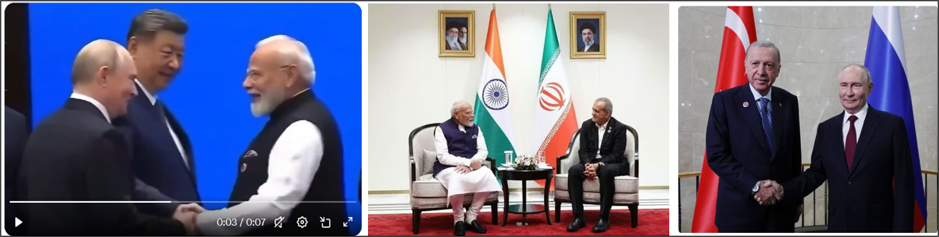
Dozens of bilateral head of states meetings were held on the sidelines of the SCO Summit, particularly on August 31.
Summit procedure
Today, the SCO is made up of ten member states: Russia, Belarus, India, Iran, Kazakhstan, Kyrgyzstan, China, Pakistan, Tajikistan, Uzbekistan, and two observer countries — Afghanistan and Mongolia — and 14 dialogue partners — Azerbaijan, Armenia, Bahrain, Egypt, Cambodia, Qatar, Kuwait, the Maldives, Myanmar, Nepal, the UAE, Saudi Arabia, Turkey and Sri Lanka. It is the world’s largest regional cooperation organization by population, geographical coverage and growth potential.
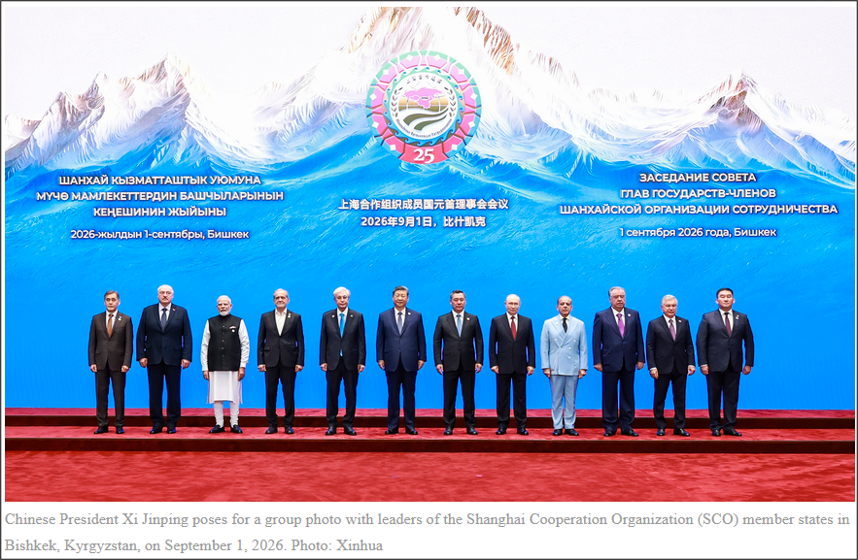
The summit focused on issues of multilateral cooperation across the full range of areas: politics, security, trade, investment, energy, industry, ecology, tourism, new technologies, as well as matters of improving the SCO’s activities and the international agenda. During the discussions, the leaders put forward several initiatives and proposals for the further development of cooperation within the SCO.
In his address, SCO Secretary General Nurlan Yermekbayev separately focused on the intensification of the SCO’s interaction with international and regional organizations. Among the practical results, he highlighted the approval of the SCO–CSTO–CIS Roadmap and the holding of the first trilateral event in this format, the SCO obtaining observer status at the CIS, as well as the development of cooperation with the Eurasian Economic Commission, the UN Environment Programme, and the League of Arab States, and the signing of a Memorandum with the Central Asian Regional Information and Coordination Centre. Contacts have also been established with a few other international structures.
The SCO summit wrapped up in Bishkek on Tuesday. Leaders of the member states signed and issued the Bishkek Declaration, approved the protocol on amendments and additions to the SCO Charter, the regulations on the SCO Universal Center for Countering Security Challenges and Threats and the regulations on the SCO Anti-drug Center, and adopted 28 outcome documents covering such areas as security, economic and people-to-people cooperation, and organizational development.
China will also establish an international cooperation center on AI applications for SCO countries, set up a China-SCO port economy cooperation center in Tianjin, and jointly implement 100 technological cooperation projects with SCO countries over the next three years, per Xinhua.
The centerpiece of the event was the signing of the Bishkek Declaration, a document marking a quarter-century of the bloc’s existence and outlining its future trajectory. Leaders also approved amendments to the 2002 SCO Charter to modernize the organization’s administrative framework.
Pakistan takes the rotating chairmanship for 2026–27 and will host the 2027 summit in Islamabad. The city of Lahore, Pakistan, received the status of the SCO Tourism and Cultural Capital for 2026–2027.
The Bishkek Declaration: What and Who signed?
The SCO closed its heads-of-state summit in Bishkek on September 1 with a joint statement — the Bishkek Declaration — timed to the bloc’s 25th anniversary and signed by the leaders of all ten member states: Russia, China, India, Pakistan, Iran, Belarus, Uzbekistan, Kazakhstan, Tajikistan, and the host, Kyrgyzstan. Besides the members, many other participants signed the document. It is a long anniversary text, adopted alongside some 28 other outcome documents and amendments to the SCO Charter.
But the single most consequential fact about the declaration is not what it says. It is whose signature sits on it. Narendra Modi’s India put its name to a text condemning American and Israeli military action, mourning a dead Iranian supreme leader, and rejecting the sanctions architecture the United States has built. That signature is the real story.
What the declaration says
On the war, the SCO condemned the military strikes, by the US and Israel, on Iranian territory that it said caused numerous civilian casualties and significant damage to Iran’s economy, characterizing those strikes as violations of international law and the UN Charter that created serious risks to international peace and security.
It expressed condolences on the death of Supreme Leader Seyyed Ali Khamenei — killed earlier in the war — reaffirmed support for Iran’s sovereignty and territorial integrity and called for the conflict to be resolved solely through political and diplomatic means.
It extended the point to Gaza, calling a comprehensive and just settlement of the Palestinian question the only path to stability in the region.
On sanctions, without naming the United States, the members opposed “unilateral coercive measures” inconsistent with UN and WTO rules and damaging to the global economy — language that simultaneously covers US sanctions on Iran, Western sanctions on Russia, and the tariff pressure on India.
On the nuclear question, they upheld Iran’s position directly, affirming every member’s “inalienable right” to peaceful nuclear energy and declaring that measures restricting that right are contrary to international law. The rest of the text is familiar SCO liturgy.
India’s Modi, from the Knesset to Bishkek: the anatomy of a reversal.
India’s signature was interesting. Six months earlier, Modi had planted India firmly in the opposite camp — and the Bishkek text reverses, almost line for line, the position he took in February.
On February 25–26, 2026, Modi made a state visit to Israel: the first Indian prime minister to address the Knesset, honored with the Speaker’s Medal as the first foreign leader to receive it. Two days after he left, on February 28, the US and Israel opened their war on Iran. India’s response was conspicuous silence: it did not condemn the strikes on Iranian sovereignty, and it did not condole the killing of Iran’s supreme leader.
New Delhi zeroed out its Chabahar port funding in the 2026–27 budget under US pressure, let bilateral trade with Iran collapse, and offered only a muted, “humanitarian” reaction when an Iranian frigate returning from joint exercises with India was sunk by the US Navy near Sri Lanka.
Modi had put India firmly in the Israel–US camp — while critics at home called it a strategic surrender. Among India’s BRICS and SCO partners, Russia, China, and Iran above all, this aroused irritation and suspicion.
What turned India back was oil. India imports roughly 85 percent of its fuel and draws a large share of its crude and LNG through the Strait of Hormuz. Under the 50 percent US tariff wall — half of it levied explicitly to punish Russian-crude purchases — New Delhi had spent early 2026 trimming Russian imports and leaning on Gulf suppliers, a quiet alignment with Washington.
With Gulf barrels suddenly unreliable and Washington’s tariffs making the alignment costly anyway, India turned back to discounted Russian crude out of straightforward energy necessity. As one analysis put it, the energy shock reordered India’s alignments — the tilt toward Washington of a few weeks earlier giving way to a familiar, interest-driven return to Moscow. Seen against that background, the Bishkek signature is the visible completion of a U-turn.
India will lean toward Washington and Jerusalem when the terms are right and swing back toward Moscow and the Global South when its energy and standing require it, bending each forum to its own positions rather than adopting anyone’s line.
And the timing is not incidental. India hosts the 18th BRICS summit in New Delhi on September 12–13 — ten days after Bishkek — as BRICS chair for 2026. Yet India deliberately themed its BRICS presidency around resilience and cooperation. India signed a confrontational SCO text while steering its own BRICS summit deliberately away from confrontation. The New Delhi declaration on September 13 will be the better test of where India stands, and whether the correction that began at Bishkek holds.
The role of NATO member Turkey is also interesting; President Erdogan signed the Declaration as well. Turkey would consider full membership in the China- and Russia-led SCO, President Erdogan said after the Bishkek summit. Ankara is already a dialogue partner. Erdogan insisted this would not mean breaking with NATO or the West. On the other hand, he stated: “The Shanghai Cooperation Organization, representing approximately 3.5 billion people and a gross domestic product of $35 trillion, has become one of the indispensable elements of the multipolar order over the past 25 years. We see the organization, which brings the Asia-Pacific region and the Middle East together on the same platform, as a supporter and complement to the United Nations.”
Thus, it appears that Turkey keeps one foot in the alliance while deepening ties with the bloc that includes China, Russia, India, Iran, and Pakistan. No doubt, sitting on two chairs, drawn in two opposite directions, will be increasingly difficult in the future.
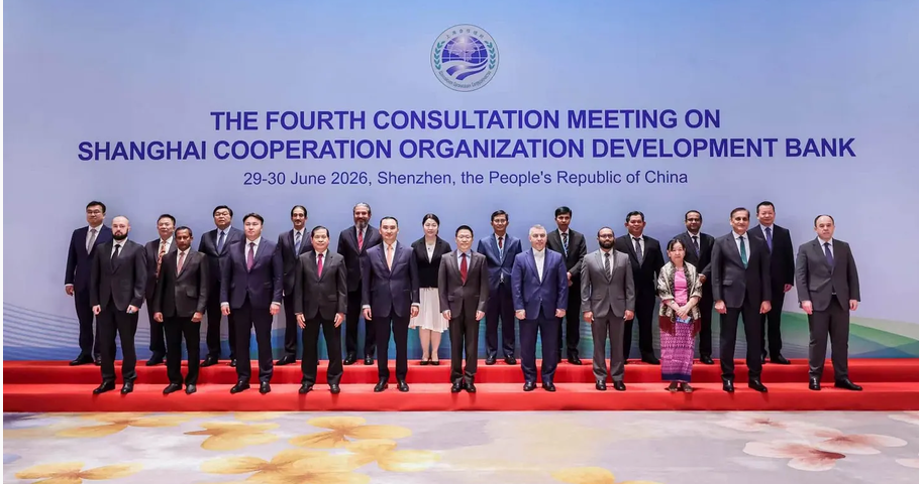
A Regional Development Bank for the SCO: time for platform coordination
In 2025 SCO members approved the creation of a new SCO development bank, with further steps towards its institutionalization expected in 2026. The decision to create a regional development bank for the Shanghai Cooperation Organization is a step towards widening the array of available finance instruments for the economies of the Global South in the Eurasian region. At the same time, it also raises several questions regarding the future of regional development institutions in Eurasia and across the developing world.
Overall, the current priorities related to the launch of the new SCO development bank could be summarized as follows:
From quantity to quality. The rise in the number of development institutions calls for greater coordination among MDBs (multilateral development banks)/RDBs (regional development banks) – thus far there is no horizontal platform that would bring together the regional development institutions from Eurasia and across the Global South.
Co-financing operations. The creation of a platform for regional development institutions that includes the SCO bank would facilitate co-financing operations: in the case of SCO bank the key partners in Eurasia should include the New Development Bank, AIIB as well as the Eurasian Development Bank (EDB).
Sectoral priorities. Across sectors and areas of focus there may be a need for the SCO Bank to target those areas that are complementary to those of the already established regional banks such as NDB/EDB.
Financing of SCO Development Bank operations: there may be a role/niche that the SCO development bank could play to boost settlements in national currencies of SCO economies. This relates to the possibility of employing the rising role of the Chinese yuan.
Regional centers: the geography of emerging development institutions driven by Global South economies can be a potent force supporting the creation of new international financial centers. The SCO development bank may create a network of regional development centers.
The SCO development bank needs to explore the opportunities inherent in the growing economic cooperation of BRICS and SCO with ASEAN, particularly given the absence of a core regional development bank in ASEAN proper.
SCO development bank, as well as other BRICS related banks, have been structured to bypass the IMF and World Bank by lending in members’ own currencies and making settlements of trade in national currencies. The point is the overall system built to work without the US dollar: Payment transactions that bypass SWIFT, gold-settlement vaults from Mumbai to Moscow, a Hong Kong exchange that converts yuan into physical gold the same day, and a land corridor linking India, Iran and Russia that no navy patrols, which is part of how Iran keeps trading under blockade.
Statement by Sergey Glazuev
On the Bishkek SCO summit Dr. Sergey Glazyev, a well-known Russian economist, warned Washington’s threat to cut Iran’s partners off the dollar. The answer is a sovereign digital settlement currency—gold-backed first, then a commodity basket—so SCO trade no longer runs through NATO’s payment system.
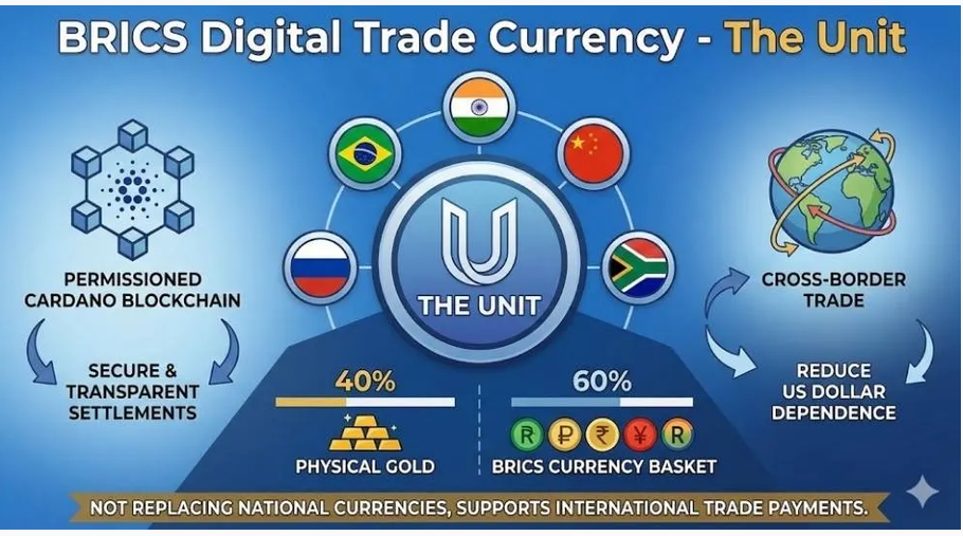
This is the right moment to put forward a proposal to introduce a global digital settlement currency, one that Russian experts have long advocated. Almost a decade ago, a project for such a currency — SOLID — was presented at the Eastern Economic Forum, whose next session will also take place this week. Russian experts have now developed a project for another such currency — UNIT — a gold-backed stablecoin. It was presented on the sidelines of last year’s BRICS summit of heads of state, the next meeting of which will take place in two weeks.
We have long proposed launching a highly stable digital settlement currency pegged to two baskets: exchange-traded (dual) commodities and the currencies of the participating countries in this payment system. The obvious response to the American threat to ‘disconnect from the dollar system’ countries that trade with one of the SCO members is for the SCO countries to introduce a digital settlement currency independent of the United States and other NATO countries that are aggressing against the world.
At the first stage, such a currency could be a gold-backed stablecoin; later, the basket backing it could be expanded to include exchange-traded commodities produced in the SCO countries. Further delay in implementing this initiative risks serious economic losses for all countries trading with Iran, except Russia.
China, India, and other SCO states now have a stake in this as well. The time has come. The SCO should declare itself a serious integration grouping with its own currency-settlement and trade-financial instruments. The dollar weapon is the US’s last instrument. SCO settlement outside that system is the reply.
Development of the SCO+ format
Although no new member states were accepted, some of the key developments at the SCO summit involved the further evolution of the SCO+ format and discussions within the bloc concerning its role in the future of Eurasia’s governance and international cooperation.
Within the framework of SCO summits, the SCO+ format was employed and institutionalized in Tianjin, China during the September 2025 summit. At the time, the SCO+ format involved the participation of some of the regional integration arrangements from Eurasia, including ASEAN and the Eurasian Economic Union (EAEU).
The SCO also continued to broaden its network of partnerships and accords with the signing of a memorandum of understanding with the African Union Commission.
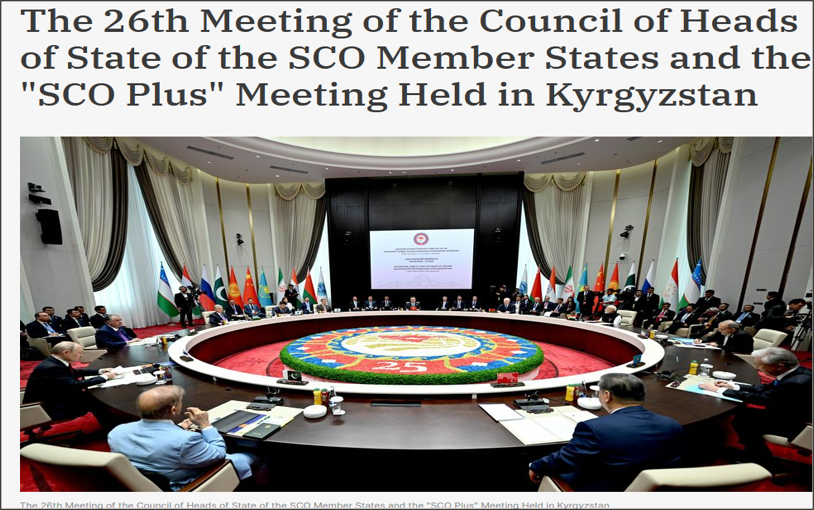
SCO Plus meeting was held under the theme: “The UN as a Key Element of a Just World Order: The Contribution of the SCO Plus States to the Formation of a Multipolar World. The event was attended by the leaders of the member states, the observer state – Mongolia, dialogue partners – Azerbaijan, Armenia, Egypt, Laos, Turkey, and guests of the presiding side – Vietnam, Togo, as well as heads of the executive bodies of the EAEU, CSTO, UN, CICA, and CIS.
The discussions at the SCO summit focused on the role of the SCO+ format, with some of the most important proposals being advanced by the President of Uzbekistan Shavkat Mirziyoyev. He called for stronger cooperation between the Shanghai Cooperation Organization (SCO) and the United Nations, proposing new mechanisms to coordinate regional initiatives and to advance solutions within the UN framework.
On the critical issue of the relationship between global institutions and regionalism, President Mirziyoyev emphasized how the SCO+ format and regional institutions could serve as supporting pillars for global organizations such as the United Nations that in turn is to retain it central coordinating role in global governance. To align approaches within the UN framework, Uzbekistan called for establishing a Partnership Network of Regional Organizations built on the basis of the “SCO Plus” format.
Finally, President Mirziyoyev advanced the proposal to establish a permanent SCO Plus Forum of Cultures and Civilizations. This initiative, according to the President of Uzbekistan, would “create a platform for countries with different political systems, cultural traditions and approaches to international affairs to exchange experience and strengthen mutual understanding”.
In this respect, the further evolution of the SCO+ format retains substantial reserves for further expansion to include such regional integration blocs as the Gulf Cooperation Council (GCC) as well as South Asian Association for Regional Cooperation (SAARC).
The SCO Bishkek Summit 2026: All Signed Agreements
The 28 signed agreement covered eight different sectors.
Security & Counter-Terrorism
- Universal Security Center: Established the Universal Center for Countering Security Challenges and Threats of SCO member states, creating a new mechanism for coordinated responses to security threats.
- Anti-Drug Cooperation: Approved regulations for the Executive Committee of the SCO Anti-Drug Center.
- Drug Addiction: Endorsed the SCO Program of Cooperation on Combating Drug Addiction until 2030.
- Synthetic Drugs: Adopted a coordination program through 2030 to combat the spread of synthetic drugs and their precursors.
- Crime-Fighting Cooperation: Amended the 2010 Agreement on Cooperation among SCO governments in Combating Crime, updating the framework for law-enforcement cooperation.
- Nuclear Security: Adopted a declaration on strengthening multilateral cooperation on nuclear and physical nuclear security.
- Emergency Assistance: Adopted a statement on providing assistance to SCO member states affected by emergency situations and disasters.
Cyber, Information & Artificial Intelligence
- Information Security: Approved a 2026-2028 cooperation plan on international information security.
- Artificial Intelligence: Signed an intergovernmental Memorandum of Cooperation in Artificial Intelligence, establishing a framework for cooperation in the AI sector.
- Regional Computing & AI Infrastructure: Approved a concept for creating regional data-processing centers and computing capacity and developing the AI industry within the SCO.
- Information Cooperation: Signed a memorandum on cooperation in the information sphere between the authorized bodies of SCO member states.
- Translation & Multilingual Cooperation: Adopted a decision concerning the provision of translation services for SCO activities.
Trade, Logistics & Connectivity
- Ports & Logistics: Adopted a 2026-2030 Action Plan (Roadmap) for developing ports and logistics centers across SCO member states.
- SCO Strategic Framework: Adopted the Bishkek Declaration, marking the 25th anniversary of the Shanghai Cooperation Organization and setting out broad priorities for future cooperation.
Energy & Green Development
- Green Technology Corridor: Approved a 2026-2030 program for scientific and technical cooperation on creating an SCO “Green Technology Corridor.”
- Energy Conservation: Adopted a statement supporting greater cooperation in energy conservation and energy efficiency.
- Energy Systems: Adopted a statement on developing cooperation in the field of energy systems.
- Climate Change: Signed an intergovernmental Memorandum on Cooperation in Combating Climate Change.
Climate, Environment & Biodiversity
- Biodiversity Initiative: Adopted an SCO initiative on the conservation and sustainable management of biodiversity.
- Biodiversity Action Plan: Approved a 2026-2031 Joint Action Plan for biodiversity conservation and sustainable management.
Diplomatic & International Partnerships
- African Union Partnership: Signed a Memorandum of Understanding between the SCO Secretariat and the African Union Commission, expanding institutional cooperation between the two organizations.
- International Role: The summit’s broader declarations and decisions reaffirmed the SCO’s emphasis on multilateral cooperation and partnership.
Tourism & Cultural Cooperation
- Lahore Tourism and Cultural Center: Declared Lahore, Pakistan, the SCO Tourism and Cultural Center for 2026-2027.
- Family Institution: Adopted a statement supporting and strengthening the institution of the family.
- Voluntary Ambassador Program: Amended the regulations governing the honorary title of “Voluntary Ambassador of the Shanghai Cooperation Organization.”
Institutional & Organizational Matters
- SCO Charter: Adopted a protocol introducing amendments and additions to the SCO Charter of June 7, 2002.
- Termination of Previous Decisions: Adopted a decision on the termination of specified decisions of the Council of Heads of State.
- Secretary-General’s Report: Received the SCO Secretary-General’s report on the organization’s work in 2025.
- Regional Anti-Terrorist Structure Report: Received the report of the SCO Regional Anti-Terrorist Structure (RATS) on its work in 2025.
The Protocol on Amendments and Additions to the SCO Charter of June 7, 2002, is particularly important because institutional capacity determines whether economic decisions can actually be implemented. It enables the practical launch of the Universal Centre for Countering Challenges and Threats to SCO Member States, established in Tashkent, and the SCO Anti-Drug Centre in Dushanbe. The regulations for these institutions were also approved.
Epilogue
The Shanghai Cooperation Organization (SCO) enters a new stage with the conclusion of its 2026 summit in Bishkek this week. Over the past 25 years, the SCO has grown from six founding members into a partnership of 27 countries, making it the world’s largest trans-regional organization. What is driving the organization’s growth and resilience?
In a multipolar world, countries should not seek enemies or build walls but build bridges and address common challenges through multilateral cooperation. Therefore, the Shanghai Spirit represents not only the SCO’s founding principles, but also the trend of present times. Being on the right side of history means embracing multilateralism in a multipolar world and taking a collective approach to common challenges.
The global balance of economic and political power is shifting from the West toward the East and the Global South, with Eurasia emerging as a center of gravity. In this context, the SCO, whose members are largely located in Eurasia, is becoming an important platform for connectivity, cooperation and addressing common challenges, as well as an increasingly important political and institutional voice of the Global South.
Perhaps the most important conclusion from Bishkek is that the SCO is beginning to acquire the architecture of an economic system. Its ten members account for roughly half of humanity and more than one-third of global GDP. Intra-SCO exports are already estimated at US$725 billion, while Russia’s own SCO trade has exceeded US$400 billion and more than 98% of its settlements with SCO partners are in national currencies.
The 2026-2030 logistics roadmap addresses physical connectivity. The national-currency trend and proposed Development Bank address finance. The AI and data-centre concept address digital infrastructure. The Green Technology Corridor addresses technology and industrial modernization. The energy statements address the region’s power system. The tourism and cultural programmes address services and people-to-people connectivity.
More detailed practical information can be found in the following articles:
Geopolitics Prime: What the SCO is really up against, By Pepe Escobar
September 03, 2026
Russia’s pivot to Asia: What Russia Gained From The 2026 SCO Summit: Results & Analysis
Published on September 5, 2026
Two recent interesting videos available here:
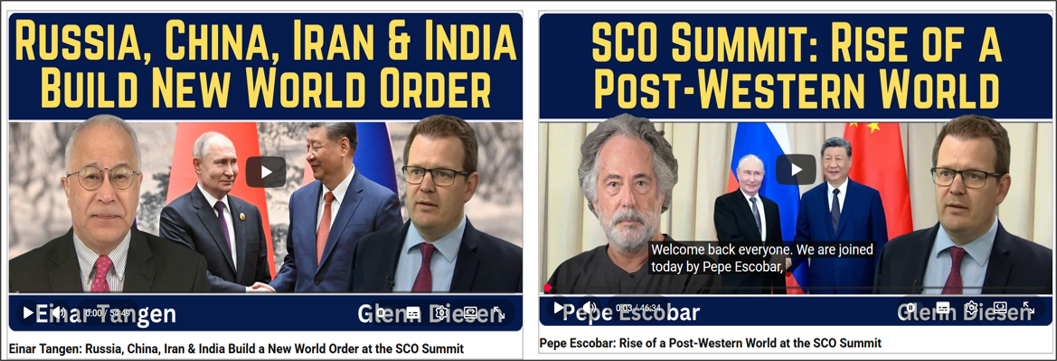
Einar Tangen: Russia, China, Iran & India Build a New World Order at the SCO Summit
Glenn Diesen September 1, 2026
Pepe Escobar: Rise of a Post-Western World at the SCO Summit
Glenn Diesen, YouTube, September 2, 2026